
Monorepo Vs Polyrepo: How To Choose The Right Setup
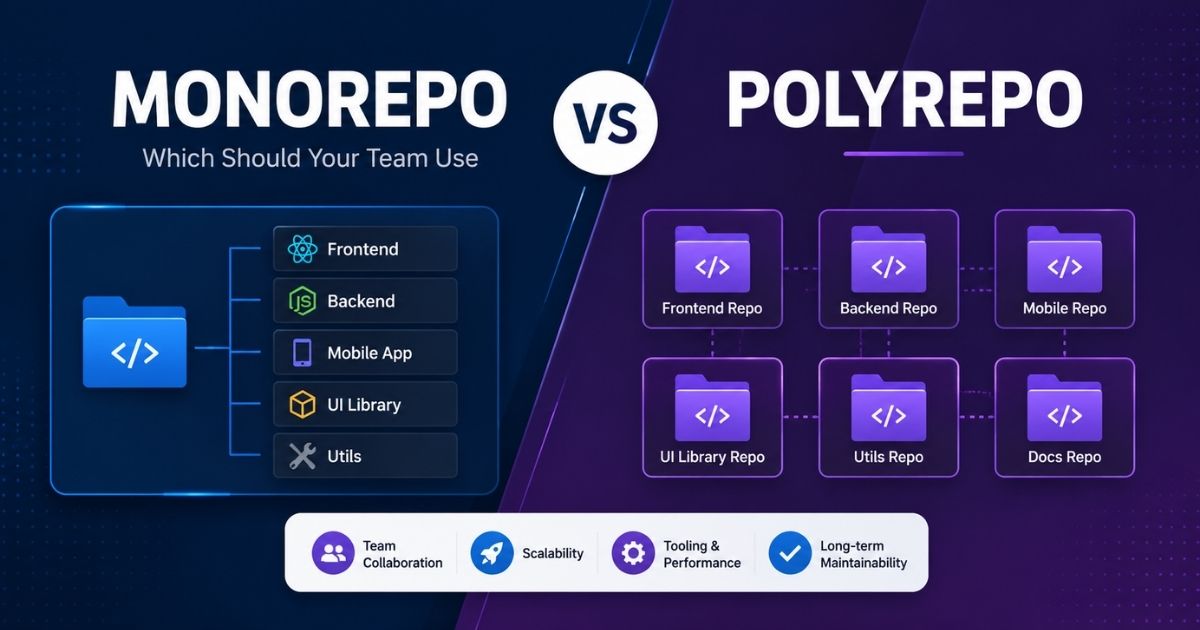
by Daniel Wright | Aug 4, 2026 | Software Development Insights
Table of Contents
- What Is A Monorepo?
- What Is A Polyrepo?
- Monorepo Vs Polyrepo: Key Differences
- Monorepo Vs Polyrepo Comparison Table
- Monorepo Vs Polyrepo By Team Size
- Tooling Comparison Table
- Monorepo Pros And Cons
- Polyrepo Pros And Cons
- Decision Matrix: Which Repository Strategy Fits Your Team?
- How AI Coding Tools Affect The Monorepo Vs Polyrepo Decision
- How To Migrate From Polyrepo To Monorepo
- Common Mistakes To Avoid
- Final Verdict
Every growing engineering team eventually hits the same fork in the road: keep everything in one repository, or split it across many. It sounds like a small technical choice until you're six months into a project and realize the wrong call is now baked into your build systems, your CI/CD pipelines, and how your engineering teams actually work together day to day.
Monorepo vs polyrepo isn't a trend to follow. It's an architectural decision with real consequences for dependency management, code quality, and how fast your team ships. Some companies swear by a single repository holding all their projects. Others insist on separate repositories for every service. Both camps have data and horror stories to back them up.
Below, we'll break down what each approach means, where they win and where they fail, and how to pick the right one for your team's stage and size.
What Is A Monorepo?
A monorepo is a single repository that holds the source code for multiple projects, services, and shared libraries in one place. Instead of splitting a company's applications across dozens of separate repos, everything lives in one repo with one shared history and one set of build systems.
Companies like Google and Meta run monorepo architecture at massive scale, with thousands of engineers committing to the same repository daily. It favors code sharing, cross project changes in a single commit, and consistency across all the projects a team maintains.
What Is A Polyrepo?
A polyrepo setup splits a company's codebase into many repositories, typically one per service or application. Each team owns its own repository, with its own release cycle, its own build pipeline, and its own set of tools. This is the default in most microservices architectures, echoing the same tradeoffs you face when choosing between microservices and monolithic architecture.
Multiple services move independently, and engineering teams can work independently without touching code that belongs to other teams. The tradeoff is coordination overhead: shared libraries and cross project changes now require touching several repositories instead of one.
Monorepo Vs Polyrepo: Key Differences
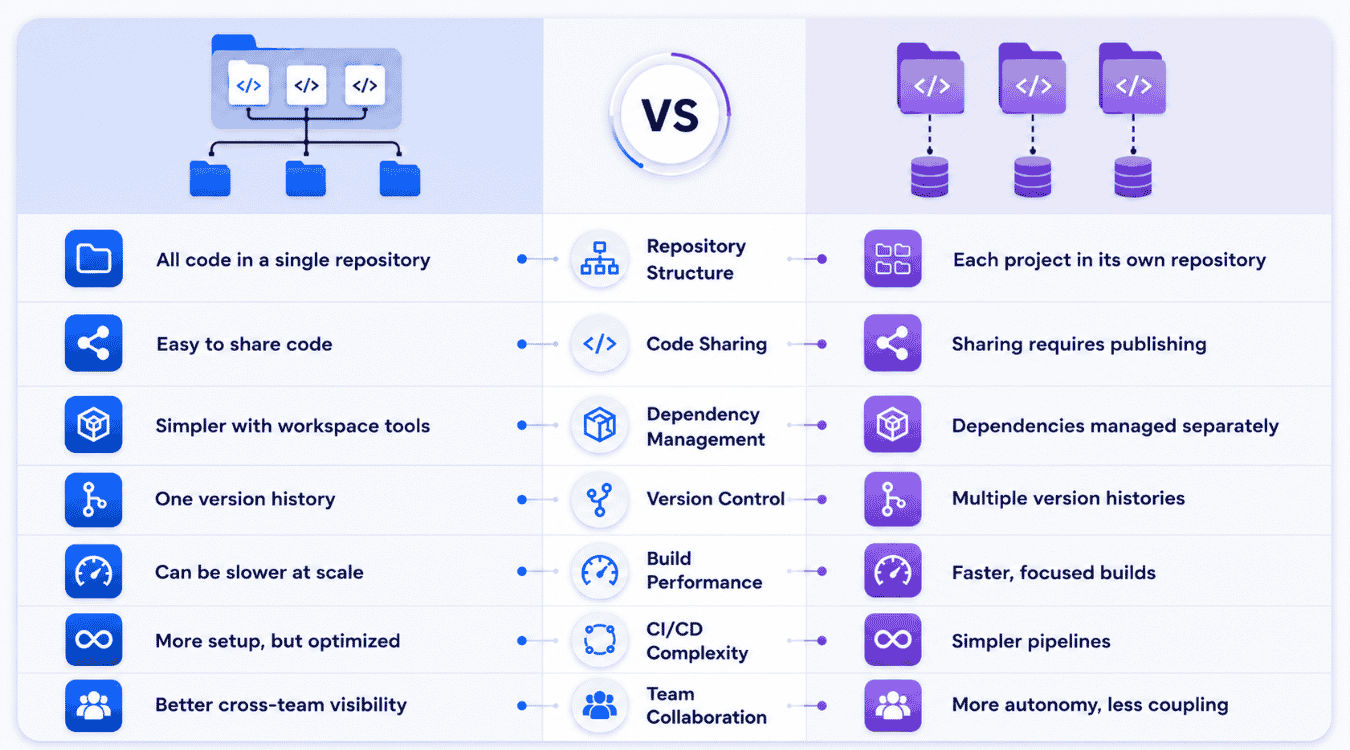
These two models diverge in ways that touch almost every part of software development, from how code gets reviewed to how deployment processes get triggered. Here's where the real differences show up.
Repository Structure
In a monorepo, all the projects sit inside one repository, organized into folders for apps, packages, and shared libraries. A polyrepo scatters those same projects across separate repos, each with its own configuration and its own git history.
Neither structure is inherently better. A single code repository suits teams building tightly coupled products, while separate repositories suit teams running individual projects that rarely touch each other's code.
Code Sharing
Sharing code across projects is far simpler in one repo, where teams share code through direct imports with no publishing step required. Multiple repos need that same utility packaged, versioned, and published before another team can use it.
This is why teams chasing code reuse often lean toward monorepos. Polyrepo setups solve it with shared libraries and package registries, but that adds a layer of process every single change has to pass through.
Dependency Management
Managing dependencies in a monorepo means one version of a library across every project, enforced by default. There's no debate about which team is running an outdated package.
Multiple repositories give each team freedom to upgrade on their own schedule, which sounds good until dependency management turns into a spreadsheet of who's on what version. Fine grained access control over what each project depends on gets harder to enforce the more repos you add.
Version Control
A single repo gives you one commit history for the entire codebase. A change that touches five services can go out as a single commit, reviewed once, tested once.
Version control in a polyrepo means five separate pull requests, five separate reviews, and hoping nobody merges out of order. Trunk based development is far easier to enforce when there's only one repository to enforce it on.
Build Performance
Build performance is where monorepos take the most criticism. Without specialized tooling, building everything on every change turns into a huge amount of wasted compute and painfully slow feedback loops.
Polyrepos avoid this by keeping each repo's build small and scoped to that project. The catch is you lose visibility into how a change in one repo affects the rest of your complex systems.
CI/CD Complexity
CI/CD complexity in a monorepo comes from figuring out what actually needs to rebuild and retest when a change touches shared code. Get this wrong and every commit triggers a full rebuild across every project.
Polyrepos keep individual pipelines simple, but coordinating deployment processes across multiple services during a release becomes its own project, often needing a dedicated team just to manage the choreography, especially as more advanced DevOps best practices come into play.
Team Collaboration
How teams collaborate changes completely between these two models. Monorepos push teams toward shared standards almost by accident, since everyone sees everyone else's code, which naturally encourages a more consistent code review process.
Polyrepos protect team autonomy. Different teams can pick different testing frameworks and different workflows without asking permission. That freedom comes at the cost of context switching whenever someone needs to work across repository boundaries.
Monorepo Vs Polyrepo Comparison Table
Here's a quick side by side look at how the two models stack up across the factors that matter most for day to day software development.
Factor | Monorepo | Polyrepo |
|---|---|---|
Code Sharing | Direct imports, easy reuse | Requires published packages |
Dependency Management | Single version enforced | Independent per repo |
Build Speed | Needs caching tools | Fast by default per repo |
CI/CD | Complex without tooling | Simple per repo, complex across repos |
Team Autonomy | Lower | Higher |
Access Control | Coarser by default | Fine grained by default |
Best For | Tightly coupled products | Independent services |
Monorepo Vs Polyrepo By Team Size
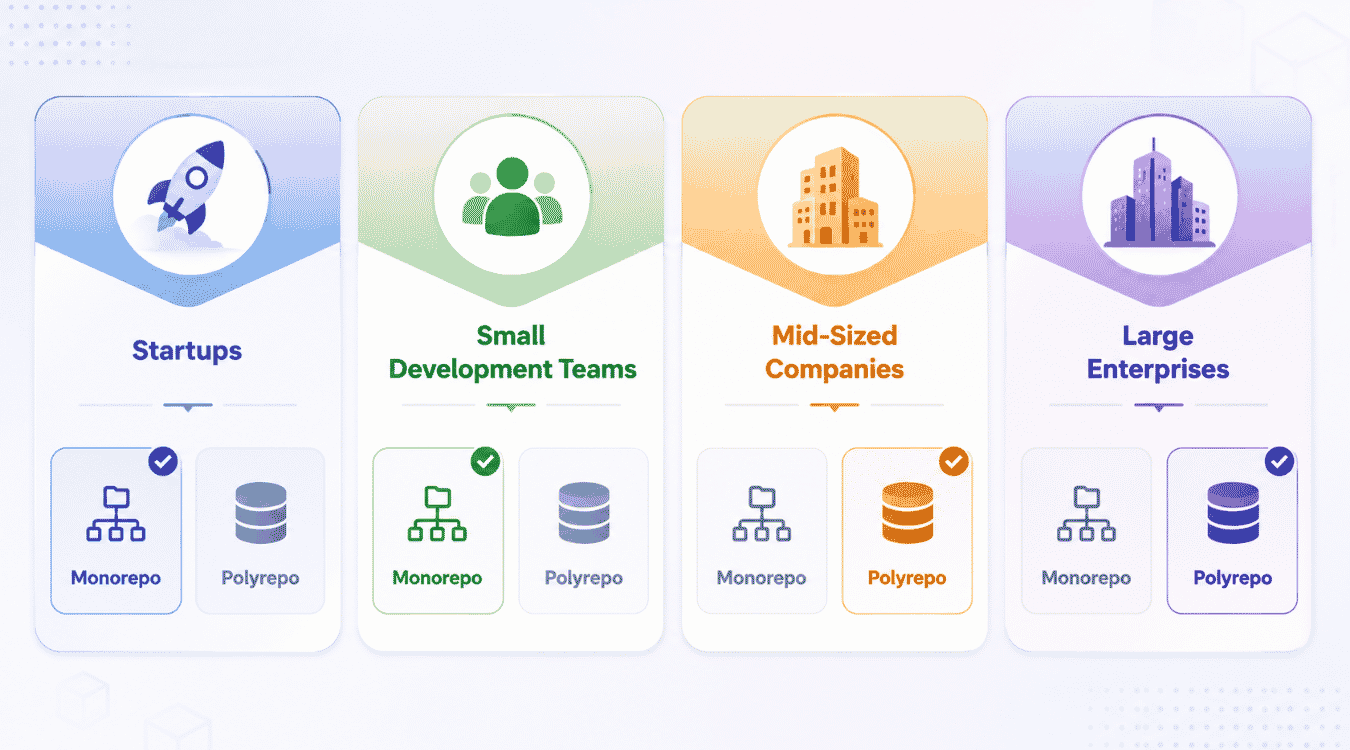
The right repository strategy shifts as a team grows. What works cleanly for five engineers can quietly turn into a bottleneck once headcount, products, and release cycles start multiplying.
Startups
Most startups begin in one repo without ever deciding to. A small team, one product, and no real reason to split things up into individual projects yet. This is usually the right call.
A single repository keeps development setup simple and avoids the overhead of managing multiple repos before there's anything worth separating. The moment a startup builds its second product or its first mobile app, that calculus starts to shift.
Small Development Teams
Small teams working on a handful of related projects usually do fine with a monorepo. Code sharing stays simple, and there's no need for a dedicated team to manage cross repository coordination across smaller repositories.
Once a small team starts supporting external clients or shipping separate products with different release cycles, separate repos start making more sense. The deciding factor is usually whether the projects still change together or have started to drift apart.
Mid-Sized Companies
This is where the decision actually gets hard. Mid-sized companies often have several repositories already, some legacy, some new, and engineering teams that have grown past the point where everyone knows what everyone else is doing.
The honest answer for most mid-sized companies is a hybrid approach. Core, tightly coupled services move into one repo, while newer or experimental projects stay in their own repository until they prove they belong, mirroring the broader refactor vs rebuild tradeoff many teams face during modernization.
Large Enterprises
At enterprise scale, both models work, but neither works without serious investment. Companies managing many projects across dozens of teams and running monorepo architecture at massive scale need specialized tooling and dedicated platform teams most companies never have to build, much like the planning needed for a successful cloud migration strategy.
Enterprises running polyrepo setups instead invest heavily in developer tooling, service catalogs, and security requirements that keep hundreds of repositories consistent. The common thread: at this size, the tooling budget matters more than the model itself.
Tooling Comparison Table
A quick breakdown of the most common tools teams reach for, and where each one actually fits.
Tool | Setup | Language Support | Incremental Builds | Remote Caching | CI Performance | Learning Curve | Best Use Case |
|---|---|---|---|---|---|---|---|
Nx | Moderate | JS/TS-focused, extensible | Yes | Yes | Strong | Moderate | JS/TS monorepos |
Turborepo | Low | JS/TS only | Yes | Yes | Strong | Low | Fast JS/TS setups |
Bazel | High | Polyglot | Yes | Yes | Excellent at scale | Steep | Polyglot codebases at scale |
Lerna | Low | JS/TS only | Limited | No native support | Basic | Low | Simple package publishing |
Plain Git | None | Any | No | No | Manual | None | Small teams, single project |
Monorepo Pros And Cons
Weighing these out clearly is the fastest way to cut through the noise.
- One repository means every team works from the same source of truth
- Teams share code and reuse it without publishing packages first
- Cross project changes ship as a single commit instead of five
- Dependency management stays consistent since there's only one version of anything
- Easier to ensure consistency in code quality across all the projects
- Fine grained access control tools now exist to lock down parts of a single repo
- Refactoring at scale avoids the code duplication that creeps into separate repos
Cons:
- Build performance suffers without specialized tooling and remote caching
- Permissions and security requirements need deliberate governance to hold up at scale
- Coordination overhead grows fast once many teams work in the same repository
Polyrepo Pros And Cons
The other side of the coin looks just as compelling, depending on your setup.
- Team autonomy lets every group pick their own tools and testing frameworks
- Multiple repos mean smaller, faster builds scoped to just one project
- Teams can work independently without waiting on unrelated changes elsewhere
- Fine grained access control comes naturally since each repository has its own permissions
- Individual projects can move through their own release cycle on their own schedule
- Security requirements are easier to isolate when sensitive code sits in its own repository
- New tools and new projects can be spun up without touching legacy code
Cons:
- Code duplication creeps in as shared libraries get copied instead of imported
- Cross project changes require coordinating pull requests across several repositories
- Managing dependencies across multi repo setups often needs a dedicated team just to track versions
Decision Matrix: Which Repository Strategy Fits Your Team?
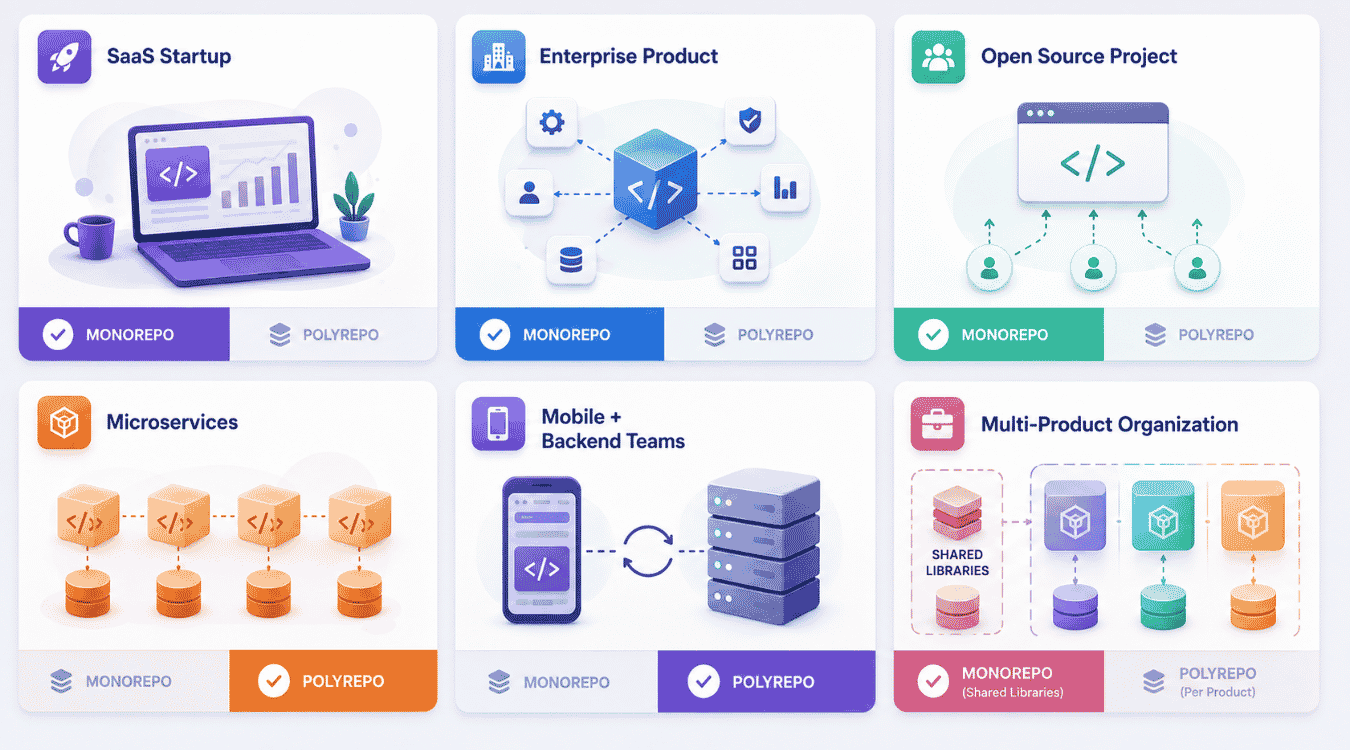
Different project types call for different answers. Here's how the decision plays out across six common scenarios, from a lean SaaS startup to a company running several products at once.
SaaS Startup
A single product built by one small team almost always starts in one repo. There's no coordination overhead to justify splitting things up yet, and a single repository keeps onboarding new hires fast, which is especially helpful if you're also experimenting with integrating AI into a SaaS product.
Enterprise Product
Enterprise products with many interconnected modules benefit from a monorepo, provided there's a dedicated team ready to invest in build systems and CI/CD tooling. Without that investment, the same product turns into a slow, painful repo nobody wants to touch.
Open Source Project
Open source projects usually favor a single repo per project, since contributors expect to find one clear place to submit code changes. A multi repo structure only makes sense once the project splits into genuinely separate tools with separate audiences.
Microservices
Microservices architectures lean naturally toward polyrepo setups, since each service is meant to deploy and scale on its own. That said, plenty of companies now run microservices inside a monorepo, using build systems that only rebuild what changed, often as part of a broader monolith to microservices migration.
Mobile + Backend Teams
Mobile and backend teams often work at different release cycles, which pushes many companies toward keeping each platform in its own repository. Others keep everything in one repo so a single API change and its client updates ship together.
Multi-Product Organization
Running several distinct products under one company usually calls for a hybrid approach: shared internal libraries in one repo, each product in its own repository. This avoids tight coupling between products that have nothing to do with each other.
How AI Coding Tools Affect The Monorepo Vs Polyrepo Decision
AI tools have quietly become part of this decision. The way GitHub Copilot, Cursor, Claude Code, and ChatGPT understand a code base depends heavily on how that code base is organized in the first place.
Large codebases used to be a strong argument for polyrepos. Smaller, separate repos meant less for a developer to hold in their head at once. AI code search changes that math somewhat. Tools built around large context windows can now read across an entire monorepo and understand how a change in one service affects three others, something that used to require deep familiarity with the whole system.
Claude Code and similar tools work best when they can see the full picture. A single repo gives them one dependency graph to reason about, one set of conventions to follow, and one place to search when answering a question like where else does this logic get used. Ask that same question across a dozen separate repositories and the answer gets a lot less reliable, even for a capable AI assistant.
Cursor and GitHub Copilot both lean on dependency analysis to suggest relevant code as you type. That analysis is more accurate inside one repository, where imports resolve directly with no need to guess at a package version installed somewhere else. In a polyrepo setup, these tools still work, but they're often limited to whatever repository is currently open, missing context that lives one repo over.
None of this means polyrepos are obsolete. ChatGPT and other general purpose AI tools still work across multiple repos just fine for isolated tasks, and team autonomy still matters more than AI convenience for plenty of organizations. But if your team leans heavily on AI tools for cross project changes, refactors, or onboarding new engineers, that's a real point in favor of consolidating into fewer repositories, or at least investing in tooling that stitches your multi repo setup together for the AI to search.
The practical takeaway: AI tools reward whichever structure keeps related code close together, whether that's one repo or a well organized set of a few. Ignoring this shift when making architectural decisions today just means solving the same context problem manually that a well chosen repo structure could have solved for free.
How To Migrate From Polyrepo To Monorepo
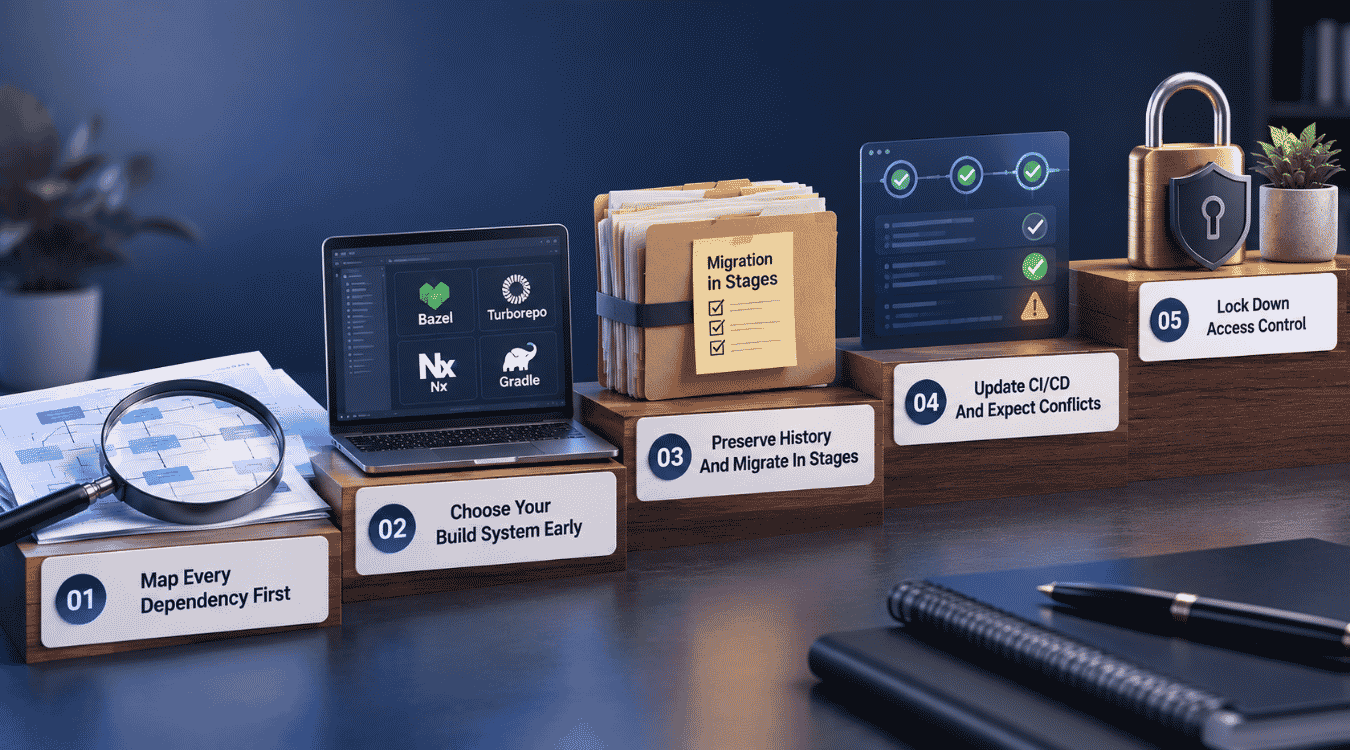
Migrating between these two models is one of the more disruptive changes an engineering team can take on, and it rarely goes as smoothly as planned. The same is true for any significant platform shift such as a cloud migration for growing teams. Here's how to do it in stages instead of all at once.
Map Every Dependency First
Before merging anything, get a clear picture of which projects share code, which teams own what, and where hidden coupling already exists despite living in different repositories. Talk to every team involved, not just the ones with obvious overlap, since some of the messiest dependencies hide in code nobody's touched in years. Skipping this step is how migrations turn into months of broken builds and finger pointing over whose change broke what.
Choose Your Build System Early
Pick your build system before you move a single file. Nx, Turborepo, and Bazel all handle incremental builds differently, and switching tools mid-migration is far more painful than choosing carefully upfront. Whatever you pick needs to support the languages already in use across your projects, not just the ones you plan to standardize on later. Run a small pilot with two or three projects first, so you catch tooling gaps before the whole team depends on it.
Preserve History And Migrate In Stages
Tools like git subtree let you fold a repository into a new monorepo without losing its commit history, which matters more than it sounds like the first time someone needs to trace a bug back to its origin. Move one project at a time, get its build and CI/CD pipeline working cleanly inside the new repository, then move the next. Trying to merge everything in a single commit is how teams end up with weeks of broken deployment processes and no clear rollback plan if something goes wrong.
Update CI/CD And Expect Conflicts
Each project you migrate needs its pipeline rebuilt to work with the new repository's structure, and testing this incrementally catches problems while they're still small instead of surfacing all at once. Shared configuration files that every team used to own separately will also collide during the move, along with linting rules, environment variables, and secrets management setups. This is normal. Set expectations with your engineering teams ahead of time so nobody's surprised when the first few weeks feel slower, not faster than before.
Lock Down Access Control
A monorepo without deliberate permissions turns every engineer into someone who could technically touch every project, which becomes a real security requirement problem fast. Set up fine grained access control through code owners and branch protection rules from day one, not after something goes wrong. Migrating in the other direction, from monorepo back to polyrepo, follows similar logic in reverse: extract one project at a time, keep its history intact, and don't touch its CI/CD setup until the extraction has proven stable on its own.
Common Mistakes To Avoid
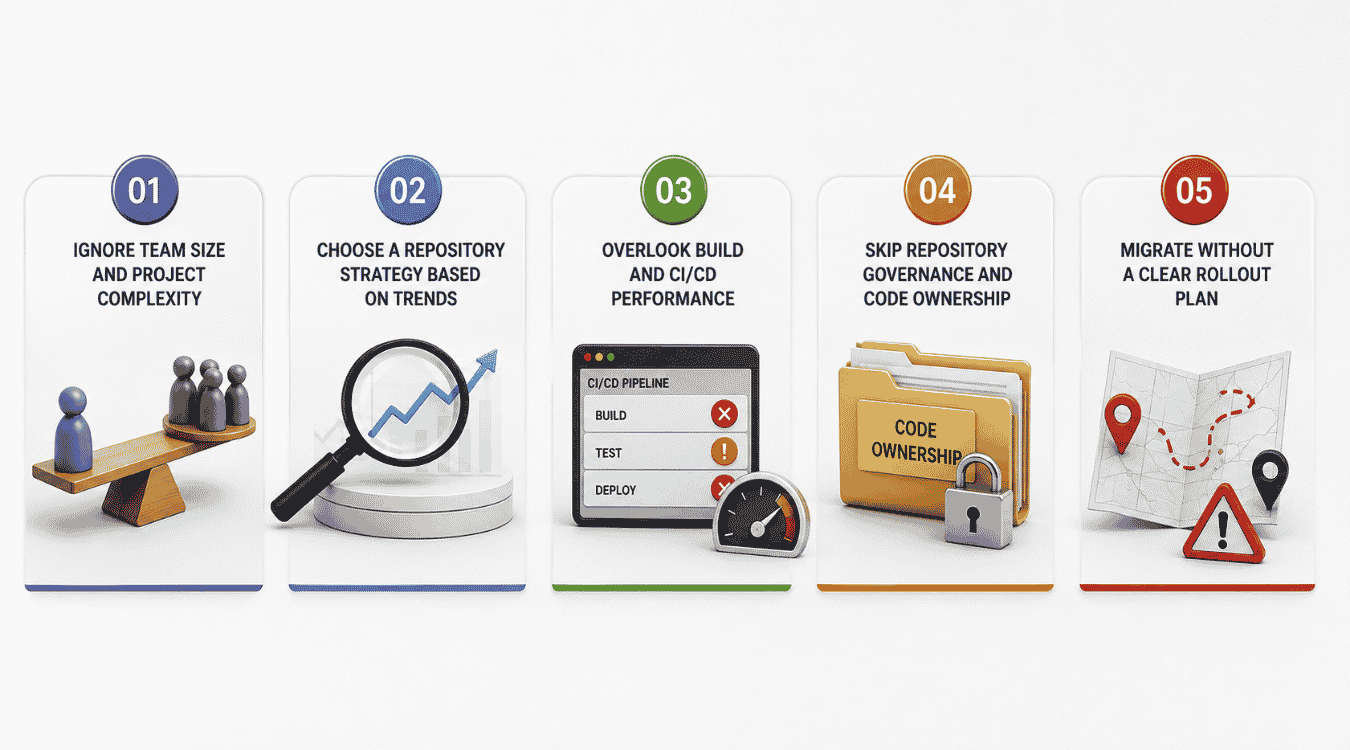
Most repository disasters trace back to a handful of avoidable decisions made early on. These are the mistakes that show up most often, regardless of which model a team eventually picks.
Ignore Team Size And Project Complexity
A five-person team adopting the same monorepo architecture Google uses is solving a problem it doesn't have yet. The specialized tooling and governance that make monorepos work at massive scale add overhead that small teams simply don't need.
Match the strategy to where your team actually is, not where you hope to be in three years. Project complexity should drive this decision, not ambition.
Choose A Repository Strategy Based On Trends
Plenty of teams pick a repository strategy because a well-known company uses it, without checking whether their own situation looks anything alike. Netflix's polyrepo setup and Google's monorepo architecture both work because of years of investment in supporting tools, not because one approach is objectively correct.
Copying the structure without copying the tooling behind it usually just imports the downsides.
Overlook Build And CI/CD Performance
Teams often pick a repository model based on code organization alone and only think about build performance once things slow to a crawl. By then, fixing a monorepo's build systems or restructuring a polyrepo's CI/CD pipelines is a much bigger project than planning for it early would have been.
Test your build times before you're at scale, not after developer productivity and developer happiness have both taken a hit.
Skip Repository Governance And Code Ownership
Without clear code ownership, a shared repository turns into a free-for-all where nobody's sure who reviews what. This shows up fast as inconsistent code quality and a code review process that either bottlenecks on one person or lets things through unchecked.
Set up code owners, branch protection, and access control rules before your team grows, not after the first incident.
Migrate Without A Clear Rollout Plan
Rushing a migration without staging it properly is one of the most common ways teams break things for everyone at once. A rollout plan gives each team time to adjust their development workflows instead of waking up to a completely different repository overnight.
Move one project at a time, keep the old setup running until the new one's proven, and communicate every step to the teams affected.
Final Verdict
There's no universal winner in the monorepo vs polyrepo debate, and anyone promising one is skipping the details that actually matter for your team.
A monorepo makes sense when your projects are tightly coupled, your team is ready to invest in the tooling that keeps builds fast, and you want cross-project changes to ship as a single commit. A polyrepo makes sense when your teams genuinely work independently, your services scale and deploy on their own schedules, and team autonomy matters more than perfect consistency.
Most companies land somewhere in between eventually, running a hybrid approach that groups tightly coupled services together while letting genuinely separate projects live in their own repository. That's not indecision. It's just what happens when architectural decisions get made based on how the team actually works, instead of which name sounds more impressive on a blog post.
Whichever direction you choose, the model matters less than committing to the tooling, governance, and habits that make it work well over time.


