
API Monetization Strategy: Pricing Models, Metrics, And Best Practices
by Rhea Collins | Aug 9, 2026 | Technology & Innovation
Table of Contents
Your API works great. Developers love it. But is it making money? That's the gap most teams hit. They build a solid product, then treat pricing as an afterthought. A real API monetization strategy flips that. It treats your API as its own product, with its own pricing model, usage limits, and target customers.
Some api providers pick one monetization model and stick with it. Others mix subscriptions with usage-based pricing to match how their API consumers actually behave. Both can work. What matters is matching the model to your users, not copying what worked for someone else.
Get this right, and your API becomes a real revenue stream. Get it wrong, and you're either scaring off developers or leaving money on the table. Let's look at how to get it right.
What Is API Monetization?
API monetization is the practice of generating revenue directly from your API instead of giving it away for free. Instead of treating your API as just a backend tool, you turn it into a standalone product with real business value.
This can work two ways. Direct monetization means charging API users straight up, through a pricing model like pay per use or a fixed monthly fee. Indirect monetization is different. You give free access to the API itself, but it drives customer acquisition or supports a bigger business model, like Google Maps embedded in other apps.
Either way, the goal is the same. You want API consumption to translate into real revenue generation, not just usage numbers. Done right, API monetization turns something you already built into a genuine revenue stream.
Why Businesses Monetize APIs
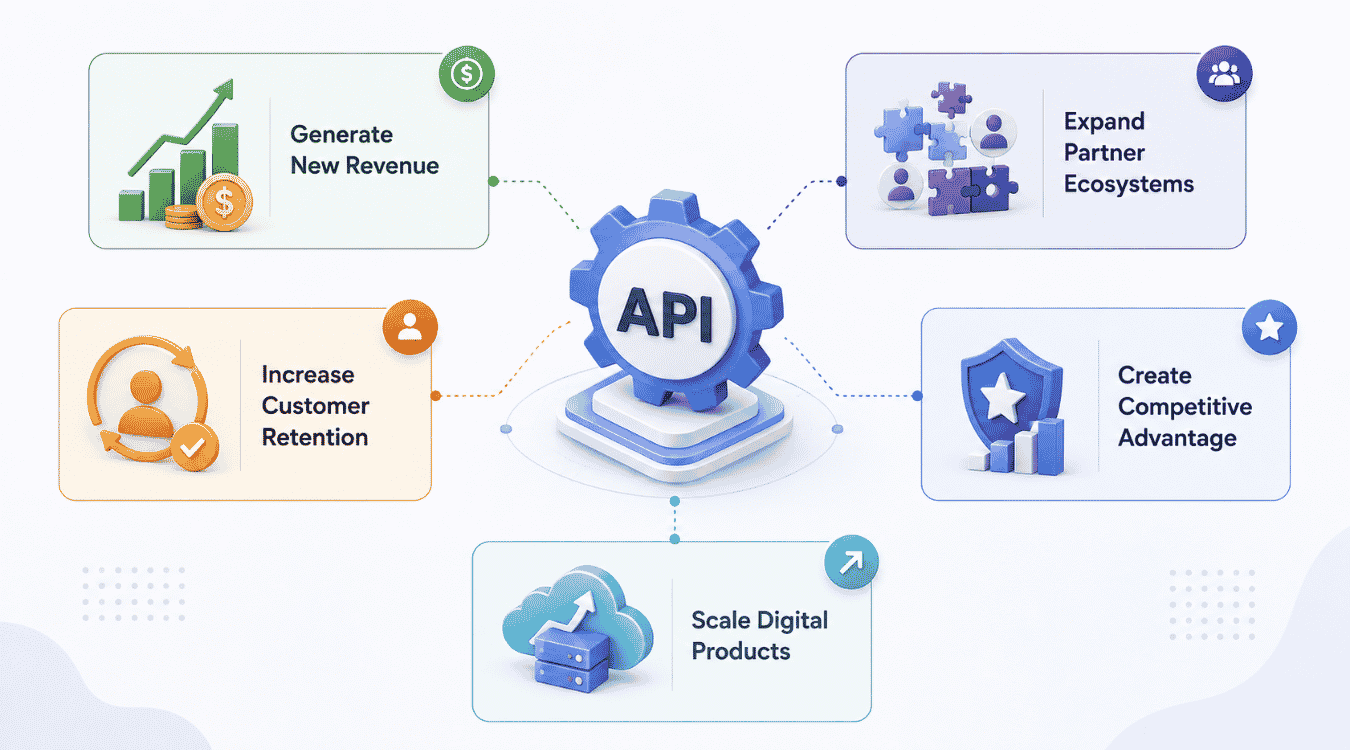
;Businesses don't monetize APIs just to make a quick buck. It's about building real revenue streams, strengthening partnerships, and turning a technical product into a business advantage. Here's why it matters.
Generate New Revenue
The most obvious reason is money. A well-priced API can generate significant revenue on its own, separate from your core product. Whether you charge per API call or run a flat subscription, api revenue adds up fast once usage scales.
Many companies find their API becomes a real revenue generation engine, not just a support feature. With the right monetization strategy, that revenue stream can eventually rival other parts of the business when it’s supported by robust SaaS development services that keep the underlying platform scalable and reliable.
Expand Partner Ecosystems
APIs make partnerships easier. Instead of building custom integrations for every partner, you open up access and let them build on top of you. This is where indirect monetization and revenue sharing come in.
Partners plug into your API, and you earn a cut of what they generate. It's a win-win. Your partner performance improves, your api economy grows, and you get exposure to new customers through lead generation you didn't have to chase yourself.
Increase Customer Retention
Customer feedback drives higher satisfaction and retention rates. When you monetize your API well, you're forced to actually listen to how people use it and refine the experience, similar to how strong UX reduces SaaS churn and improves retention. That feedback loop keeps customers around.
Listening to customers improves overall API success. Once businesses depend on your API for their own workflows, switching costs go up. That dependency, combined with good support, keeps customer retention high and churn low.
Create Competitive Advantage
A monetized API isn't just a revenue tool. It's a market signal. Offering fair pricing and pricing flexibility shows customers you understand their needs better than competitors do.
Businesses that track market trends and adjust pricing accordingly stay ahead. Customer preferences shift over time, and companies that adapt their api pricing models faster end up winning market share their competitors lose.
Scale Digital Products
APIs let you scale without rebuilding everything from scratch. With an API-first architecture, once your api products are stable, you can add enterprise customers, new features, and higher usage tiers without touching the core system.
Usage patterns show you where demand is growing, so you know where to invest next. This is how a single API turns into a full suite of api products serving very different customer segments, backed by thoughtful SaaS scalability strategies for sustainable growth.
How To Prepare Your API For Monetization
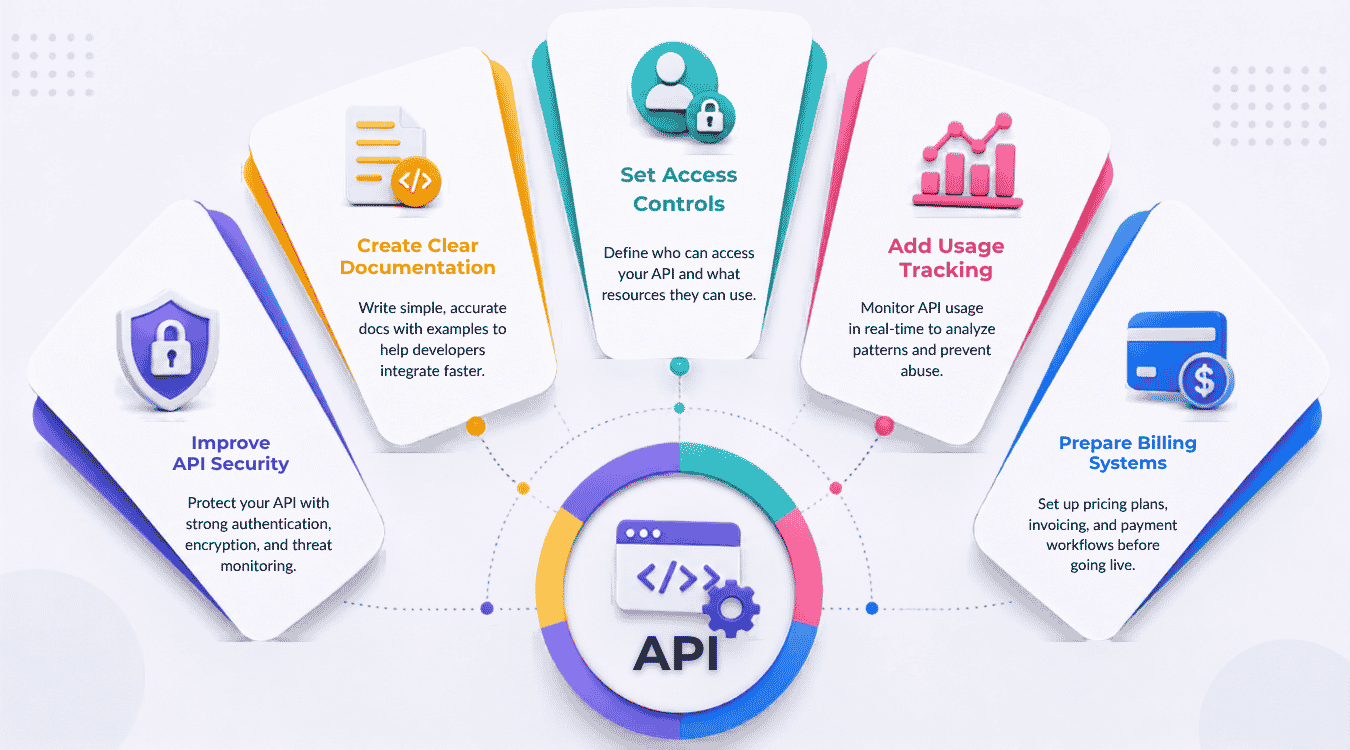
Before you charge a single dollar, your API needs to be ready. That means locking down security, documenting everything, and building the systems that make billing actually work. Skip this step, and monetization falls apart fast.
Improve API Security
You can't charge for something you can't protect. Before opening up your API to paying customers, lock down authentication, encryption, and rate limits using SaaS security architecture best practices. Weak security means bad actors can drain resources or steal data, and that kills trust fast.
Continuously monitor and optimize API performance for success, and security is part of that equation; following broader SaaS security best practices for 2026 helps keep your approach current. Enterprise customers especially will ask about your security setup before they sign anything. Get this right first; everything else depends on it.
Create Clear Documentation
Provide high-quality documentation to support API users. If developers can't figure out how to use your API, they won't pay for it. Documentation should cover endpoints, authentication, rate limits, and pricing configuration in plain language.
Establish an intuitive API developer portal for better access, so users aren't digging through scattered pages. Good docs reduce support tickets and speed up onboarding and should fit into a broader API integration strategy. Investing in strong UI/UX design services for SaaS products here directly affects how fast api consumers convert into paying customers.
Set Access Controls
Access controls decide who gets in and what they can do. This means setting up API keys, permission levels, and usage limits tied to different pricing tiers. Free tier users should have clear limits compared to paid plans.
This is also where you separate free users from enterprise customers with different feature access. Without proper access controls, you can't enforce your pricing model, and that means you can't actually collect the revenue you're owed.
Add Usage Tracking
You can't bill for what you don't track. Usage tracking means logging every API call, monitoring usage patterns, and recording data processed per user or account, in real time, as part of broader SaaS performance optimization.
Track key metrics to evaluate monetization strategy effectiveness, and usage tracking is where that data comes from. Whether you're running pay per use or tiered pricing, accurate tracking is non-negotiable and is usually supported by robust SaaS monitoring tools. Without it, billing disputes and revenue leakage become constant problems.
Prepare Billing Systems
Billing is where monetization becomes real. This means setting up systems for subscription-based pricing, usage-based billing, or hybrid models, often through tools like Stripe integration or Azure API management built on reliable SaaS infrastructure components and architecture.
Successful API monetization requires implementing technical enforcement and billing automation. Manual billing doesn't scale and creates billing friction that frustrates customers. Automating this early means you avoid painful rework once your API monetization strategy starts generating real revenue.
Popular API Pricing Models
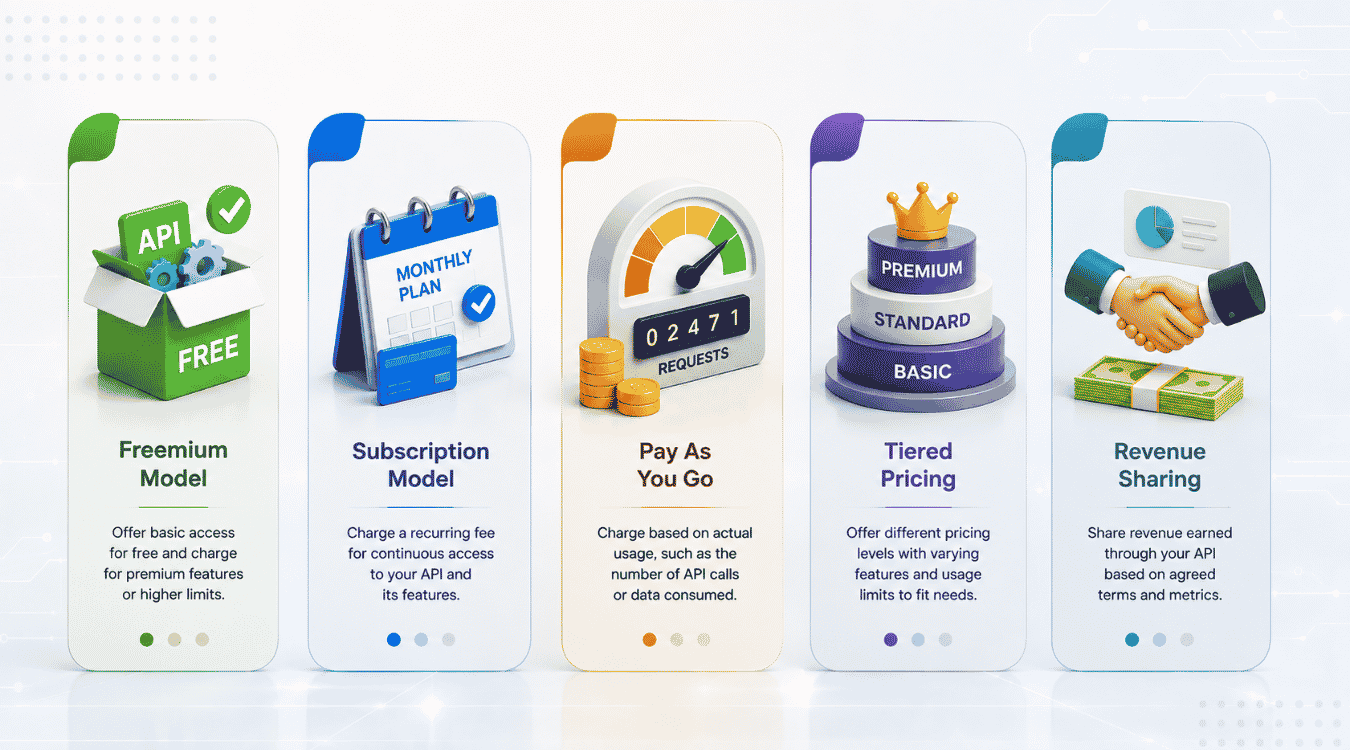
There's no single right way to price an API. Each pricing model comes with its own upside, and its own catch. Here's how the most common ones actually work in practice.
Freemium Model
Freemium models offer basic access for free with paid upgrades. Users get in the door without a credit card, try your API, and upgrade once they hit real usage or need specific features. It's the easiest way to build a user base fast.
The catch: free users don't always convert. You end up supporting a lot of API consumption that never turns into revenue. If your paid tier isn't clearly better, people just stay on the free tier forever, and your monetization strategy stalls right there.
Subscription Model
Subscription-based models charge a recurring fee for access. Customers pay a fixed monthly fee or annual rate, get a set usage limit, and know exactly what they owe every billing cycle. It's predictable for you and for them.
The trade-off is flexibility. Subscription models can undercharge your heaviest users and overcharge your lightest ones, since everyone pays the same regardless of actual usage patterns. If usage varies a lot across your api consumers, this model can leave real revenue on the table.
Pay As You Go
Consumption-based models bill users based on service usage. Customers pay per API call or per unit consumed, so cost scales directly with how much value they're getting. No usage, no charge. It feels fair, and it's easy to justify to finance teams.
The risk here is unpredictability. Pay per use pricing makes budgeting harder for customers, and unexpected usage spikes can lead to bill shock. That billing friction can push cautious buyers toward a competitor with more predictable subscription-based pricing instead.
Tiered Pricing
Tiered subscription pricing involves fixed monthly or annual plans with usage limits. You set a few tiers, each with its own rate limits and features, and customers pick the one that fits. Enterprise customers usually land in the top tier with custom limits.
The downside is complexity. Too many tiers confuse buyers, and too few forces customers into a based pricing plan that's either too small or way more than they need. Getting the tier boundaries wrong costs you revenue generated from customers who quietly leave.
Revenue Sharing
Revenue-sharing models earn a percentage from third-party transactions. Instead of charging api providers directly, you take a cut of whatever revenue your API helps generate. This is common in marketplaces and payment platforms.
The catch is dependency. Your income is now tied to partner performance, not your own effort. If a partner's business slows down, your api revenue slows down with it. It's indirect monetization, which means less control over how much you actually earn.
How To Build An API Monetization Strategy
.png)
Picking a pricing model is only one piece. Building a real API monetization strategy takes a clear process, from understanding your API's value to setting up billing and tracking results. Here's how to do it step by step.
Step 1: Define API Value
Before pricing anything, get clear on what your API actually does for customers. API monetization requires treating an API as a standalone digital product, not a side feature, and should align with your broader SaaS product development strategy and an overall B2B SaaS product development guide. What problem does it solve, and how much time or money does it save someone?
Customers are really paying for that value, not the API calls themselves. If you can't explain it in one sentence, your pricing model won't make sense to api users either, especially as you invest in scalable software architecture. Get this right first, everything else gets easier.
Step 2: Identify Target Users
Effective API monetization strategies involve understanding customer segments and behavior. Not all api consumers are the same. Some are solo developers testing an idea. Others are enterprise customers running production workloads at scale.
Figure out who you're actually building for. Your target market shapes everything downstream, from pricing model to usage limits. A pricing plan built for enterprise customers will scare off small developers, and vice versa.
Step 3: Choose Pricing Model
Core approaches to API monetization include subscription tiers and pay-as-you-go consumption. Now match a model to how your target users actually behave. Heavy, unpredictable usage fits usage-based pricing. Steady, predictable usage fits subscription models better, and your SaaS design system for scalable products should support clear, consistent presentation of those options.
Many successful API businesses combine multiple monetization strategies into hybrid models. Don't feel locked into just one. Whatever fits your customer preferences and usage patterns is the right monetization model, not whatever's trending.
Step 4: Set Usage Limits
Usage limits protect your infrastructure and shape customer behavior. Decide how many API calls each tier allows, and what happens when someone hits that ceiling. Options include throttling, overage fees, or a forced upgrade.
Rate limits also prevent abuse from a small number of heavy users draining resources meant for everyone else. Get this balance wrong, and you either frustrate good customers or let bad actors run up your costs for free.
Step 5: Enable Billing
Successful API monetization requires implementing technical enforcement and billing automation. Pricing configuration turns into actual invoices here, so understanding broader software development pricing models can help you choose structures that fit your business. Set up subscription-based pricing, usage-based billing, or a hybrid, and connect it to a real payment processor.
Manual billing doesn't scale past a handful of customers. Automating this early avoids billing friction later, and makes sure the revenue you're generating actually gets collected without constant manual work on your end, especially when it’s underpinned by solid best practices of SaaS architecture.
Step 6: Monitor And Improve
Track key metrics to evaluate monetization strategy effectiveness. Once billing is live, the work isn't done. Watch usage patterns, revenue generated, and customer retention closely, especially in the first few months after launch, and consider a periodic SaaS technical audit to validate that your platform can support the monetization approach.
Continuous monitoring of metrics drives data-driven optimizations. Customer feedback is critical for informed decision-making here too. Use what you learn to adjust pricing, fix confusing tiers, and keep improving your API monetization strategy over time.
How To Measure API Monetization Success
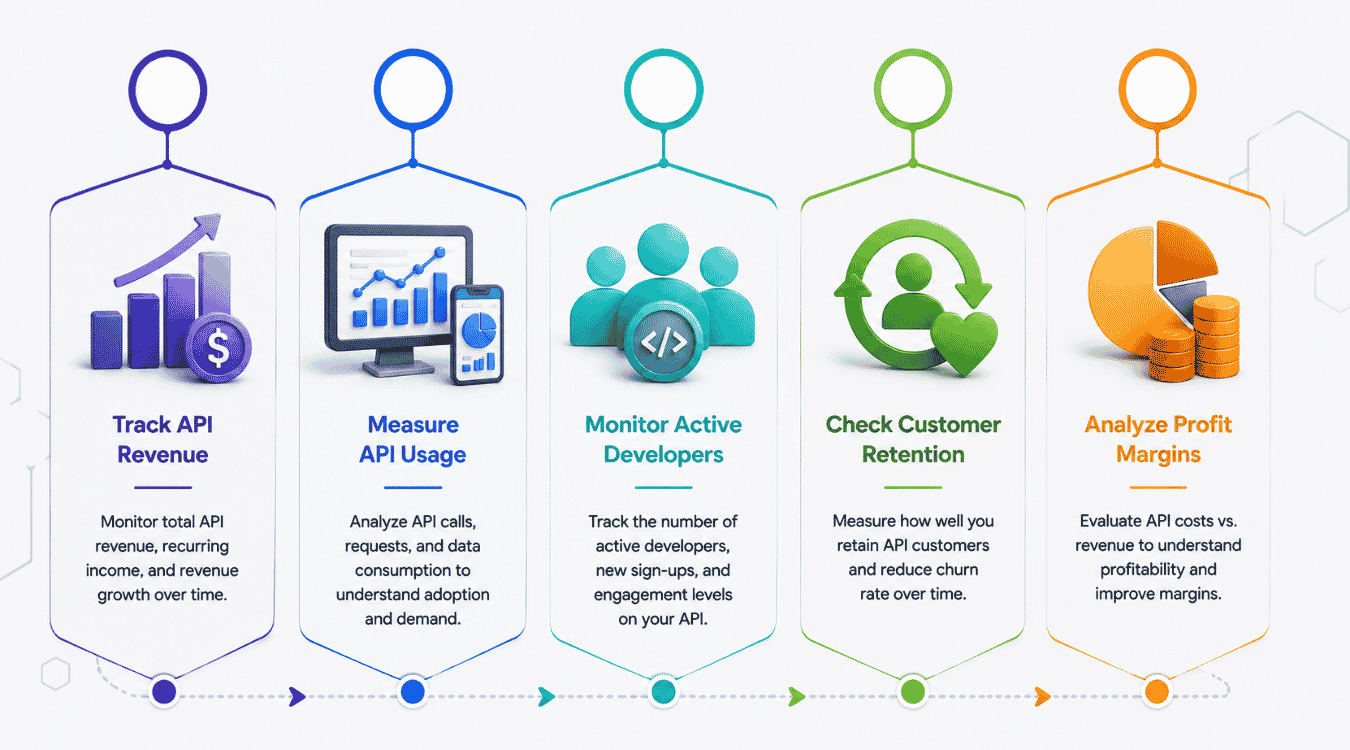
Launching your API monetization strategy is only half the job. Real success shows up in the numbers: revenue, usage, developer activity, and retention. Here's what to track and why each metric matters.
Track API Revenue
Numbers don't lie, so start with revenue generated across every pricing model you're running. Break it down by subscription based api pricing, pay-per-use, and any revenue-sharing deals separately, so you know exactly where money is coming from.
Comparing revenue potential against actual results tells you fast whether your pricing strategies are working. Teams that have successfully monetized their API usually check this weekly, not quarterly. Waiting too long means missing problems before they compound.
Measure API Usage
Raw usage numbers provide valuable insights into how customers actually interact with your API. Track total API calls, peak usage times, and which api features get hit hardest across different customer segments.
Usage patterns often reveal gaps between what you built and what customers need. High usage on a free tier with low conversion, for example, signals your freemium tiers might need a better upgrade path. Numbers here guide real pricing decisions and should inform how you adapt your platform to the future of SaaS development.
Monitor Active Developers
Revenue matters, but active developers are the engine behind it. Track how many api users are actively building with your API each month, not just how many signed up once and disappeared.
Cultivate a vibrant developer community to enhance engagement, since active developers renew, upgrade, and refer others. Leveraging AI features that increase engagement can also help keep builders active. A shrinking active user count usually shows up in revenue a few months later, so catch the drop early instead of waiting for the invoice numbers to confirm it.
Check Customer Retention
Customer feedback is critical for informed decision-making, and retention numbers back that up. Track how many customers renew each billing cycle versus how many churn, broken out by target audience and pricing tier.
Customer expectations shape the choice between predictable pricing and low-friction entry models, and retention data shows you which one your audience actually prefers. Low retention on a specific tier usually means the fixed fee or unit price doesn't match the value customers are getting.
Analyze Profit Margins
Revenue looks good on paper, but margins tell the real story. Factor in infrastructure costs, support costs, and billing fees against what each pricing model actually brings in after expenses.
Some api monetization models look profitable until you account for support overhead on lower tiers. Comparing different monetization models side by side on margin, not just revenue, helps you decide where to double down and where to quietly phase out api access that's costing more than it earns.
Best Practices For A Successful API Monetization Strategy
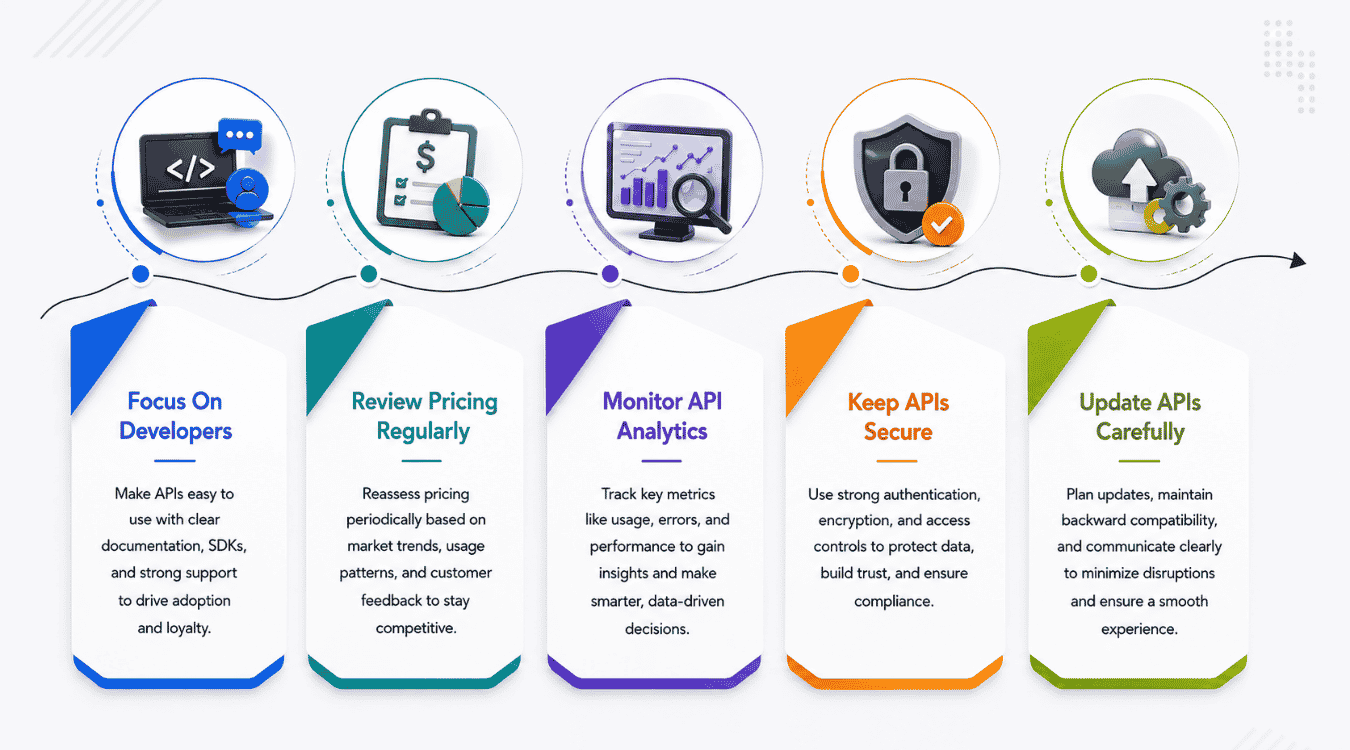
Getting your API monetization strategy live is one thing. Keeping it working long-term is another. Here's what separates teams that stay profitable from teams whose pricing quietly falls apart.
Focus On Developers
Developers are the ones actually using your API every day, so their experience shapes everything else. Good documentation, fast support, and fair pricing keep them building instead of looking elsewhere, as shown in many case studies of successful SaaS launch stories.
Cultivate a vibrant developer community to enhance engagement, since engaged developers become advocates who bring in new customers. Ignoring developer experience to squeeze out more revenue usually backfires, pushing your best api users toward a competitor with better support.
Review Pricing Regularly
Markets shift, and pricing strategies that worked last year might not work now. Set a regular schedule, quarterly works for most teams, to review your pricing model against actual usage and revenue data.
Competitors change their pricing, customer needs evolve, and your own costs shift too. Locking in one pricing model forever and never revisiting it is a common mistake. Regular reviews catch problems early, before churn or lost revenue forces a rushed fix.
Monitor API Analytics
Analytics tell you what's actually happening, not what you assume is happening. Track usage patterns, active developers, and revenue generated continuously, not just during scheduled reviews.
Good analytics provide valuable insights into which features drive the most usage and which pricing tiers are underperforming. Skipping this step means flying blind. Teams that check analytics regularly catch drop-offs and pricing mismatches long before they show up as a real revenue problem.
Keep APIs Secure
Security isn't a one-time setup step; it's ongoing work. New vulnerabilities show up constantly, and paying customers expect their data and access to stay protected the entire time they use your API.
Enterprise customers especially will walk away fast if a security issue hits. Continuously monitor and optimize API performance for success, and treat security monitoring as part of that same ongoing process, not a separate checkbox you handle once and forget.
Update APIs Carefully
Improving your API is necessary, but careless updates break things for paying customers. Version your API properly, give advance notice before changes, and avoid breaking existing integrations without warning.
Customers building production systems on your API need stability more than they need every new feature immediately. Rushed updates that break customer workflows damage trust fast, and trust is hard to rebuild once a paying customer gets burned by a surprise change.
Final Discussion
Getting API monetization right isn't about picking the trendiest pricing model and walking away. It takes real work: understanding your API's value, knowing your target users, and setting up billing that actually holds up as you scale.
Pricing keeps evolving too. Transaction-based pricing, which charges for completed business actions instead of just API calls, is gaining ground alongside token math for AI-heavy APIs. Staying rigid on one model while the market moves is how good APIs lose revenue quietly.
Treat your API monetization strategy as something you revisit, not something you set once. Watch the numbers, listen to developers, and adjust before problems show up in your revenue instead of after.


