
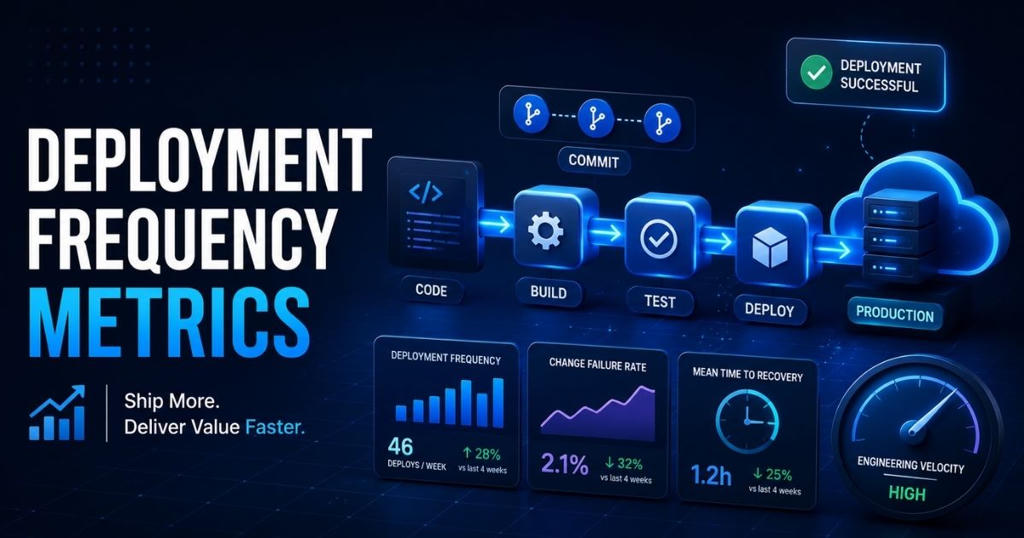
How To Improve Deployment Frequency Metrics: 7 Proven Ways
by Rhea Collins | Aug 6, 2026 | SaaS
Table of Contents
- What Deployment Frequency Metrics Mean
- How To Measure Deployment Frequency Metrics
- What Causes Low Deployment Frequency
- 7 Ways To Improve Deployment Frequency Metrics
- DevOps And CI/CD Best Practices For Faster, Safer Deployments
- How Software Architecture Impacts Deployment Frequency Metrics
- How Deployment Frequency Connects With Other DORA Metrics
- Common Deployment Frequency Mistakes And How To Avoid Them
- How GainHQ Helps Teams Deploy Faster
Most engineering teams know their deployment frequency metrics look weak. Few know exactly why, or what to fix first.
Deployment frequency measures how often code reaches production, and it's one of four key DORA metrics tracked across software delivery performance. According to the latest DORA research, elite teams deploy multiple times a day. Low performers deploy less than once a month. That gap rarely comes down to effort. It comes down to process.
Below, we'll break down what drives low deployment frequency, how to measure it accurately, and seven practical ways engineering teams can increase deployment frequency without sacrificing stability. Small, safe, frequent releases beat large, risky ones every time.
What Deployment Frequency Metrics Mean
Deployment frequency measures how often code changes reach a production environment. It tracks successful deployments over a set period, whether that's daily, weekly, or monthly. The metric shows how fast engineering teams can move code changes from development into the hands of real users.
Deployment frequency is one of four key DORA metrics used to evaluate software delivery performance. Development teams use it alongside lead time, failure rate, and recovery time to get a full picture of delivery health. On its own, it reflects speed. Paired with the other metrics, it reflects speed without cutting corners on stability, especially when teams use engineering KPIs to balance delivery and reliability.
Simply put, deployment frequency measures how often an organization successfully releases code to production, and how consistently it can keep doing so.
How To Measure Deployment Frequency Metrics
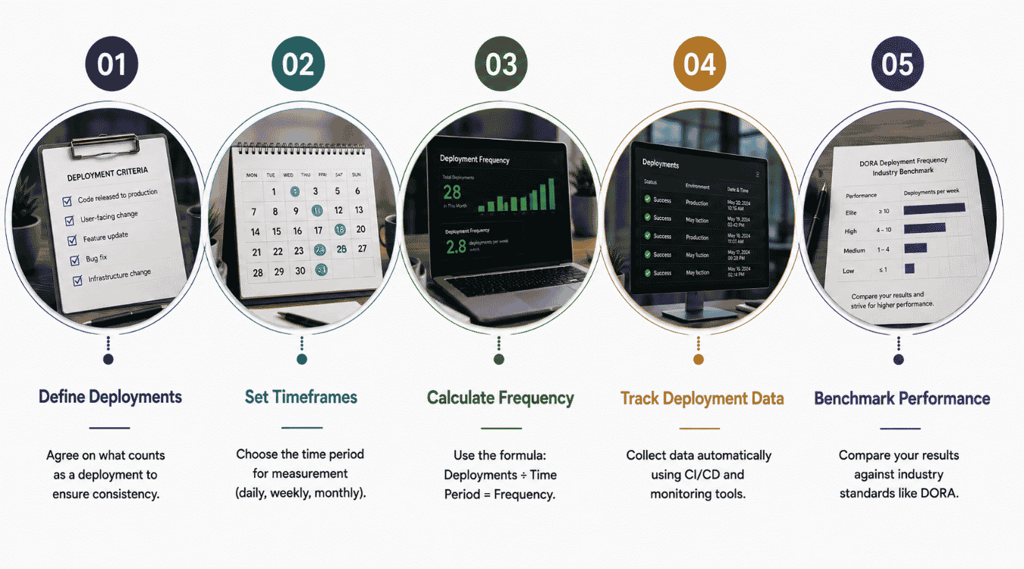
Measuring deployment frequency metrics takes more than counting releases. Teams need a clear definition, a consistent timeframe, and reliable deployment data to track deployment frequency accurately over time.
Define Deployments
Before you calculate deployment frequency, define what counts as a deployment. A deployment should mean a successful release to a production environment, not a push to staging or a test branch. Without this distinction, deployment data becomes unreliable fast.
Teams that skip this step often end up comparing different things across sprints. Clear definitions keep tracking deployment frequency consistent across development teams, projects, and tools.
Set Timeframes
Deployment frequency measures how often code ships within a set period, so choosing the right timeframe matters. Daily and weekly windows work well for teams deploying often. Monthly windows suit slower release cycles.
Consistent timeframes make it easier to spot trends and compare performance over time. Shifting the window mid-analysis distorts the numbers and makes benchmarking against other DORA metrics harder to trust.
Calculate Frequency
Calculating deployment frequency is simple in principle: count successful deployments and divide by the timeframe. A team deploying twenty times in a month averages roughly five deployments a week.
The real value comes from consistency. Teams that calculate deployment frequency the same way every cycle can track real trends instead of noise, and compare their numbers fairly against DORA metrics benchmarks.
Track Deployment Data
Most teams already have the tools needed to track deployment frequency. CI/CD pipelines, deployment logs, and the version control system all generate the deployment data required, often without extra setup.
Pulling this data automatically instead of manually saves time and reduces errors. Existing tools like GitHub, GitLab, and Jenkins can surface deployment frequency metrics directly, so teams spend less time tracking and more time improving.
Benchmark Performance
Once deployment frequency is tracked, teams need a benchmark. According to DORA and Google Cloud research, elite teams deploy multiple times a day. High performers deploy once a day to once a week.
Medium performers release once a week to once a month, while low performers deploy less than once a month. These four tiers give engineering leaders a clear reference point for where their team stands today.
What Causes Low Deployment Frequency
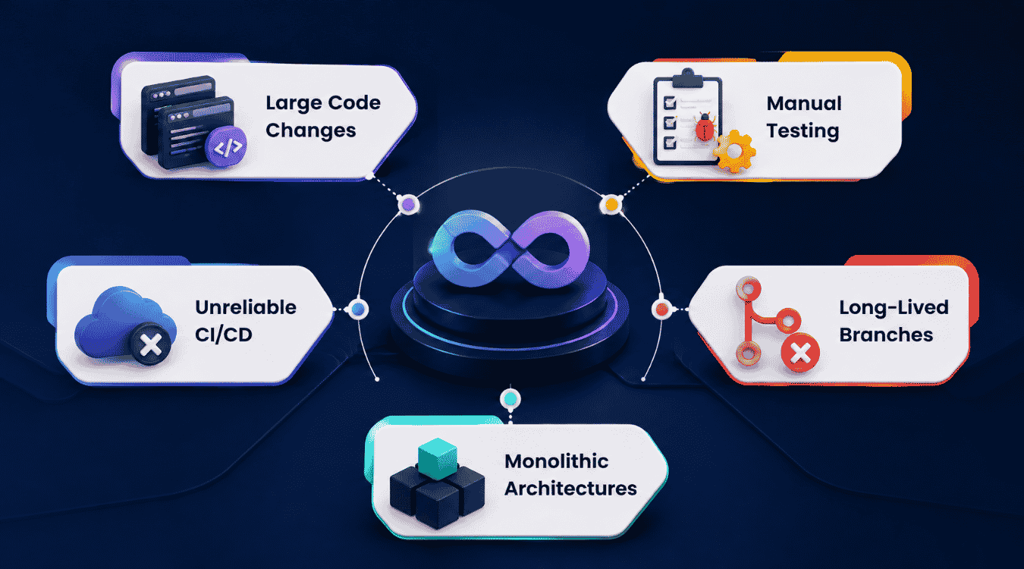
Low deployment frequency rarely comes from one issue alone. It usually stems from a mix of large code changes, weak automation, and outdated development processes that slow every release down.
Large Code Changes
Large code changes are one of the biggest blockers to frequent deployments. When development teams bundle weeks of work into a single release, testing takes longer and risk increases. Every deployment becomes a bigger event instead of a routine task.
Smaller deployments reduce complexity and make each release easier to validate. Breaking large code changes into incremental pieces helps teams increase deployment frequency without adding pressure to any single release.
Manual Testing
Manual testing slows down even well-intentioned engineering teams. When every code change requires human verification before it reaches a production environment, deployment frequency drops by default. Testing becomes a bottleneck instead of a safeguard.
Automated testing removes much of that friction. Teams that shift toward automated test suites can validate code changes faster and more consistently, which directly supports higher deployment frequency without sacrificing code quality.
Unreliable CI/CD
An unreliable CI/CD pipeline creates hesitation around every deployment. If builds fail unpredictably or pipelines break without warning, teams deploy less often just to avoid the disruption. Trust in the deployment pipeline matters as much as its speed.
Fixing flaky pipelines and adding robust monitoring helps rebuild that trust. A stable deployment pipeline gives engineering teams the confidence to deploy code more often, which is the foundation for improving deployment frequency metrics.
Long-Lived Branches
Long-lived branches quietly work against frequent deployments. The longer a branch stays separate from the main version control system, the harder merging becomes. Conflicts pile up, and each merge turns into its own risky event.
This pattern often traces back to a development process that avoids trunk-based development. Shorter-lived branches merged frequently reduce conflict and make it far easier to deploy code on a consistent, predictable schedule.
Monolithic Architectures
Monolithic architectures tie every feature together in one deployable unit. A small change in one part of the system often means redeploying the whole application, which naturally lowers deployment frequency across the team.
Breaking a monolith into smaller, loosely coupled services allows teams to deploy code independently. This architectural shift is often what separates teams stuck at monthly deployments from those releasing multiple times a day, and it closely mirrors the trade-offs between microservices vs monolith architecture that many SaaS products face.
7 Ways To Improve Deployment Frequency Metrics
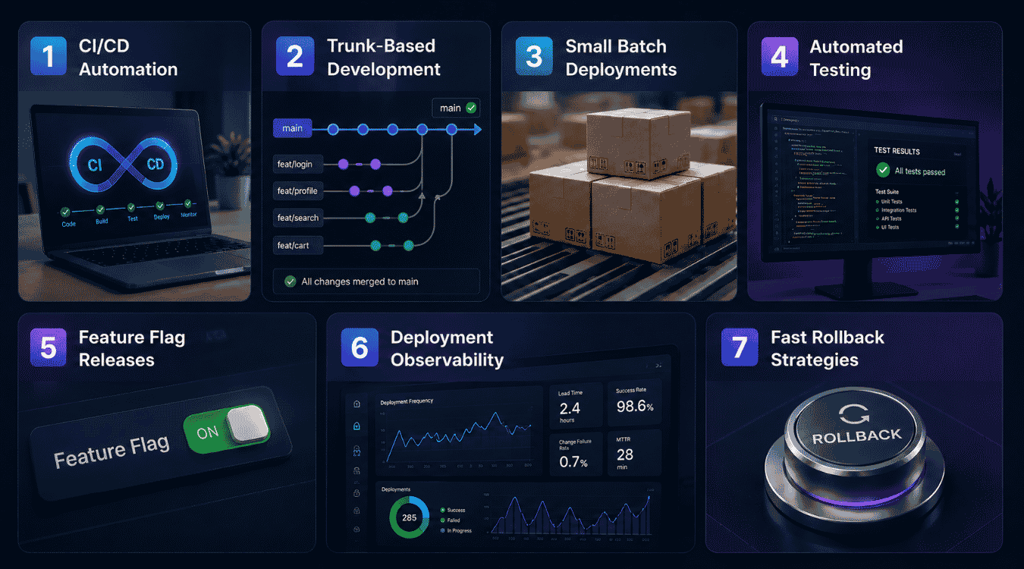
Improving deployment frequency metrics takes more than good intentions. These seven practices help engineering teams deploy code more often while protecting stability, code quality, and their team's ability to respond fast.
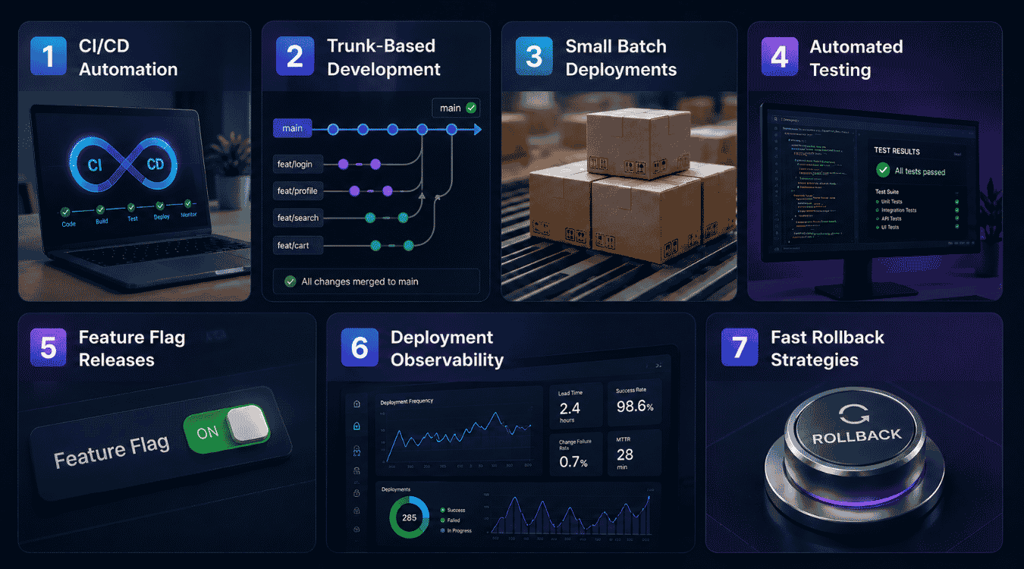
1. CI/CD Automation
CI/CD automation removes the manual steps that slow down every production deployment. When builds, tests, and releases run automatically, engineering teams spend less time on repetitive work and more time shipping code changes.
Automating the deployment pipeline also reduces human error, which is often the real cause behind failed deployments. Teams that invest in CI/CD automation typically see a steady rise in the number of deployments without added risk.
2. Trunk-Based Development
Trunk-based development keeps engineers merging small, frequent changes into a single shared branch instead of maintaining long-lived branches. This approach reduces merge conflicts and keeps the version control system easier to manage.
Shorter integration cycles mean code changes reach production deployment faster. Teams practicing trunk-based development often report more frequent deployments simply because there's less friction between writing code and shipping it.
3. Small Batch Deployments
Small batch deployments break large code changes into manageable pieces. Instead of shipping a month of work at once, teams release smaller updates continuously, which lowers risk with every single deployment event. This practice aligns with DevOps best practices for modern teams, where continuous integration and delivery keep changes small and frequent.
Smaller batches are also easier to test and review. If something breaks, the smaller scope makes it simple to isolate the issue, which supports both higher deployment frequency and stronger code quality.
4. Automated Testing
Automated testing validates code changes without waiting on manual QA cycles. This shift lets engineering teams move code through the deployment pipeline faster while still catching bugs before they reach users.
Strong test coverage builds confidence across the team. When automated testing consistently catches issues early, teams feel safer approving frequent deployments instead of second-guessing every release.
5. Feature Flag Releases
Feature flags decouple deployment from release, letting teams ship code to production without exposing new features to every user right away. This separation makes deployment frequency less risky by design.
Teams can roll new features out gradually, test with a smaller audience, and adjust before a full release. Feature flag releases give engineering teams more control while still supporting continuous delivery.
6. Deployment Observability
Deployment observability gives teams real-time visibility into what happens after code reaches production. Monitoring deployment events, error rates, and system health helps engineering teams catch problems before users notice them, and robust software observability for SaaS teams is critical as systems grow more distributed.
Strong observability also supports other DORA metrics, since faster detection often means faster time to restore. Robust monitoring turns every deployment into a source of useful data instead of a leap of faith.
7. Fast Rollback Strategies
Fast rollback strategies give teams a safety net when a deployment doesn't go as planned. Automated rollback capabilities let engineering teams quickly restore service instead of scrambling to patch issues live in production.
Knowing rollback is fast and reliable removes hesitation around shipping often. This confidence is often what finally lets teams drive continuous improvement in deployment frequency without fear of breaking things.
DevOps And CI/CD Best Practices For Faster, Safer Deployments
DevOps research keeps pointing to the same idea. Teams that implement DORA metrics and invest in automation improve their software delivery process without losing stability or speed.
Deployment Automation
Deployment automation takes manual steps out of every release. Engineering teams can ship code changes without waiting on someone to trigger each step by hand. That consistency is often what separates high-performing teams from the rest.
Setting up a new deployment pipeline takes some upfront work. But it pays off fast. Once automated, deployments repeat cleanly across multiple systems and multiple teams, and a team's deployment frequency starts climbing on its own.
Continuous Integration
Continuous integration means code changes merge into a shared branch often. Conflicts and bugs get caught early instead of piling up. Small, frequent merges support good deployment frequency because every change stays easy to verify.
Frequent integration also shortens lead time for changes, since code doesn't sit around unmerged. Teams that stick with continuous integration move code changes through software development faster, with fewer surprises along the way.
Automated Testing
Automated testing checks every code change before it reaches production. Manual review time drops, and releases stop stalling on QA. High-performing teams treat this as one of the key metrics behind reliable delivery.
Strong test coverage means teams trust their changes are successfully deployed without new bugs slipping through. Pair automated testing with continuous integration, and the whole pipeline moves faster without cutting corners.
Deployment Monitoring
Deployment monitoring tracks what happens right after code reaches production. Engineering teams get real-time visibility into performance, errors, and system health. Good monitoring also cuts failed deployment recovery time down significantly.
When something breaks, teams quickly spot the issue and respond before users notice. Strong monitoring feeds into other engineering metrics too, since faster detection supports better DORA metrics benchmarks overall.
Infrastructure As Code
Infrastructure as code means environments get defined through version-controlled configuration instead of manual setup. Development, staging, and production stay consistent, and separate deployment stages cause fewer errors.
Since infrastructure changes get tracked and repeated, teams can spin up or update multiple systems reliably. That consistency removes a common source of deployment failures and keeps deployment frequency benchmarks steady across projects.
How Software Architecture Impacts Deployment Frequency Metrics
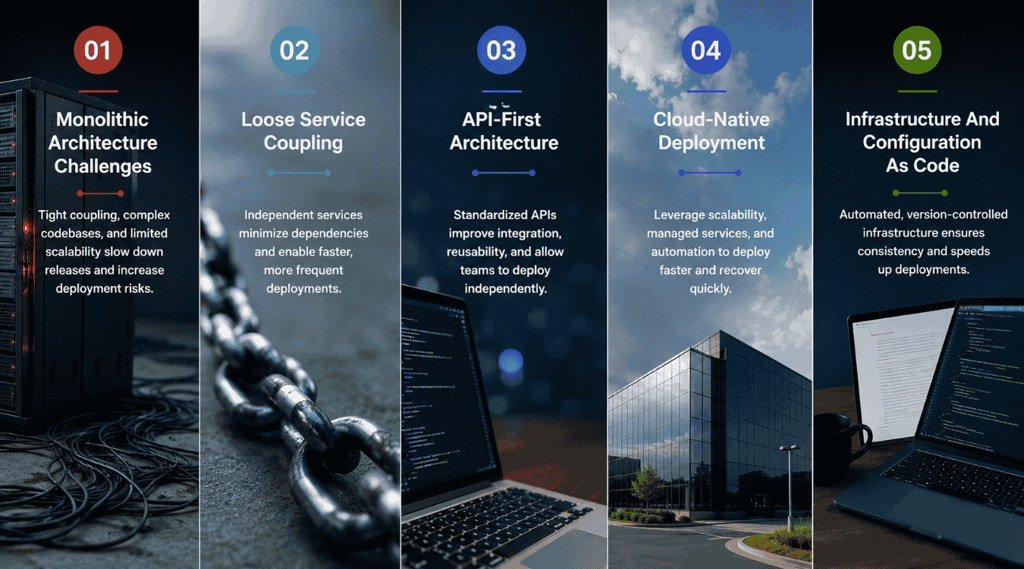
Architecture shapes how often teams can deploy code, sometimes more than any process change. The way systems get built either supports frequent releases or quietly blocks them at every turn.
Monolithic Architecture Challenges
Monolithic systems bundle every feature into one deployable unit. A small fix in one area often means redeploying the whole application, which slows down the entire release cycle.
Teams stuck with a monolith tend to batch changes together to reduce the number of risky deployments. Over time, that habit drags deployment frequency down and makes every release feel like a bigger event than it needs to be.
Loose Service Coupling
Loosely coupled services let teams deploy one part of the system without touching the rest. A change to the billing service, for example, doesn't require redeploying the entire application.
This setup gives engineering teams more freedom to ship independently. Multiple teams can work on multiple systems at the same time, each shipping on its own schedule instead of waiting on a shared release train.
API-First Architecture
API-first architecture separates services behind clear contracts, so teams can update one service without breaking others. Changes stay isolated, and testing gets simpler since each API can be verified on its own.
Teams building this way tend to see steadier deployment frequency benchmarks over time. Since services don't depend heavily on each other, code changes move through the software delivery process with far less coordination overhead, which is one of the key API-first architecture benefits.
Cloud-Native Deployment
Cloud-native deployment relies on containers and orchestration tools to spin up, scale, and update services quickly. Deployments become smaller, faster events instead of major undertakings, especially when teams follow a structured cloud native development guide to design for automation and scalability from day one.
Teams get more flexibility to test in production-like environments before a full rollout. Combined with good deployment frequency practices, cloud-native setups make it easier to track multiple metrics across environments without added manual work.
Infrastructure And Configuration As Code
Defining infrastructure and configuration through code keeps environments consistent everywhere. Development, staging, and production all match, so surprises during deployment drop off fast.
Teams can version, review, and roll back configuration just like application code. That level of control supports four key metrics tracked in DORA, since consistent environments make deployments, recovery, and lead time far easier to measure accurately and fit naturally into a well-defined software development life cycle.
How Deployment Frequency Connects With Other DORA Metrics
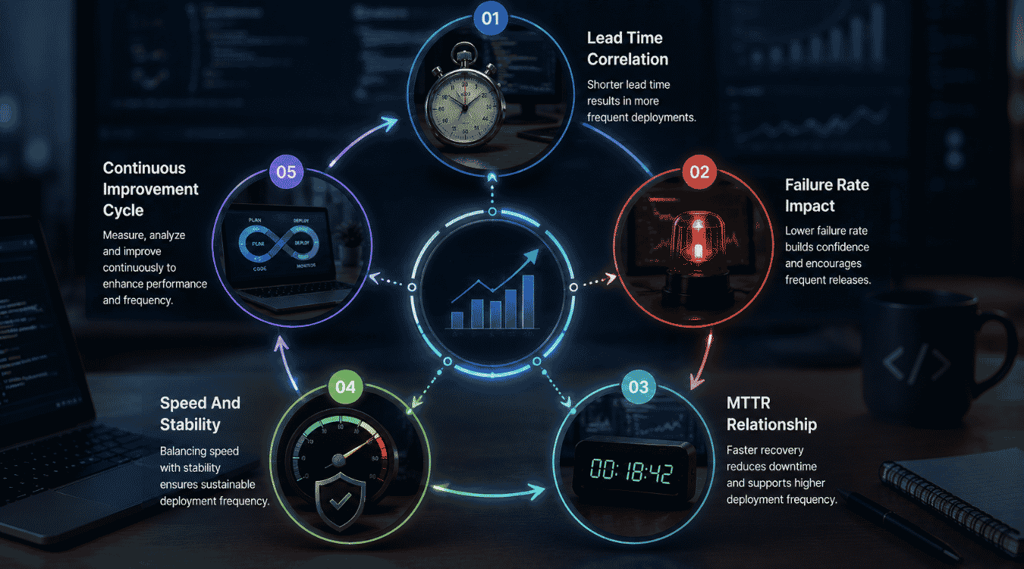
Deployment frequency rarely moves on its own. Push it up or down, and the other three DORA metrics tend to shift right along with it, for better or worse.
Lead Time Correlation
Higher deployment frequency usually means shorter lead time for changes. Smaller, more frequent releases spend less time waiting in a queue, so code reaches production faster after it's written.
The relationship works both ways too. Teams that shorten lead time often find deployment frequency rises naturally, since code isn't sitting around unmerged or waiting on a big batch release.
Failure Rate Impact
Pushing deployment frequency up without the right safeguards can backfire. Bigger releases done more often, without smaller batches or automated testing, tend to raise the failure rate instead of lowering it.
Done right, though, frequent deployments actually reduce failure rate. Smaller changes are easier to test and easier to catch problems in before they reach users, so more deployments don't have to mean more risk.
MTTR Relationship
Teams that deploy frequently often recover faster from incidents. Smaller changes are easier to isolate, so pinpointing what broke takes less time, and failed deployment recovery time drops as a result.
Fast rollback strategies and strong deployment monitoring help here too. When a rollback takes minutes instead of hours, deployment frequency stays high because teams aren't afraid of the fallout from a bad release.
Speed And Stability
Speed and stability aren't opposites, even though it can feel that way. Chasing deployment frequency alone, without watching failure rate or recovery time, just trades one problem for another.
High-performing teams balance all four key metrics together instead of optimizing one in isolation. Speed backed by stability is what separates sustainable deployment frequency from a number that looks good but breaks under pressure.
Continuous Improvement Cycle
Tracking deployment frequency alongside the other DORA metrics creates a feedback loop. Teams see where releases slow down, fix the bottleneck, and measure again to confirm it worked.
Over time, this cycle drives continuous improvement across the whole software delivery process. Small, steady gains in deployment frequency, lead time, failure rate, and recovery time compound into real, lasting performance improvements.
Common Deployment Frequency Mistakes And How To Avoid Them
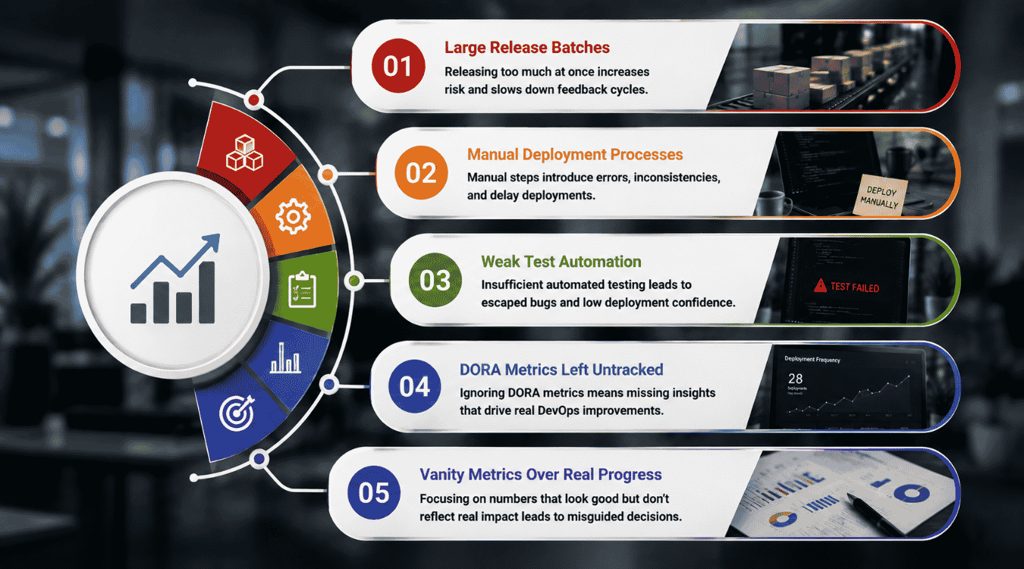
Improving deployment frequency metrics comes with a few common traps. Most teams don't hit these on purpose, but they quietly cancel out progress if left unchecked.
Large Release Batches
Bundling weeks of code changes into one release feels efficient, but it backfires fast. Bigger batches mean more testing, more risk, and more things that can break at once.
Breaking work into smaller pieces takes discipline early on. Once teams get used to shipping smaller batches, deployment frequency rises naturally, and each release stops feeling like a high-stakes event.
Manual Deployment Processes
Manual steps slow down every release, even simple ones. If someone has to trigger builds, run checks, or push code by hand, deployment frequency stays capped no matter how good the team is.
Automating the deployment pipeline removes this bottleneck for good. Once the process runs on its own, teams stop losing time to repetitive tasks and start shipping code changes on a much tighter schedule, especially when partnering with a capable full-stack web development company that can design and maintain end-to-end automation.
Weak Test Automation
Skipping automated testing puts pressure on manual QA, and that pressure slows everything down. Teams end up choosing between shipping fast and shipping safely, which shouldn't be a tradeoff at all.
Solid test coverage removes that choice. Strong automated testing catches issues early, so teams can deploy more often without gambling on code quality every time a release goes out.
DORA Metrics Left Untracked
Some teams track deployment frequency in isolation and skip the rest of DORA metrics entirely. That's a mistake, since lead time, failure rate, and recovery time all tell part of the same story.
Teams that implement DORA metrics together get a fuller picture. Watching all four key metrics side by side keeps deployment frequency gains honest instead of hiding problems building up elsewhere.
Vanity Metrics Over Real Progress
Deploying often looks good on a dashboard, but numbers alone don't mean much. A high deployment count paired with rising failure rates isn't progress, it's just risk dressed up as speed.
Real improvement means watching deployment frequency alongside stability metrics, not instead of them. Teams that avoid chasing vanity metrics build lasting gains instead of numbers that fall apart under real production pressure.
How GainHQ Helps Teams Deploy Faster
At GainHQ, we work with engineering teams that want to ship code more often without sacrificing stability. Our custom software development services include setting up CI/CD pipelines, automating testing, and restructuring deployment processes so releases stop feeling risky.
We also help teams move away from monolithic setups that slow deployment frequency down. Whether that means breaking systems into loosely coupled services or introducing feature flags for safer rollouts, our engineers build with long-term delivery speed in mind, not just a quick fix, drawing on the broader capabilities of our flexible custom software solutions.
If your team is stuck deploying monthly and wants to move toward daily releases, GainHQ can help design a deployment pipeline built for continuous improvement from day one, often as part of building custom software solutions that fit your exact workflows.