Nearshore Software Development Teams: Benefits, Costs And Hiring
by Daniel Wright | Sep 10, 2026 | Software Development Insights
Table of Contents
- What Are Nearshore Software Development Teams?
- Nearshore Vs Offshore Vs Onshore Development Teams
- Benefits Of Nearshore Software Development Teams
- How Much Do Nearshore Software Development Teams Cost
- How To Build The Right Nearshore Development Team
- How To Hire A Nearshore Software Development Team
- How To Manage A Nearshore Software Development Team
- How To Measure, Scale And Improve Your Nearshore Team
- Final Discussion
Software teams need to ship faster, but hiring enough skilled developers at home can get expensive and slow. Offshore outsourcing may cut costs, yet large time zone gaps can make daily collaboration harder. Nearshore software development teams offer another option: skilled talent in nearby countries that can work closely with your in-house team.
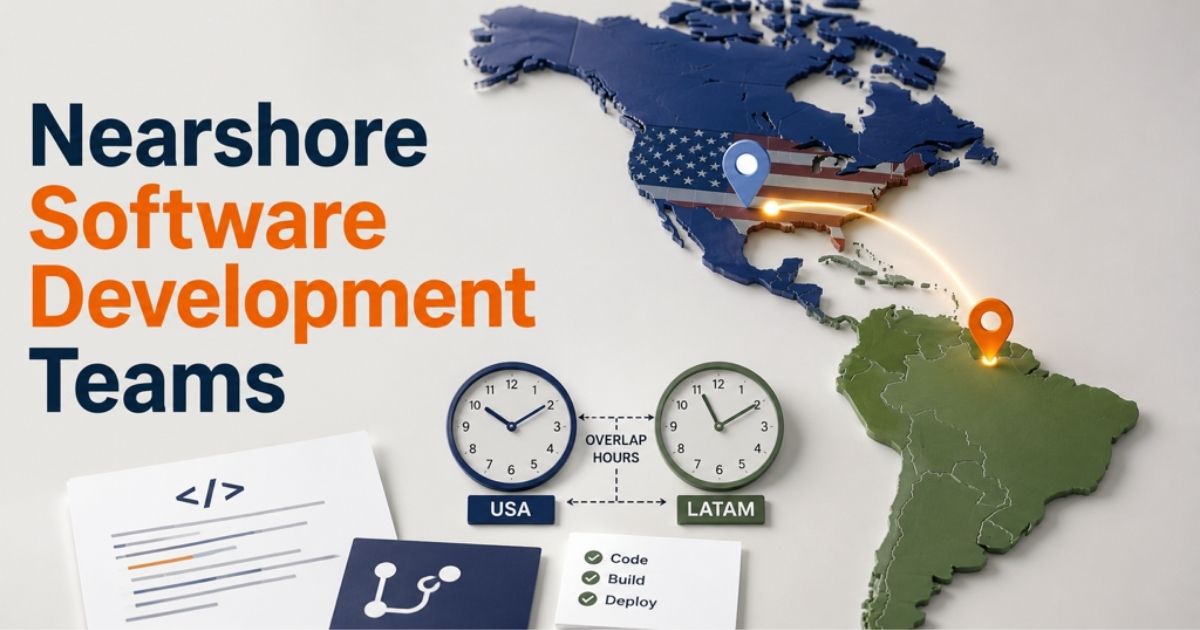
For U.S. companies, nearshore software development often means working with developers across Latin America. Many locations provide substantial overlap with U.S. business hours, which supports live standups, quick feedback, and Agile workflows. Nearshore talent also typically costs less than comparable U.S. hiring.
But cost and location are only part of the decision. You also need the right team structure, hiring model, management process, and partner. This guide explains how to build a nearshore team that actually works.
What Are Nearshore Software Development Teams?
Nearshore software development teams are groups of software engineers based in nearby countries that work with your in-house team or handle part of a software development project. The nearshore software development model combines outsourcing with geographic and time zone proximity. For U.S. companies, nearshore development commonly means working with engineering teams across Latin America.
Unlike traditional offshore outsourcing, nearshore teams usually share much of the same workday with the client. That time zone alignment makes real-time collaboration much easier. Developers can join daily standups, review code, solve blockers, and discuss product changes without waiting until the next day.
Companies use nearshore software development outsourcing to access skilled talent, expand engineering capacity, and support development without relying only on local hiring.
Nearshore Vs Offshore Vs Onshore Development Teams
Nearshore, offshore, and onshore software development all give companies access to external engineering talent. The main differences are location, cost, time zone overlap, and how teams collaborate. Nearshore sits between the other two models, offering lower costs than onshore development while keeping more real-time collaboration than many offshore models.
Factor | Nearshore | Offshore | Onshore |
|---|---|---|---|
Location | Nearby countries | Distant countries | Same country |
Development Cost | Moderate | Usually lowest | Highest |
Time Zone Overlap | High | Usually lower | Full |
Real-Time Collaboration | Easy | More limited | Easiest |
Talent Pool | Large regional pool | Largest global pool | Local talent pool |
Cultural Alignment | Generally high | Varies by region | Usually highest |
Travel | Relatively easy | More difficult | Easiest |
Best Fit | Agile, collaborative projects | Cost-focused or async work | High-control or regulated work |
For U.S. companies, nearshore software development often means working with teams in Latin America. Current comparisons commonly report around 4–8 hours of working-day overlap, which makes daily standups, code reviews, and quick decisions easier. Offshore software development can provide a broader talent pool and lower hourly rates, but larger time differences often require stronger asynchronous development processes.
Onshore software development offers the closest communication and legal alignment, but it usually comes at the highest cost. Nearshore outsourcing offers a middle ground for companies that want cost efficiency without giving up much of the shared workday. The right outsourcing model ultimately depends on your budget, project needs, engineering capacity, and how much real-time collaboration your development team requires.
Benefits Of Nearshore Software Development Teams
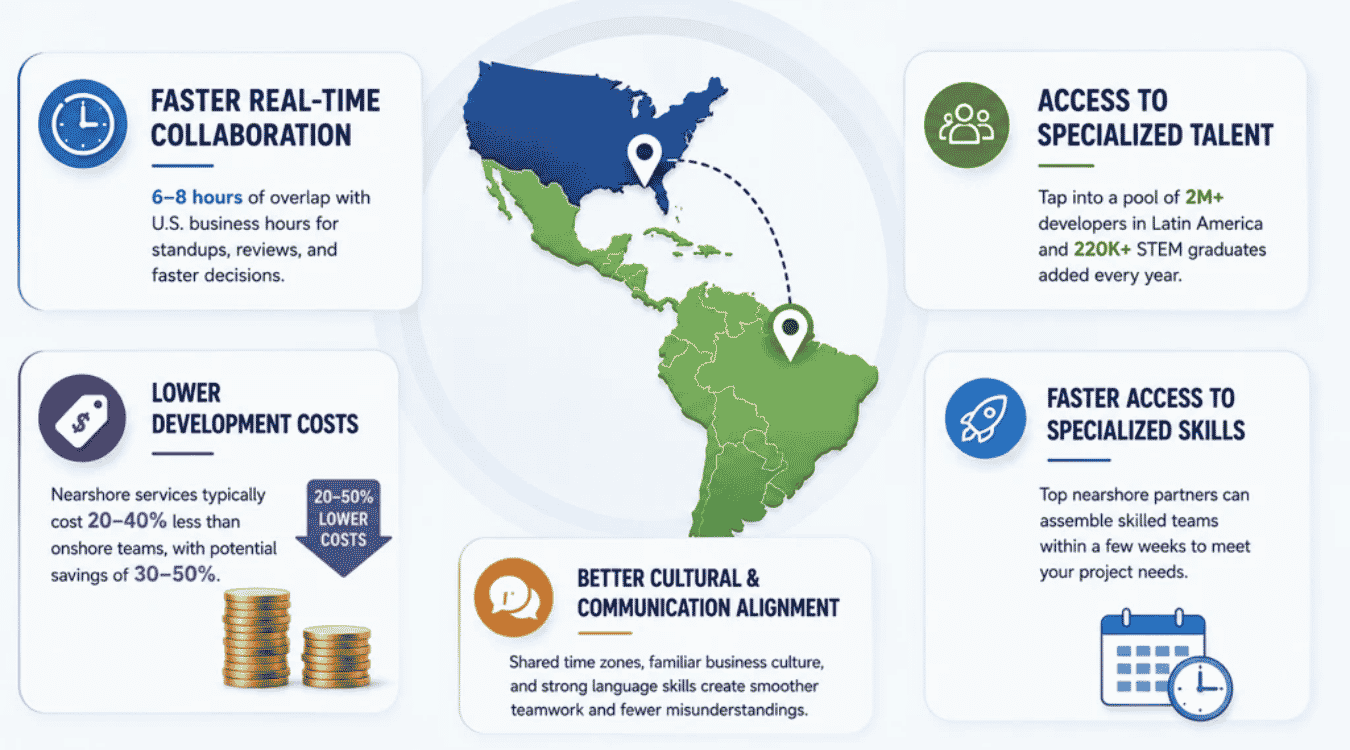
Nearshore software development teams give companies more than lower hiring costs. The model combines skilled talent, nearby time zones, and easier communication. For companies that need to scale engineering capacity, those advantages can make software projects easier to run, especially when paired with strong engineering team management practices.
Faster Real-Time Collaboration
Time zone alignment is one of the clearest benefits of nearshore development. Improving reports that nearshore teams can maintain 6–8 hours of overlap with U.S. business hours. That gives developers enough shared time for daily standups, sprint reviews, code reviews, and quick decisions.
That overlap matters when a software development project moves fast. A blocked developer can ask a question and get an answer the same day. Teams can solve bugs together instead of waiting overnight. Real-time collaboration also fits Agile workflows better than an outsourcing model built around long asynchronous handoffs.
Lower Development Costs
Nearshore software development can lower engineering costs without pushing work to distant countries. Improving reports that nearshore services typically cost 20–40% less than comparable onshore teams. BairesDev puts its own nearshore savings at 30–50% below U.S. rates. Actual savings depend on location, seniority, and engagement model.
Nearshoring is not always the cheapest outsourcing option. Offshore software development may offer lower hourly rates. The value comes from balancing cost savings with shared work hours and easier communication. Companies should compare total delivery costs rather than developer rates alone.
Access To Specialized Talent
Local hiring can limit a company to the engineers available in one city or country. Nearshore outsourcing opens a much broader talent pool. Latin America alone has more than 2 million software developers, according to a 2026 Coderio analysis. The region also adds more than 220,000 STEM graduates each year.
That scale helps companies find skilled developers for cloud, AI, DevOps, mobile, and web development, including modern AI software development. Nearshore software development companies can also provide senior engineers for specific technical gaps. An in-house team can add that expertise without rebuilding the entire development team.
Better Cultural And Communication Alignment
Shared hours help, but good teamwork also depends on how people communicate. Nearshore developers often have experience with U.S. business culture, Agile methods, Scrum, and DevOps. That familiarity can make project management and daily conversations feel more natural.
Language skills still vary by country and developer, so cultural compatibility should never be assumed. A nearshore development partner should test communication skills during hiring. Strong cultural alignment can reduce misunderstandings, speed up decisions, and help distributed teams work as one engineering team.
Faster Access To Specialized Skills
A company may need a DevOps engineer today and an AI specialist next month. Local recruitment can take time, especially for senior or niche roles. Nearshore development companies maintain regional talent networks that can make those searches faster. Improving says top providers can often assemble skilled nearshore teams within a few weeks.
That flexibility helps companies expand development capabilities without making every role a permanent local hire. Teams can add technical expertise for a product launch, digital transformation project, or ongoing support. The result is more flexible engineering capacity without lowering the hiring bar.
How Much Do Nearshore Software Development Teams Cost
Nearshore software development teams usually cost less than comparable U.S. teams but more than low-cost offshore teams. Published 2026 rates vary widely, so budget by seniority, country, engagement model, and total delivery cost rather than one average hourly rate, similar to how you would estimate overall custom software development cost and pricing factors.
Cost By Developer Seniority
Seniority has a major effect on nearshore software development costs. Current LATAM benchmarks put mid-level developers around $30–$55 per hour. Senior developers often cost $45–$80, while leads and architects can reach $60–$100 or more.
Developer Level | Typical 2026 Rate |
|---|---|
Mid-Level | $30–$55/hr |
Senior | $45–$80/hr |
Lead / Architect | $60–$100+/hr |
Specialized skills can raise the price. AI, DevOps, cloud, data, and security engineers often sit above general software development rates. Match seniority to the work instead of filling every position with the most expensive talent.
Cost By Country
Nearshore rates also vary across Latin America. Mexico and Brazil often sit toward the higher end of the market, while Colombia and Argentina can offer lower rates. Local demand, English fluency, seniority, and technical expertise all affect the final price.
Country | Senior Developer Rate |
|---|---|
Colombia | $40–$65/hr |
Argentina | $38–$62/hr |
Brazil | $42–$68/hr |
Mexico | $45–$70/hr |
Costa Rica | $48–$72/hr |
Country alone should not decide where you hire. US companies should also compare time zone overlap, talent depth, communication, and development capabilities. A slightly higher rate may offer better value if the team needs less oversight and delivers faster.
Cost By Engagement Model
The engagement model changes both cost and responsibility. Staff augmentation adds individual nearshore developers to your existing team. Dedicated teams include more roles and ownership. Project outsourcing can also include management, QA, planning, and full delivery responsibility, and each option aligns with different software development pricing models and cost structures.
Model | Typical Cost Structure |
|---|---|
Staff Augmentation | Per developer/hour or month |
Dedicated Team | Monthly team cost |
Project Outsourcing | Fixed, capped, or hourly |
3–4 Person Squad | About $25K–$45K/month |
A focused three-to-four-person nearshore team may cost around $25,000–$45,000 per month based on one current market estimate. Compare what each quote includes before choosing the cheapest number.
Hidden Costs Beyond Rates
The quoted hourly rate is not the full cost of nearshore software outsourcing. Your budget may also include onboarding, internal management, tools, compliance, developer replacement, and lost productivity during team changes, as well as other software development hidden costs.
Hidden Cost | What It Covers |
|---|---|
Onboarding | Setup and ramp-up time |
Management | Internal leadership time |
Tools | Software and infrastructure |
Compliance | Legal and security work |
Replacement | Hiring and lost productivity |
ParallelStaff estimates that hourly rates account for about 65–75% of total nearshore spending, with onboarding, management, and tooling making up the rest. Another 2026 analysis puts total cost at roughly 1.15–1.30 times nominal hourly cost.
Nearshore Vs Other Models
Nearshore sits between onshore and offshore on price. Current 2026 comparisons place senior U.S. developers around $150–$200 per hour, nearshore developers around $55–$85, and offshore developers around $40–$70, a pattern that also appears in broader SaaS development cost benchmarks.
Model | Senior Developer Rate |
|---|---|
U.S. Onshore | $150–$200/hr |
LATAM Nearshore | $55–$85/hr |
Offshore | $40–$70/hr |
Offshore outsourcing may offer lower headline rates. Nearshore development trades some of that savings for stronger time zone overlap and real-time collaboration. Current benchmarks commonly place nearshore costs around 40–60% below comparable U.S. onshore rates. The better comparison is total cost per delivered outcome, not just hourly price.
How To Build The Right Nearshore Development Team
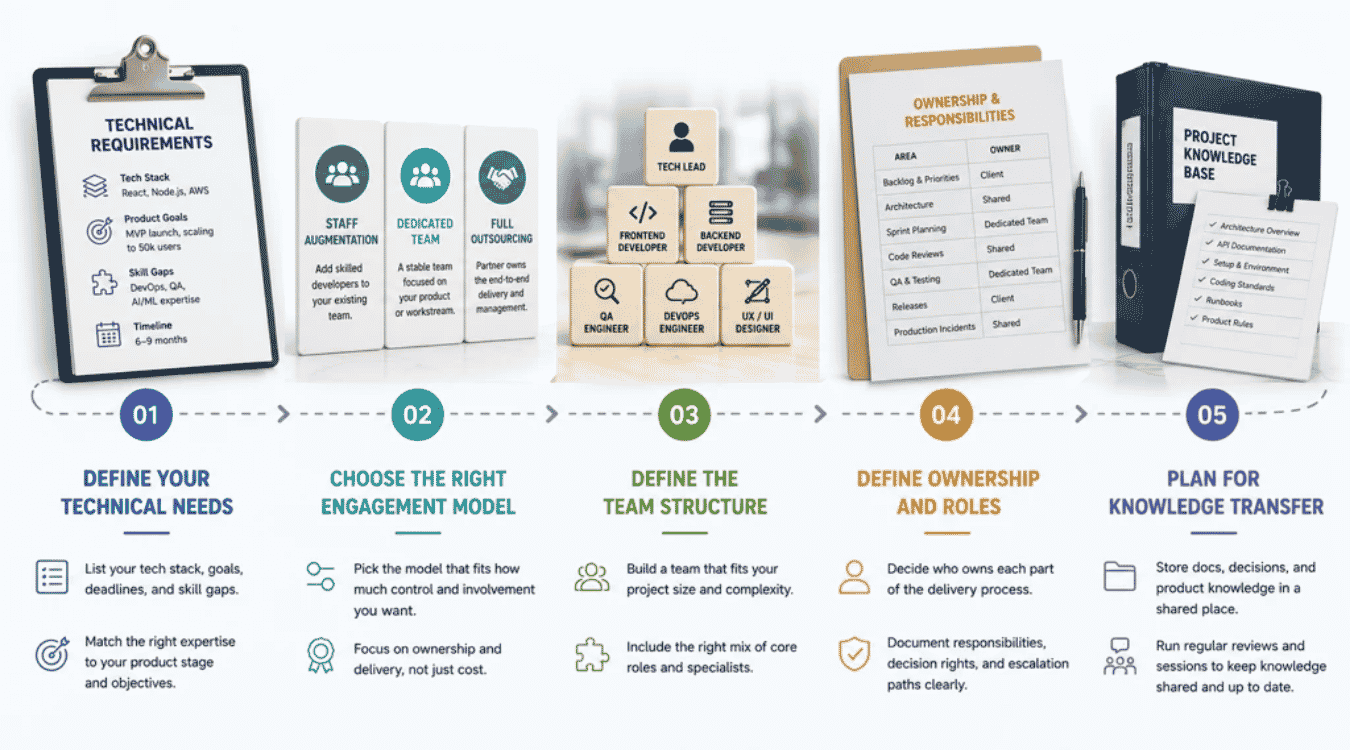
A strong nearshore team starts with clear decisions before anyone writes code. You need the right skills, team structure, ownership, and delivery model. Those choices help nearshore developers work as part of your engineering team instead of a separate vendor.
Define Your Technical Needs
Start with the work your development team needs to deliver. List your tech stack, product goals, deadlines, and current skill gaps. Decide whether you need web development, cloud, DevOps, QA, AI, or other technical expertise.
Your product stage matters too. An MVP may need flexible full-stack developers, while a complex platform may require senior engineers with deeper industry expertise. BairesDev says its nearshore talent pool covers more than 100 technologies, which shows how broad provider capabilities can be. Clear requirements make it easier to hire nearshore software developers who fit the actual work.
Choose The Right Engagement Model
The nearshore software development model should match how much control your in-house team wants. Staff augmentation works well when you already have project managers and technical leaders. Nearshore developers simply join your existing development processes, much like other outsourced software development engagement models.
Dedicated teams make more sense when you need a stable group to own a product or workstream. Full software development outsourcing gives the partner even more responsibility across the development cycle. BairesDev offers all three models, while current industry guidance also separates them by management responsibility and project ownership, similar to broader in-house vs outsourcing software development. Pick based on ownership, not just price.
Define The Team Structure
Team structure should follow the project, not a fixed template. A small MVP team may have three to five people. A growth-stage product team often needs five to eight. Larger modernization projects may require eight to twelve or more, according to 2026 team-structure data from ParallelStaff and other scaling engineering team strategy.
Most nearshore development teams include a tech lead, frontend and backend developers, and QA. DevOps, cloud, UX, or security specialists can join when needed. Smaller engineering teams can combine roles. Larger software projects usually need clearer specialization to keep quality and delivery on track.
Define Ownership And Roles
Clear ownership prevents work from getting stuck between your company and the nearshore development partner. Decide who owns the backlog, architecture, sprint planning, code reviews, QA, releases, and production incidents before development starts.
The answer also depends on your engagement model. With staff augmentation, the client usually manages daily priorities and project ownership. A dedicated team can take more responsibility for sprint planning and delivery. Write those responsibilities down. Every engineer and project manager should know who can make a decision, who approves work, and who handles problems when they appear.
Plan For Knowledge Transfer
Knowledge should never live with one developer or only with the nearshore company. Store technical decisions, architecture notes, setup steps, runbooks, and product rules where both nearshore and in-house teams can reach them.
Shared knowledge becomes even more important as engineering capacity grows. Coderio notes that larger nearshore engagements need clear team boundaries, ownership domains, shared standards, and governance to maintain delivery stability. Regular code reviews and cross-team sessions also spread product knowledge. That makes onboarding easier and reduces disruption if a developer changes roles or leaves.
How To Hire A Nearshore Software Development Team
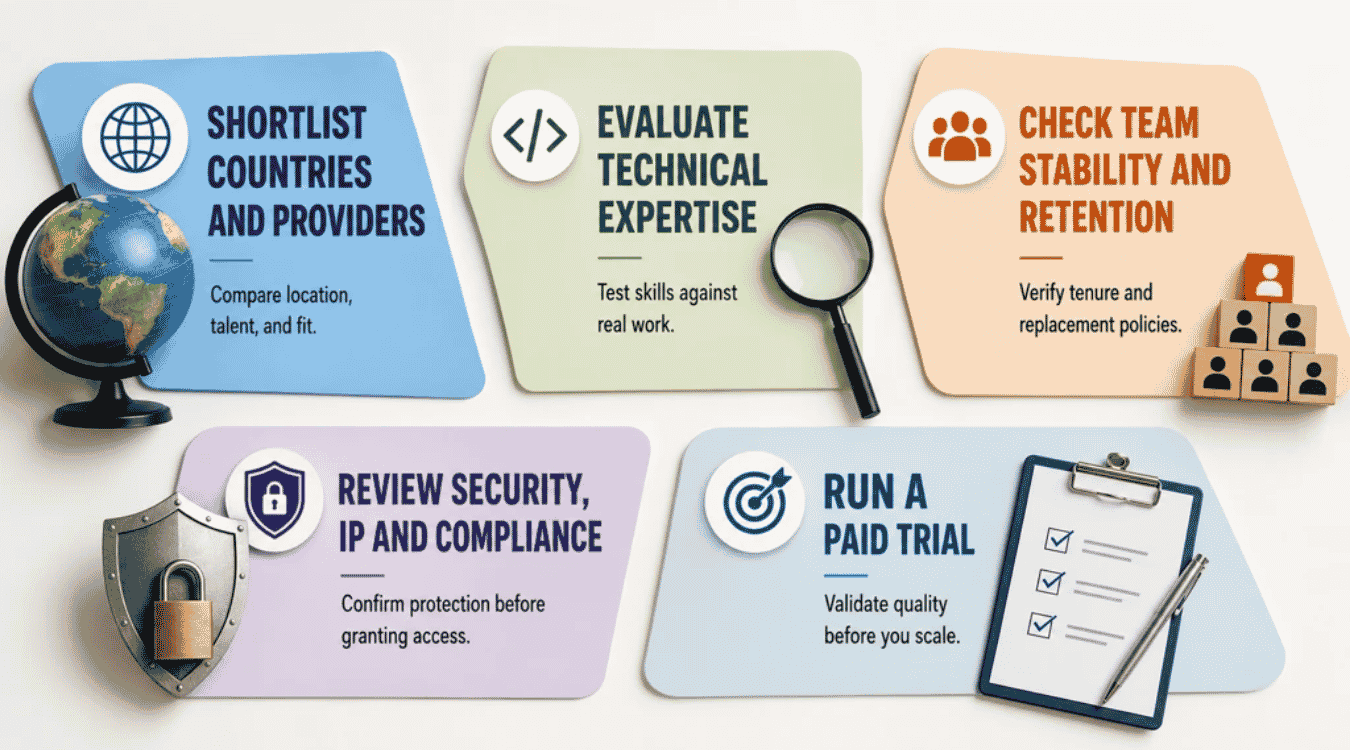
The right nearshore team should fit your product, work style, and long-term goals. Price matters, but it should not drive the whole decision. Look at talent quality, communication, retention, security, and how the partner handles real software projects, just as you would when weighing hiring developers vs outsourcing models.
Shortlist Countries And Providers
Start with countries that match your working hours and technical needs. For U.S. companies, Mexico, Brazil, Colombia, and Argentina are major nearshore development markets. Brazil, Colombia, and Argentina account for 58% of placements reported by Hire With Near, while Mexico remains another key market, while other regions support broader offshore software development strategies.
Don't choose a location on price alone. Compare time zone overlap, English skills, talent depth, legal rules, and technical specialties. Then review nearshore software development companies within those markets. The right nearshore company should have relevant industry expertise and a clear hiring process.
Evaluate Technical Expertise
Treat nearshore developers like candidates for your in-house team. Review real project experience, technical depth, and knowledge of your stack. Ask senior engineers to explain past architecture choices and how they solved difficult software engineering problems.
Technical tests should match the actual role. A backend developer might review an API design, while a DevOps candidate might solve an infrastructure problem. Revelo recommends a vetting process that checks technical skills, English proficiency, and background before hiring. Also test how candidates explain decisions. Strong technical expertise matters more when developers can communicate it clearly and can work effectively with your chosen tech stack aligned to 2026 product goals.
Check Team Stability And Retention
A skilled developer adds little value if they leave after a few months. Ask each nearshore development partner about turnover, average tenure, replacement policies, and how often engineers move between client accounts. Also ask who keeps the project knowledge when someone leaves.
Team stability becomes more important for long software projects. Frequent replacements create new onboarding work and can slow development. First Factory also recommends evaluating nearshore providers for accountability and retention instead of chasing the lowest hourly rate. Stable dedicated teams keep product knowledge longer and build stronger working relationships with your existing engineering teams.
Review Security, IP And Compliance
Security checks should happen before developers receive access to your code or data. Review how the provider handles identity access, devices, credentials, backups, and employee departures. Ask for evidence of security controls instead of accepting a simple promise.
Contracts also need clear rules for source-code ownership, confidentiality, IP transfer, and data protection. Relevant certifications may include ISO 27001 or SOC 2, while GDPR applies when the engagement involves covered personal data. Current partner-evaluation guidance treats security, compliance, and IP protection as separate checks alongside technical capability. Your requirements should match your industry and software project.
Run A Paid Trial
Interviews tell you what a nearshore developer knows. A small paid trial shows you how that person actually works. Choose a task that reflects the real project but does not expose sensitive production systems.
Watch more than the final code. Check communication, problem-solving, code quality, documentation, feedback response, and delivery speed. Current 2026 hiring guidance recommends paid trial tasks or pair sessions because they reveal practical delivery skills better than CV keyword checks alone. Start with a limited scope and clear success criteria. Scale the nearshore engagement only after the team proves it can deliver.
How To Manage A Nearshore Software Development Team
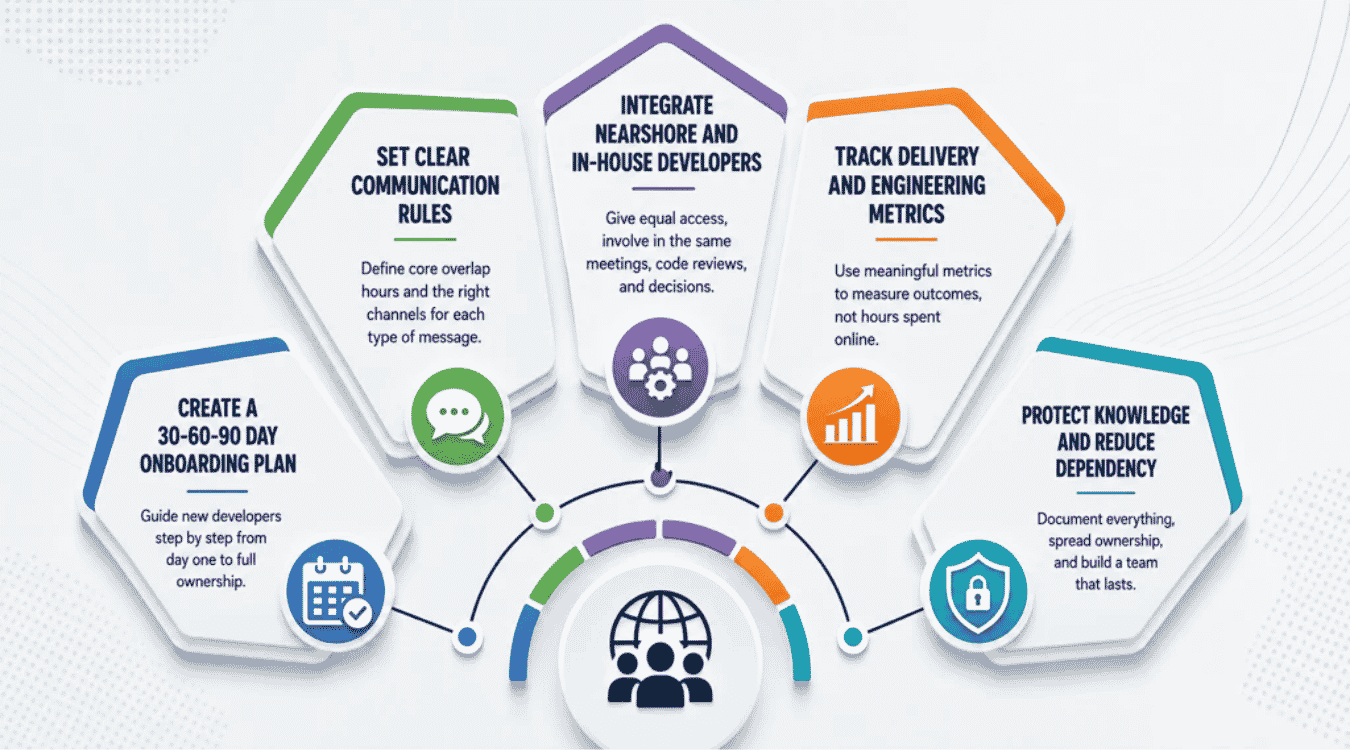
Good management turns nearshore software development teams into part of your wider engineering team. Clear onboarding, shared work hours, simple communication rules, and useful metrics matter. The goal is to create one team, not two groups separated by location, following proven remote engineering team management best practices.
Create A 30-60-90 Day Onboarding Plan
Give new nearshore developers a clear path from day one. The first 30 days should cover product goals, codebase access, tools, security, and development processes. Assign small real tasks so developers can learn the system without too much risk. Current nearshore guidance also recommends structured first-month onboarding rather than leaving new hires to figure things out alone.
Days 31–60 can add more ownership and harder work. By days 61–90, developers should handle normal sprint tasks with less help. Use that point to review performance, gaps, and next steps.
Set Clear Communication Rules
Time zone overlap only helps when teams use it well. Set core hours when everyone is available for standups, code reviews, planning, and urgent questions. Save deep work for the rest of the day. Recent nearshore guidance recommends reserving shared hours for work that truly needs live discussion.
Keep communication simple. Decide which tool handles quick questions, project updates, technical decisions, and urgent issues. Write down key decisions after meetings. Clear rules help distributed teams stay aligned without filling every shared hour with calls.
Integrate Nearshore And In-House Developers
Treat nearshore developers as part of the development team, not as people who only receive tickets. Give them access to the same repositories, relevant meetings, documentation, and product context as your in-house team. Current 2026 guidance recommends the same standups, repository access, and team attention from day one.
Mix people across software projects where possible. Shared code reviews and technical discussions help both groups build trust. Direct contact also reduces dependence on project managers as communication middlemen. One engineering culture works better than separate nearshore and internal groups.
Track Delivery And Engineering Metrics
Measure results instead of hours online. Useful metrics include deployment frequency, lead time for changes, change failure rate, and time to restore service. DORA uses those measures to assess software delivery speed and stability, while its current Quick Check also includes deployment rework rate, making them central engineering KPIs.
Add team-level measures when useful, such as cycle time, PR turnaround, escaped defects, and sprint predictability. Review trends rather than one bad week. A nearshore development partner should help improve development capabilities, not simply add more people to the payroll, particularly when you focus on improving deployment frequency and related DORA metrics.
Protect Knowledge And Reduce Dependency
Product knowledge should belong to your company, not one developer or nearshore company. Keep architecture decisions, setup guides, runbooks, API details, and key development processes in shared documentation. Require updates as the software changes.
Spread ownership across both nearshore and in-house engineers. Use peer code reviews, cross-team sessions, and backup owners for critical systems. Clear documentation also supports faster onboarding and safer team changes. Google’s DORA research has linked quality documentation with stronger software delivery practices. A developer can leave. Your ability to maintain the product should not leave with them.
How To Measure, Scale And Improve Your Nearshore Team
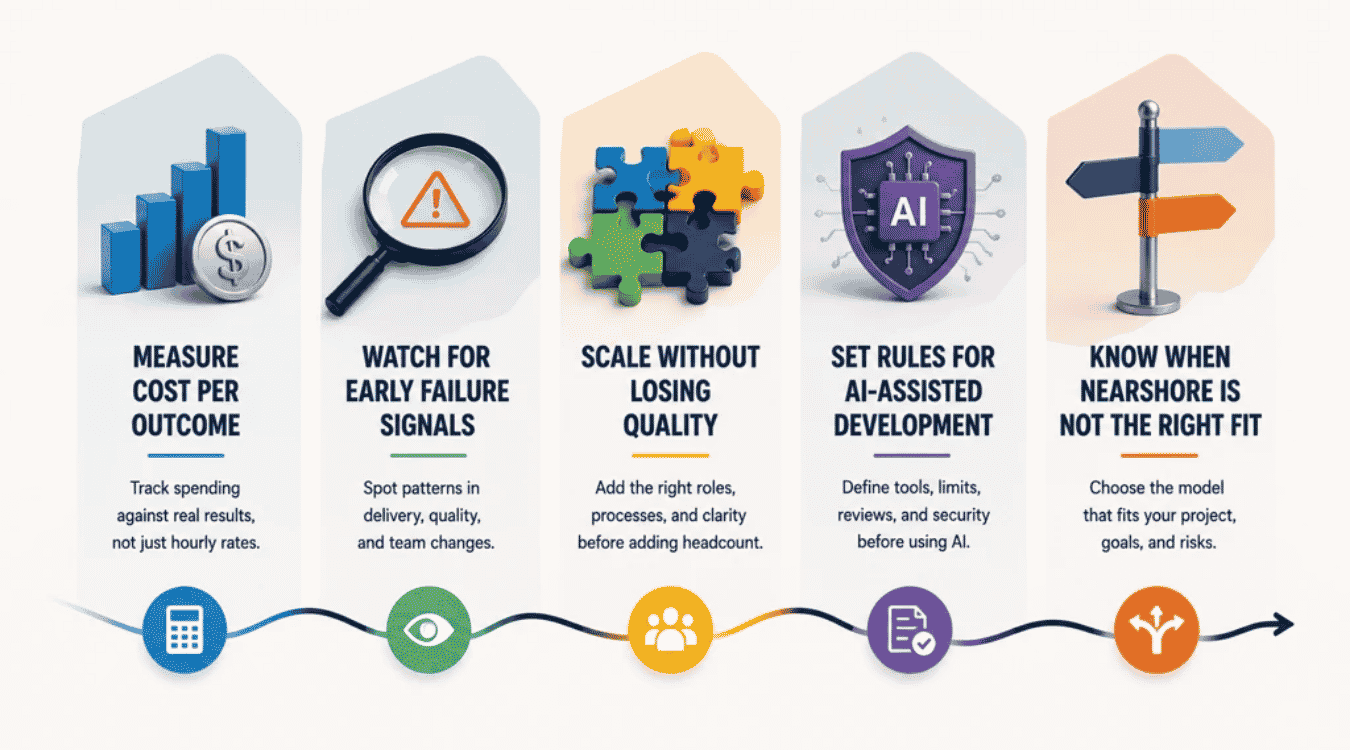
A nearshore team should create measurable value as it grows. Headcount alone tells you very little. Track delivery, cost, quality, and team health instead. Clear signals help you improve nearshore engagements before small problems become expensive ones.
Measure Cost Per Outcome
Hourly rates are easy to compare, but they do not show the full value of nearshore software outsourcing. Measure what you spend against useful outcomes, such as features shipped, release speed, defects fixed, or engineering capacity added.
Include onboarding, project management, tools, rework, and internal support in the calculation. Hidden expenses can make the real cost higher than the quoted developer rate. A strong nearshore model should improve cost efficiency across the entire development cycle. That gives tech companies a clearer view of ROI than hourly rates alone.
Watch For Early Failure Signals
Small problems often appear before a nearshore engagement fails. Watch for slower releases, repeated defects, missed sprint goals, rising rework, and long code review times. Frequent developer replacement is another warning sign, especially when basic software release checklist and deployment practices are missing.
Communication matters too. Nearshore engineering teams should not depend on one project manager for every decision. Direct contact between skilled professionals helps problems move faster. DORA now includes rework alongside delivery metrics such as deployment frequency and change lead time when teams assess software performance. Track trends over time. One bad sprint is normal. A pattern needs action.
Scale Without Losing Quality
More developers do not always mean faster delivery. Add people only when your development processes can support them. A team may need another QA engineer, DevOps specialist, or technical lead before it needs more developers.
Clear ownership also becomes more important as you scale engineering teams. Define product areas, coding standards, review rules, and release responsibilities. A project management office may help coordinate larger nearshore software development services across several teams. Strong documentation and shared standards let companies increase engineering capacity without creating more confusion. That can turn nearshore development outsourcing into a long-term competitive advantage.
Set Rules For AI-Assisted Development
AI tools now play a major role in software engineering. DORA's 2025 research found that 90% of surveyed technology professionals used AI at work, while more than 80% said it improved productivity. Yet 30% reported little or no trust in AI-generated code.
Set the rules before nearshore developers use these tools. Define approved AI products, data limits, code review requirements, and security controls. Emerging technologies can increase delivery speed, but human review still matters, especially when you want to ensure ethical, secure, and trustworthy AI software practices. DORA also found that AI can improve throughput while putting software stability under pressure when testing and feedback systems are weak.
Know When Nearshore Is Not The Right Fit
Nearshore is useful, but it is not the answer for every software project. Local engineering talent may make more sense when work needs constant physical access, strict local control, or deep knowledge that is hard to transfer.
Traditional outsourcing models may also fit some projects better. Offshore teams can offer a wider global talent pool when shared work hours matter less. Eastern Europe, for example, can work well as a nearshore region for Western European companies but is usually farther from U.S. working hours. Some teams combine these models with agile and offshore software development benefits when time zones are less critical. US companies should choose based on project needs, security, cost, and collaboration rather than assuming nearshore software development is always the best option.
Final Discussion
Nearshore software development teams offer a practical middle ground between costly local hiring and distant offshore outsourcing. Companies can access skilled talent, expand engineering capacity, and keep the real-time collaboration that modern software projects need. For U.S. companies, Latin America remains especially useful because nearshore developers can share much of the same workday.
Cost matters, but the lowest rate should not decide the choice. Current 2026 estimates place nearshore development below comparable U.S. costs, while the final price depends on seniority, location, and engagement model.
The best results come from choosing the right partner, setting clear ownership, and treating nearshore engineers as part of your development team. Measure delivery, protect knowledge, and scale only when the process is ready, guided by a clear technical roadmap aligned with product strategy.