GraphQL Vs REST API: Key Differences, Use Cases, And How To Choose
by Rhea Collins | Aug 27, 2026 | Technology & Innovation
Table of Contents
- GraphQL Vs REST API: At A Glance
- What Is A REST API?
- What Is GraphQL?
- How GraphQL And REST APIs Handle A Request
- GraphQL Vs REST API: Key Differences
- Performance: Network Efficiency Vs Server Work
- GraphQL Vs REST API: Security And Developer Experience
- When GraphQL Is The Better Choice
- When REST Is The Better Choice
- Finally, Can You Use GraphQL And REST Together?
Most teams pick between GraphQL vs REST API based on a five-year-old blog post, not their actual traffic patterns. That's backwards. A mobile app hitting three endpoints to render one screen has a different problem than a public API serving predictable, cacheable resources, and the fix looks nothing alike.
This decision comes down to one question: how many different clients are pulling different shapes of the same data? Get that answer right and everything else- caching, versioning, error handling- follows from it.
By 2026, most engineering teams aren't even choosing one anymore. They're running REST internally and GraphQL at the edge, stitching both together instead of picking a side. Here's what actually decides which one fits your project. This is really a choose-a-tech-stack decision, not just a GraphQL versus REST one.
GraphQL Vs REST API: At A Glance
Factor | REST API | GraphQL |
|---|---|---|
Endpoint Structure | Multiple endpoints per resource | Single endpoint for all operations |
Data Fetching | Fixed response shape per endpoint | Client specifies exact fields needed |
Over-Fetching Risk | Common on multi-field resources | Eliminated by design |
Schema Requirement | Optional (OpenAPI/Swagger) | Mandatory, strongly typed |
Versioning Approach | New endpoints (/v1/, /v2/) | Field deprecation, no new endpoints |
Error Handling | HTTP status codes (200, 400, 500) | Always 200, errors nested in response body |
Caching | Native HTTP/CDN caching | Requires persisted queries or custom logic |
Real-Time Support | Needs polling or SSE workarounds | Built-in via subscriptions |
Learning Curve | Lower, familiar HTTP verbs | Higher, new query language |
Best For | Public APIs, predictable data models | Multi-client apps, complex data graphs |
Tooling Maturity | Extensive, decades-old ecosystem | Growing fast, newer ecosystem |
Common Failure Mode | Endpoint sprawl over time | N+1 query explosion without batching |
What Is A REST API?
REST is an architectural style built around resources, not a query language like GraphQL. Each resource gets its own URL, and clients hit multiple endpoints to retrieve or modify data. A products endpoint returns products. An orders endpoint returns orders. Nothing fancier than that.
Pulling from multiple data sources usually means several separate calls, since REST endpoints return a fixed shape regardless of what the client actually needs. Fetching exact data or exactly the data required for one screen often means over-fetching unrelated fields. For simple use cases, this rarely matters. Once complex data relationships enter the picture, REST starts showing its limits.
What Is GraphQL?
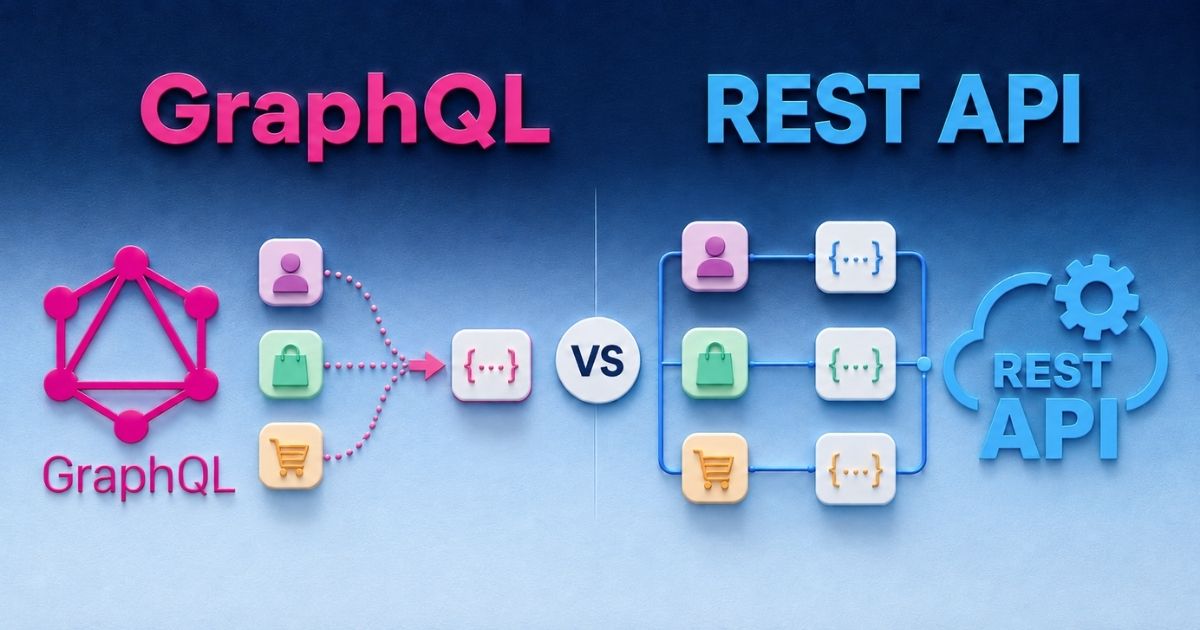
GraphQL is a query language for APIs, built to fetch data from multiple resources in a single request. One API request can pull a user, their orders, and each order's line items together, instead of triggering multiple REST API requests to stitch the same data together client-side.
Unlike REST, GraphQL APIs don't rely on HTTP status codes to signal errors. Every response comes back as 200, with success or failure details inside the response body. Caching works differently too. Since query shapes vary by request, GraphQL APIs need extra work to cache frequently accessed data, usually through persisted queries rather than standard HTTP caching.
How GraphQL And REST APIs Handle A Request
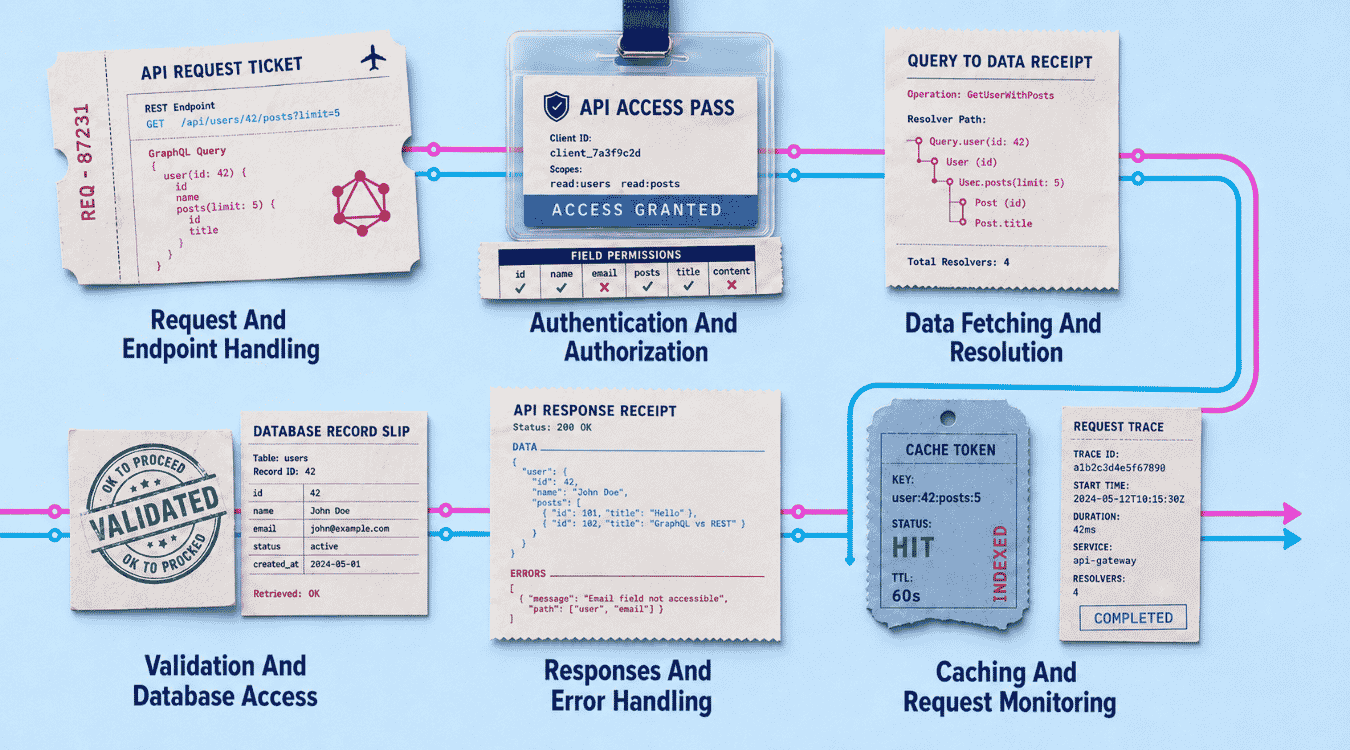
Every request goes through the same basic journey, but the two architectures take different paths from start to finish. Here's what's actually happening under the hood.
Request And Endpoint Handling
Say you're loading a dashboard that needs a user's profile, their recent orders, and account settings. In REST, that's three separate calls to three separate URLs, each one tied to standard HTTP methods like GET or POST. Multiple requests firing off for what's really one screen.
GraphQL skips that entirely. One single endpoint handles the whole thing- queries, mutations, subscriptions, all of it- so that same dashboard load becomes one call instead of three.
Authentication And Authorization
Both architectures lean on tokens or API keys to check who's asking before any data gets exchanged. Where they split is granularity. REST checks credentials at the door, endpoint by endpoint, since each URL represents its own resource with its own rules.
A GraphQL schema doesn't work that way. Everything funnels through one resolver layer built to process api requests and enforce permissions field by field instead, useful once your schema covers dozens of resource types behind that single doorway.
Data Fetching And Resolution
This is really where the two diverge the most. REST hands back whatever shape the server decided that endpoint should return, whether the client needs all of it or not.
An api query language changes that math. GraphQL resolvers only fetch data for the fields actually requested, which matters a lot once you're dealing with complex data querying across several related resources in one pass instead of stacking separate api calls.
Validation And Database Access
Both REST and GraphQL land on the same database eventually; validation is what happens on the way there. REST checks each incoming payload against whatever that specific route expects.
Schema-first validation works earlier. Before a GraphQL query even reaches a resolver, invalid fields get rejected outright, and whatever does resolve comes back as JSON data shaped exactly like the original request.
Responses And Error Handling
Status codes do a lot of heavy lifting in REST. A 404 or 500 tells you roughly what broke before you've even opened the response body, which lets tooling automatically identify request errors for common cases without much extra work.
There's no such shortcut in GraphQL. The server returns JSON data with a 200 status no matter what happened, success or failure, and the real story lives inside the response body itself.
Caching And Request Monitoring
Fixed endpoints make caching almost free in REST. Predictable responses mean browsers and CDNs can cache frequently accessed data without any real configuration.
Query shapes change too much for that trick to carry over cleanly. Most teams end up leaning on persisted queries or normalized client stores instead. Monitoring splits the same way; REST tracks metrics per endpoint, while performance data on the GraphQL side gets tracked per resolver field across that one shared endpoint.
GraphQL Vs REST API: Key Differences
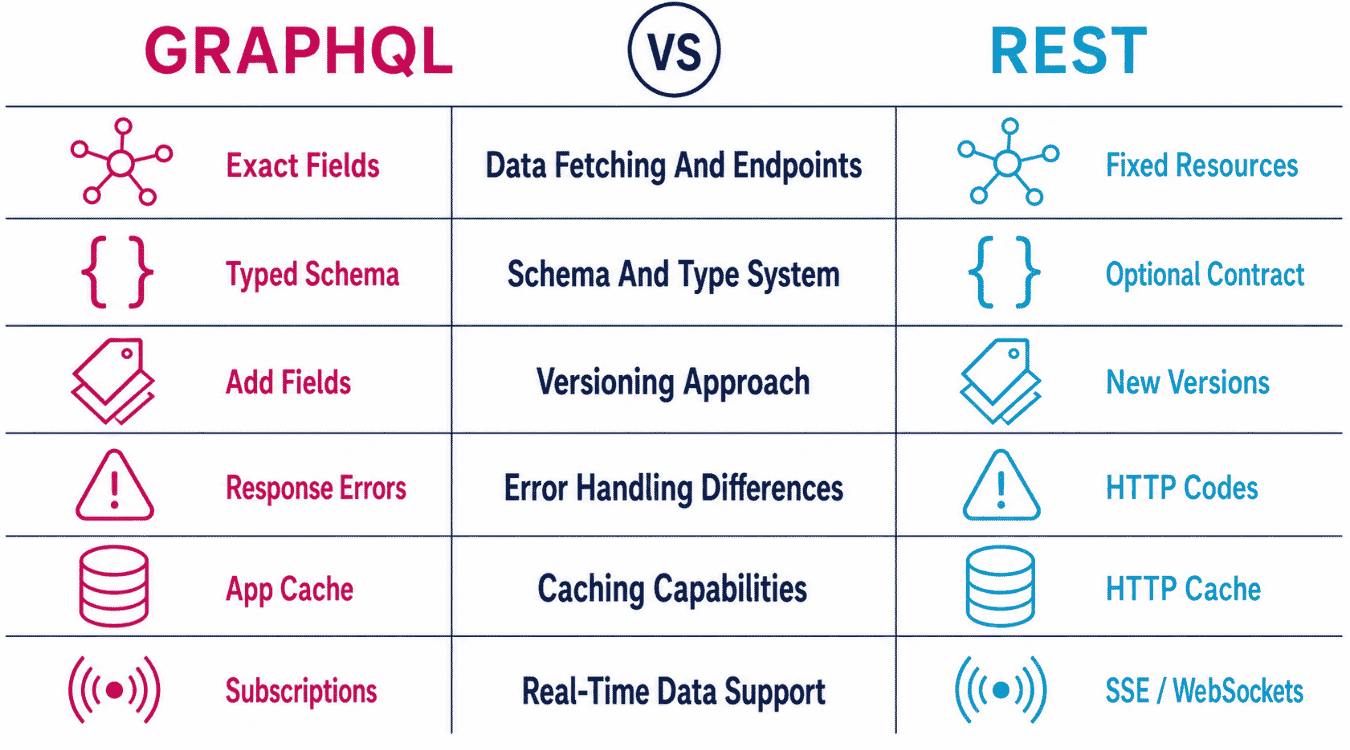
Both architectures solve the same core problem, moving data between client and server, but the mechanics behind each one create real practical differences worth understanding before you build anything. Both fall under broader architecture patterns worth comparing before you commit to either one.
Data Fetching And Endpoints
REST enables client applications to pull data through dedicated URLs, one endpoint per resource. A products page hits one URL, an orders page hits another, and each one returns a fixed shape regardless of what the screen actually needs.
Facebook's mobile team ran into a real bottleneck here. They needed a way to produce news feeds efficiently across wildly different devices, and existing api architectures at the time couldn't adapt fast enough to varying data needs per client, which is what pushed GraphQL into existence.
A single query describing exactly what's needed traces straight back to that origin. Instead of matching a URL to a resource, the server returns only what's asked for, nothing extra tacked on by default.
Schema And Type System
Data structures in REST are usually loose. JSON remains the most popular data exchange format across both architectures, but REST doesn't require any formal contract describing what a response should contain.
A stricter contract sits at the center of the other approach. Every field, type, and relationship gets defined upfront using the GraphQL schema definition language, almost like writing rules in its own small programming language before any data ever moves.
Complex data structures are where that contract earns its keep, with nested relationships spanning several resource types. A schema makes those relationships explicit, so both frontend and backend teams know exactly what shape to expect on either end.
Versioning Approach
RESTful APIs typically handle change through new endpoints, /v1/users, then /v2/users once the data model shifts. It works, but every new version means maintaining old ones alongside it, sometimes for years.
Fields get added freely on the other side of this comparison, and deprecated ones stick around with a warning label instead of disappearing outright, so client requests written months ago keep working without any coordinated version bump.
Where REST forces a decision point at every breaking change, the schema here evolves gradually instead. Teams end up shipping updates more often, without the usual scramble to migrate every client at once.
Error Handling Differences
A response code tells most of the story in REST. Success comes back as 200, a bad request as 400, a missing resource as 404, and each number carries its own data status baked right into the reply before you even open the body.
That signal disappears in the other model. Every response lands as 200 regardless of outcome, so success and failure both show up inside the same payload, and parsing the body becomes the only way to know what actually happened when you request data.
Different data formats end up carrying that responsibility instead of the status line. An errors array sits next to whatever data did resolve, which means client-side code has to check the payload itself rather than branching on a status code alone.
Caching Capabilities
Fixed URLs make caching close to automatic on the REST side. Since a given endpoint always returns the same data for the same request, browsers and CDNs can store responses without any special setup.
Query shapes change too often for that shortcut to carry over. A client might ask for exactly what data it needs on every single call, and that flexibility is exactly what breaks the usual URL-based caching model.
Persisted queries end up filling that gap during client development. Instead of caching by URL, teams cache by a fixed query signature, which gets most of the performance benefit back without needing a brand new endpoint for every variation.
Real-Time Data Support
Neither architecture ships live updates natively without extra work. REST typically needs long-polling or server-sent events bolted on, workarounds sitting outside the core spec rather than built into it.
Subscriptions handle this more directly on the other side. A client opens only one api request as a persistent connection, and the server pushes updates the moment something changes, whether that's a new message, a status update, or a record about to delete data somewhere in the system.
Schemas define data the same way for subscriptions as they do for regular queries, which matters for api backward compatibility. Fields added later rarely break a connection that's already listening, so real-time capability tends to grow without disrupting whatever's already live.
Performance: Network Efficiency Vs Server Work
Performance comparisons between these two architectures usually miss the real tradeoff. It's not that one is faster outright; it's that each one shifts the cost to a different place in the stack. Really, it's a scalable architecture decision more than a syntax preference.
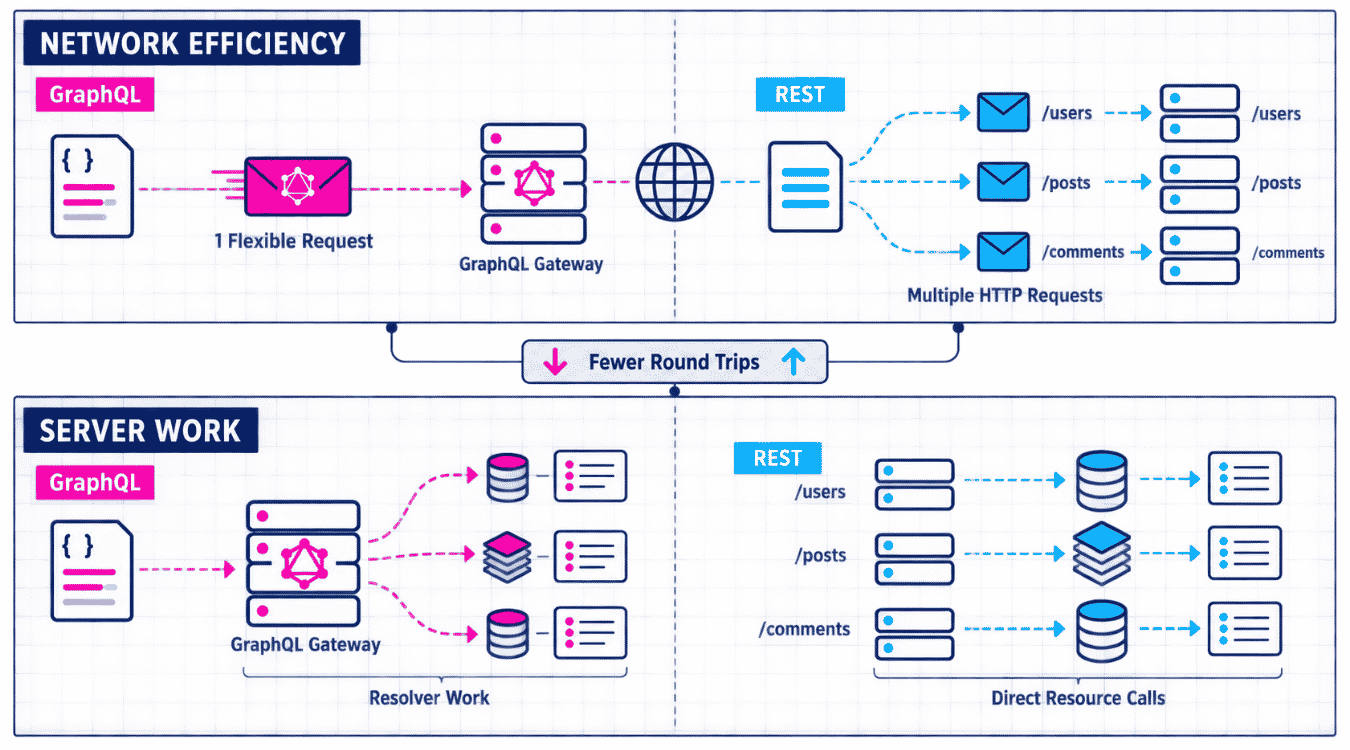
details inside the response bodyREST wins on raw simplicity. A single endpoint returning a fixed resource involves minimal server-side computation, and both REST and cached responses benefit from decades of mature infrastructure built around similar data formats and predictable payloads.
GraphQL's strongly typed api architecture shifts the burden elsewhere. Efficient data fetching means fewer round trips and smaller payloads over the wire, especially useful for related data spread across several resources, but that efficiency costs more on the server. Resolvers doing real work per field, per request, adds up fast under heavy load.
This pattern traces back to why GraphQL exists at all. Emerging social media platforms needed lighter payloads for mobile, and shifting data operations server-side was the tradeoff they accepted to get there.
Factor | REST API | GraphQL |
|---|---|---|
Network Payload Size | Often larger, fixed shape | Smaller, client-defined shape |
Round Trips Per Screen | Multiple, one per resource | Typically one per query |
Server-Side Computation | Lower, simple resource lookup | Higher, resolver work per field |
Mobile Performance | Slower on weak connections | Built for bandwidth constraints |
Caching Overhead | Low, native HTTP caching | Higher, custom caching logic needed |
Query Complexity Risk | Fixed, predictable load | Variable, can spike server load |
Best Case Scenario | Simple, high-traffic public APIs | Complex, multi-resource dashboards |
Worst Case Scenario | Chatty APIs, many round trips | Expensive nested queries unchecked |
GraphQL Vs REST API: Security And Developer Experience
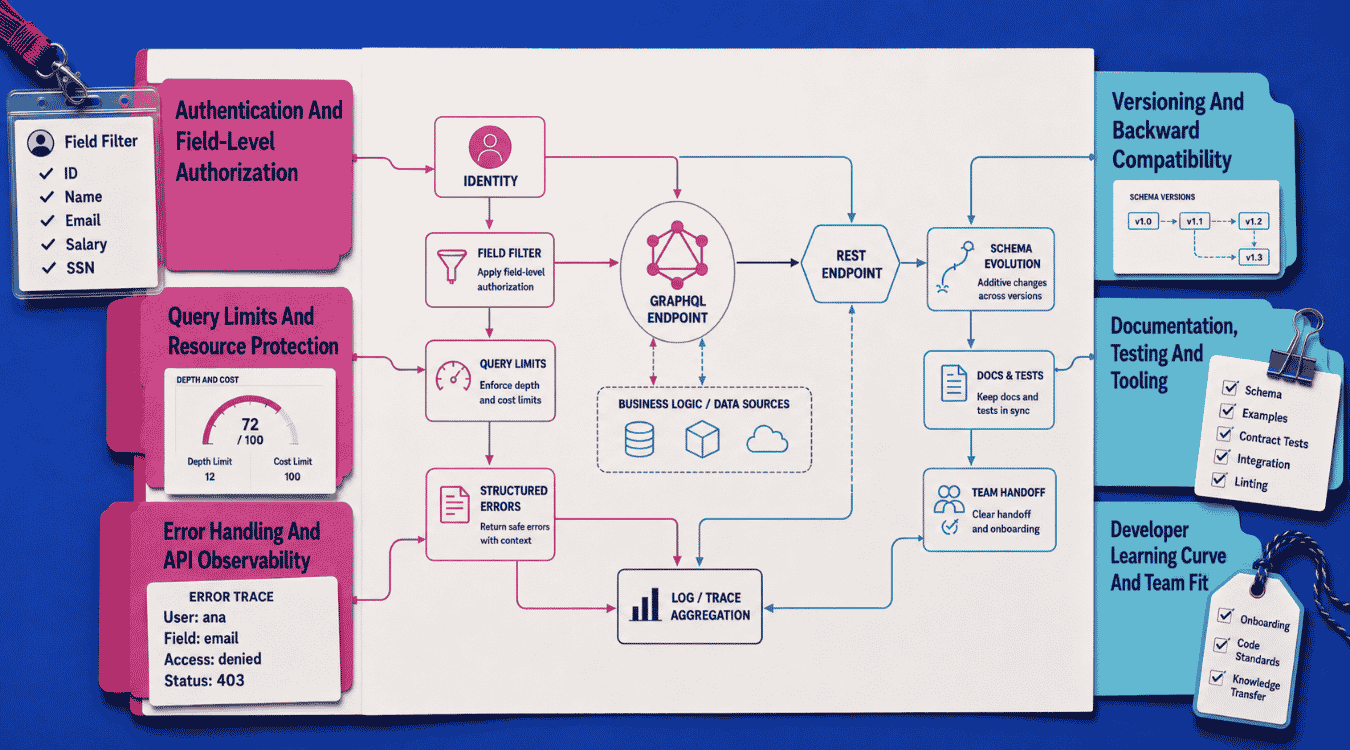
Security and day-to-day developer experience diverge just as much as the technical architecture does. Here's how each one holds up once real teams start building against it.
Authentication And Field-Level Authorization
A REST request typically checks credentials once, right at the endpoint, since each URL maps to one existing server-side resource with its own access rules baked in. Simple to reason about, easy to audit per route.
Authorization gets more granular on a GraphQL server. One schema can expose dozens of resource types, so permission checks often happen field by field inside resolvers rather than at a single gate, which takes more upfront design but catches access issues REST would only handle at the resource level.
Query Limits And Resource Protection
Both architectures follow common api architectural principles like rate limiting and request throttling, but REST gets this mostly for free since fixed endpoints make load predictable.
A flexible GraphQL schema removes that predictability. Nothing stops a client from nesting queries five layers deep, so most production setups add query depth limits and cost analysis on top of the schema itself, protection REST rarely needs by design.
Error Handling And API Observability
Status codes give REST a head start on observability. Monitoring tools can slice data retrieval performance by endpoint and status code without much custom instrumentation.
GraphQL needs more deliberate tracing since every request hits the same URL regardless of what it's actually doing. Field-level resolver timing becomes the real observability layer, which takes more setup but often surfaces exactly which part of a query is slow, something REST's endpoint-level metrics can't show.
Versioning And Backward Compatibility
REST handles change through new endpoints, which keeps old integrations working but means maintaining parallel versions indefinitely.
A GraphQL schema evolves instead of forking. Fields get deprecated with a warning rather than removed outright, so backward compatibility holds without ever standing up a second version of anything.
Documentation, Testing And Tooling
REST's documentation story leans on external specs like OpenAPI, useful but optional, so quality varies a lot from one API to the next.
GraphQL documents itself through introspection, and testing tools can query the schema directly to generate accurate docs automatically. That same introspection makes testing streaming data updates through subscriptions more straightforward too, since the schema already defines what events exist and what shape they return. Good testing strategies account for that difference early instead of bolting it on later.
Developer Learning Curve And Team Fit
REST's learning curve stays low because it reuses HTTP concepts most developers already know. New hires onboard fast, and the mental model rarely surprises anyone.
GraphQL asks more upfront: a new query language, resolver patterns, and schema design decisions that shape the whole API. Teams with capacity for that investment tend to get more out of it long term, while smaller teams often find REST's simplicity fits their actual velocity better. Factor that learning curve into your development timeline before committing to GraphQL on a tight deadline.
When GraphQL Is The Better Choice
GraphQL earns its complexity when a project actually needs the flexibility it offers, not by default just because it's newer. The clearest signal is client diversity: a web app, an iOS app, and an Android app all pulling different slices of the same data through a single schema instead of juggling separate REST endpoints for each. That flexibility is the whole point of API-first architecture in the first place.
It also fits teams working across an unusual database structure, where relationships span several tables or services and one query can pull all of it together in a single round trip. That overlap is exactly where the microservices vs monolith debate usually starts. It's the same pattern that shows up in headless commerce architecture, where product, inventory, and pricing data all live in different systems.
GraphQL tends to be the right call when:
- Multiple clients need different fields from the same data interchange
- Mobile performance matters and payload size needs trimming
- The data model spans multiple sources or nested relationships
- Teams need to add fields without breaking existing integrations
- Real-time updates matter more than JSON, XML, or other data formats served statically
Getting this right early is part of building a future-proof stack, not just picking a syntax.
When REST Is The Better Choice
REST earns its place when simplicity actually matters more than flexibility. A public API with a predictable client server model, stable data exchange needs, and no complicated fetching logic rarely benefits from GraphQL's extra setup.
It also fits situations where filtering through query parameters covers most use cases well enough, without needing a full query language to get there.
REST tends to be the right call when:
- The API serves one main client with stable, predictable needs
- Caching matters more than flexible field selection
- The team wants HTTP's simplicity, not a new query language to learn
- Multiple related resources rarely need combining into a single response
- Public-facing APIs need mature tooling and wide developer familiarity
Finally, Can You Use GraphQL And REST Together?
Yes, and by 2026 most teams aren't really choosing anymore; they're combining both. REST and GraphQL rank among the most popular api architecture styles precisely because they solve different problems well, so running them side by side often beats picking one outright. Getting the integration strategy right matters more than which one you pick first.
The common pattern looks like this: internal services stay REST, simple, stable, less complex data moving between systems that rarely change. A GraphQL layer sits on top facing external clients, aggregating those REST calls into one flexible query instead of forcing mobile and web teams to juggle several endpoints each. Teams still working through monolith to microservices tend to keep REST internally until that migration settles, and that's often the same moment they face a refactor vs rebuild decision for the API layer.
This hybrid setup also plays well with tooling. Both GraphQL APIs and REST endpoints can share the same authentication layer, and GraphQL's schema validation still produces useful error messages even when the data underneath originated from a REST call three layers down. Netflix, Shopify, and GitHub all run some version of this pattern in production today. Most modern SaaS infrastructure ends up looking like this hybrid setup eventually.