MySQL vs Postgres: The Complete 2026 Comparison
by Rhea Collins | Aug 25, 2026 | Software Development Insights
Table of Contents
- Quick Comparison Table: MySQL vs. PostgreSQL
- Key Differences: PostgreSQL Vs MySQL
- Similarities Between PostgreSQL And MySQL
- PostgreSQL Vs MySQL Performance Benchmarks For 2026
- Supported Languages For PostgreSQL Vs MySQL
- Operating System Compatibility For PostgreSQL And MySQL
- Best Use Cases For MySQL Instead Of PostgreSQL
- How Do MySQL And PostgreSQL Handle Vector Search
- When PostgreSQL Becomes The Better Database Choice
- Final Discussion
MySQL and PostgreSQL power a huge share of the world's production databases, but they solve different problems well. MySQL optimizes for read-heavy, simple-schema workloads with a mature hosting ecosystem. PostgreSQL optimizes for data integrity, complex queries, and extensibility.
Neither wins outright. The right choice depends on your workload, your team's familiarity, and where your project sits on the MVP-to-enterprise spectrum. MySQL 8.0 reached end of life in April 2026. PostgreSQL 19 shipped its first beta in June 2026. That timing is forcing a lot of teams to re-decide right now, not just inherit whatever they picked years ago.
This guide breaks down the real technical differences, what changed in 2026, and how to match the database to your specific project type.
Quick Comparison Table: MySQL vs. PostgreSQL
Factor | MySQL | PostgreSQL |
|---|---|---|
License | GPL (Community Edition), commercial tiers available | PostgreSQL License (permissive, no commercial tier needed) |
Architecture | Thread-per-connection, pluggable storage engines (InnoDB default) | Process-per-connection, single unified storage engine |
ACID Compliance | Full ACID via InnoDB, not guaranteed on all storage engines | Full ACID by default across the entire engine |
Best For | Read-heavy apps, CMS/WordPress stacks, high-traffic simple schemas | Complex queries, data integrity-critical systems, analytics workloads |
JSON Support | JSON column type, newer Duality Views in 9.x | JSONB with native indexing, more mature tooling |
AI/Vector Search | Native VECTOR type, newer and less proven | pgvector, ecosystem-mature with wide adoption |
Current LTS/Stable | MySQL 9.7 LTS (April 2026) | PostgreSQL 18 stable, PostgreSQL 19 in beta (June 2026) |
Hosting Ecosystem | Broadest managed support (RDS, Aurora, PlanetScale) | Strong and growing (RDS, Aurora, Cloud SQL, AlloyDB, Supabase) |
Neither database is a universal default anymore. MySQL still wins on raw read throughput and hosting maturity. PostgreSQL wins on data integrity, extensibility, and how well it handles complex, write-heavy, or analytical workloads. The sections below break down why.
What is PostgreSQL?
PostgreSQL is an open-source object-relational database management system built for data integrity and complex queries. Unlike simpler database management systems, it treats every transaction as fully ACID-compliant by default. Developers often search MySQL vs PostgreSQL precisely because PostgreSQL supports richer data types, custom functions, and advanced indexing out of the box. It started as a research project at UC Berkeley back in 1986. Nearly four decades later, it still ships new capabilities every year.
History of PostgreSQL
Michael Stonebraker started the POSTGRES project at UC Berkeley in 1986, building on lessons from his earlier Ingres database. The team added structured query language support in 1995 and renamed the project Postgres95. It became PostgreSQL in 1996, reflecting how far it had grown beyond its original scope.
Today PostgreSQL supports advanced data types, custom extensions, and full compliance with modern relational database standards. That Berkeley research lineage is part of why comparisons between PostgreSQL and MySQL often highlight PostgreSQL's academic rigor.
What is MySQL?
MySQL is a widely used relational database management system known for speed and strong community support. Every MySQL database relies on a pluggable storage engine, with InnoDB as the default choice for most modern deployments.
Developers researching PostgreSQL vs. MySQL often point to MySQL's simplicity for read-heavy applications like content management systems and e-commerce platforms.
MySQL also supports stored procedures, triggers, and views, giving teams enough flexibility for most business logic without needing a heavier database engine.
History of MySQL
Michael Widenius and David Axmark released the first version of MySQL in 1995, naming it after Widenius's daughter, My.
Sun Microsystems acquired MySQL AB in 2008. Oracle then acquired Sun in 2010, a move that pushed the original creators to fork the project into MariaDB a year earlier as a safeguard.
MySQL added multi-version concurrency control through the InnoDB storage engine, which Oracle had acquired separately in 2005. That single addition transformed MySQL performance under concurrent write loads.
Later releases introduced MySQL Workbench as a visual design tool and added advanced database feature sets aimed at scalable data management for growing applications.
Key Differences: PostgreSQL Vs MySQL
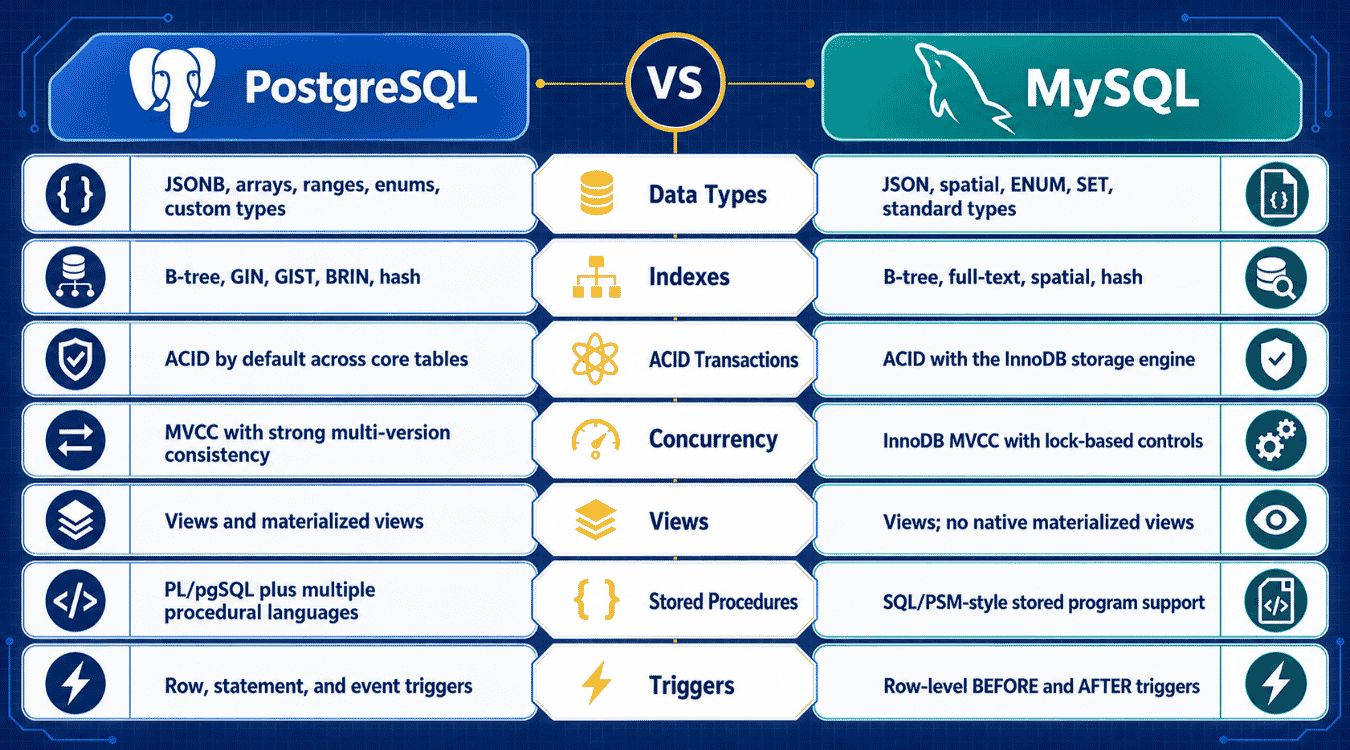
PostgreSQL and MySQL diverge most sharply in how they handle data types, transactions, and concurrency. MySQL and PostgreSQL each made deliberate technical tradeoffs decades ago, and those choices still shape which workloads each handles best. These same tradeoffs matter when choosing the right repo setup for teams managing multiple services against either database.
Data Type Flexibility
PostgreSQL supports an extensive range of data types beyond standard SQL, including arrays, hstore, and native JSON data storage with indexing.
Developers gain room to build complex data structures directly in the schema, avoiding workarounds in application code.
MySQL focuses on a leaner set of core types tuned for speed. Custom data types exist mostly through workarounds like JSON columns, but PostgreSQL's flexibility, backed by a permissive PostgreSQL license, gives teams more room to model unusual data without extra tooling.
PostgreSQL's JSONB format supports indexed queries nearly as fast as native columns, according to PostgreSQL's official documentation.
Indexing Options And Performance
PostgreSQL ships with advanced features like partial indexes, expression indexes, and multiple index types including GiST and GIN.
Developers fine-tune performance for exactly the query patterns their application runs, using these options.
MySQL relies mostly on B-tree indexes, which cover most standard use cases efficiently. Its long pairing with the Apache HTTP Server in the classic LAMP stack helped establish MySQL as a fast, dependable choice for high traffic websites.
Both databases index foreign keys automatically in most setups, but PostgreSQL's broader index catalog, according to its own release notes, tends to pay off most in analytics heavy queries.
Transaction Reliability And ACID Support
PostgreSQL enforces full ACID compliance across every table and storage layer, with no exceptions between engines.
Every transaction, whether a single insert or a complex multi table update, follows the same reliability guarantees.
MySQL's acid compliance depends on the storage engine in use. InnoDB, the default in MySQL Community Edition, supports full transactions, but older engines like MyISAM do not.
Financial systems and inventory platforms feel this distinction most, since partial writes can cause real damage there. This is exactly why teams building embedded finance software tend to scrutinize ACID guarantees more closely than typical SaaS teams do.
According to MySQL's own documentation, InnoDB has been the default engine since MySQL 5.5, closing most of that historical gap. Testing these guarantees across a staging vs production environment before go-live is still worth the extra step for financial or inventory systems.
Concurrent Query Handling
PostgreSQL handles concurrent queries through multi version concurrency control, letting readers and writers work simultaneously without blocking each other.
Teams can extend this further with logical replication, streaming only specific tables or changes to other systems in near real time.
MySQL handles concurrency well for typical web applications, and offers NDB Cluster storage engines for teams that need distributed, high-availability writes across multiple nodes.
Each approach suits different scale patterns. PostgreSQL's model, according to its documentation, favors read-heavy analytical workloads, while MySQL's clustering options favor horizontally distributed transactional systems.
Views And Materialized Views
Support for standard views exists in both PostgreSQL and MySQL, letting database developers hide complexity from application code without duplicating logic.
Materialized views go further by storing query results physically, which speeds up expensive reads.
PostgreSQL has supported materialized views natively since version 9.3, while MySQL still lacks true native support and often requires manual workarounds like scheduled tables.
Reporting heavy applications feel this gap most, since the same complex query often runs repeatedly throughout the day.
Stored Procedure Capabilities
PostgreSQL supports stored procedures in multiple procedural languages, including its native PL/pgSQL along with PL/Python and PL/Perl.
This flexibility gives database developers more options for complex business logic directly inside the database.
MySQL also supports stored procedures, though limited mostly to its own SQL based syntax. Its strong community support means most common patterns already have documented solutions and shared code examples.
Teams choosing between the two often weigh procedural language flexibility against the sheer volume of existing MySQL examples available online.
Trigger Customization And Automation
PostgreSQL supports detailed trigger customization, including row level and statement level triggers that can fire before or after multiple event types.
Fine control over automated database management tasks follows from this granularity, without requiring extra application code.
MySQL focuses on simpler trigger definitions covering standard insert, update, and delete events, which covers most common automation needs.
Both systems let developers automate validation and logging directly at the database layer, though PostgreSQL's event flexibility, according to its documentation, supports more advanced automation scenarios.
Similarities Between PostgreSQL And MySQL
Despite their different design philosophies, PostgreSQL and MySQL share more common ground than most PostgreSQL vs comparisons suggest.
Both are open-source relational database systems with decades of production use behind them. Neither requires licensing fees for core usage, which keeps them accessible to startups and enterprises alike.
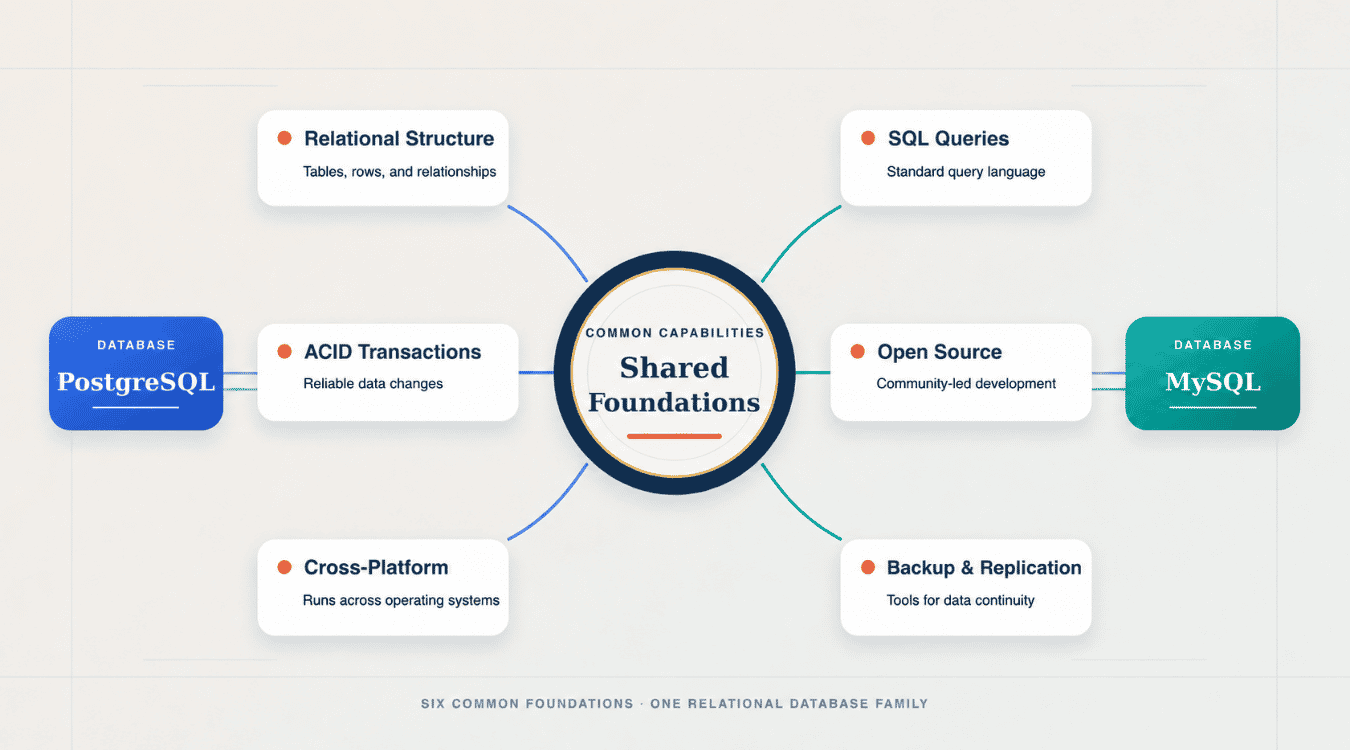
Both also handle structured query language the same way at a fundamental level, so developers moving between the two rarely face a steep learning curve.
MySQL offers ACID compliance through its InnoDB storage engine, the same core guarantee PostgreSQL provides by default. That overlap means both databases hold up reliably for transactional workloads once configured correctly.
Modern versions of each database also support JSON data types, letting teams store semi-structured data without abandoning a relational schema entirely.
A few more shared traits worth noting:
- Both remain among the most popular SQL database choices on every major developer survey, including Stack Overflow's annual rankings.
- Both support foreign keys, joins, and standard indexing for solid database performance out of the box.
- Both integrate with virtually every modern backend framework and cloud hosting provider.
- Both have active open-source communities contributing extensions, tools, and bug fixes.
- Both scale well vertically before requiring more complex distributed architectures.
PostgreSQL Vs MySQL Performance Benchmarks For 2026
For over a decade, "MySQL is faster" was treated as settled fact. The 2026 data flips that story.
PostgreSQL sustained 21,338 single-row INSERT operations per second on Ubuntu 24.04, according to a January 2026 benchmark from BinaryIgor. MySQL 8.4 managed just 4,383 QPS in the same test, a 4.9x gap in PostgreSQL's favor.
That is not a rounding error. It is a full reversal of the old assumption that MySQL always wins on writes.
Read performance tells a more balanced story. A June 2026 benchmark from Lueurexterne, running an 80 percent read mix, found MySQL 9.x edging out PostgreSQL 17 at roughly 145,000 queries per second versus 138,000. MySQL still holds the edge on simple, read-dominant workloads.
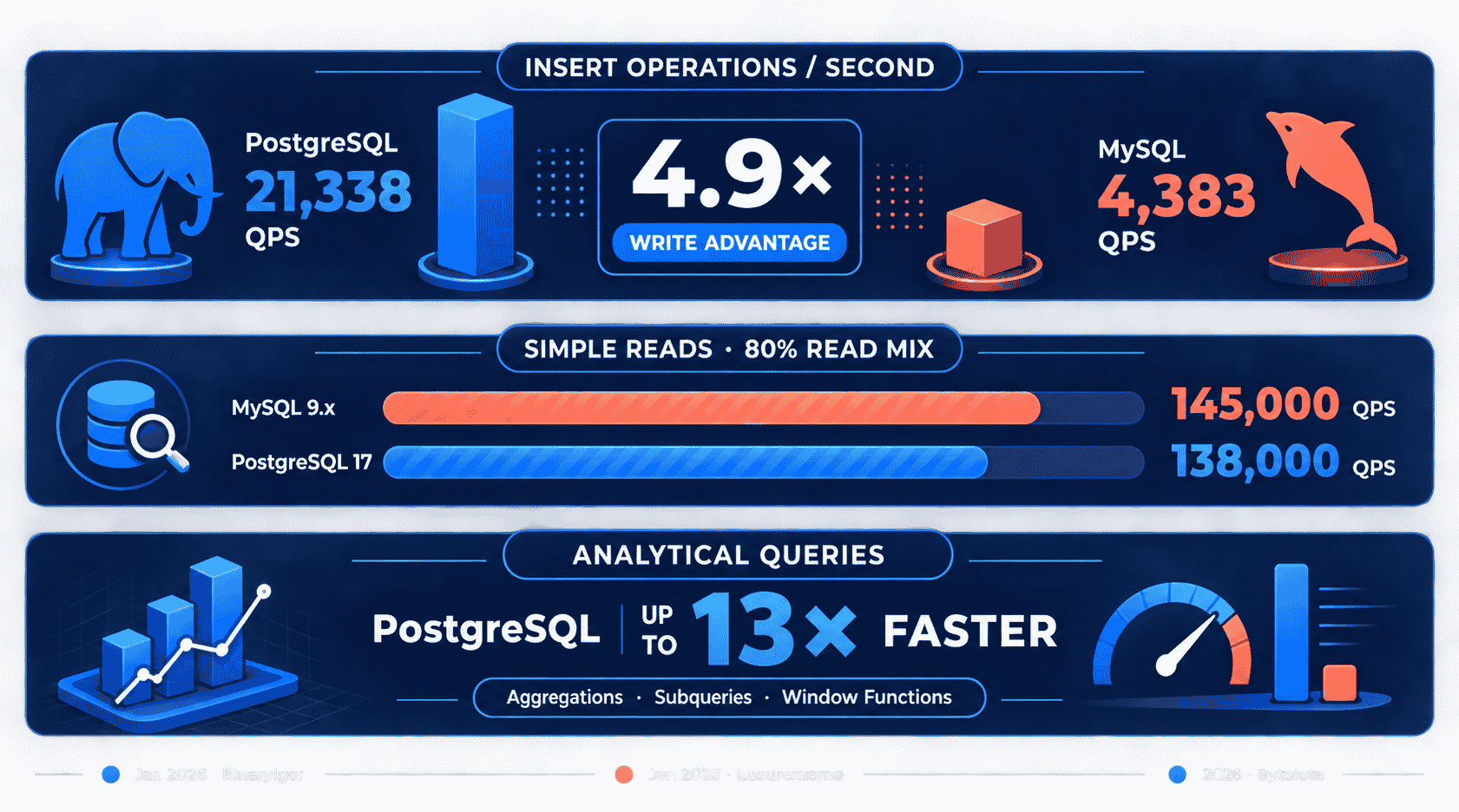
The real twist shows up in analytical queries. PostgreSQL delivers up to 13x better performance on queries involving aggregations, subqueries, and window functions, according to ByteIota's 2026 benchmark. That gap barely existed five years ago.
Developer preference has shifted alongside the numbers. PostgreSQL now holds 55.6 percent adoption versus MySQL's 40.5 percent, according to the 2025 Stack Overflow Developer Survey, the first time PostgreSQL has taken the top spot.
The pattern across every credible 2026 benchmark is consistent. MySQL still wins narrowly on simple reads and raw connection scaling. PostgreSQL now wins decisively on writes, complex queries, and analytical workloads, closing a gap that used to be its biggest weakness. Faster writes also tend to support higher deployment frequency for teams shipping database changes often.
Supported Languages For PostgreSQL Vs MySQL
PostgreSQL supports multiple procedural languages beyond its native PL/pgSQL, giving developers room to write stored logic in the language their team already knows.
MySQL keeps things simpler with one primary procedural syntax, trading flexibility for consistency across projects.
Language | PostgreSQL | MySQL |
|---|---|---|
Native procedural language | PL/pgSQL | SQL/PSM-based syntax |
Python | PL/Python | Not supported natively |
Perl | PL/Perl | Not supported natively |
Tcl | PL/Tcl | Not supported natively |
Java | Via JDBC / PL/Java | Via JDBC |
C | Supported | Supported |
Operating System Compatibility For PostgreSQL And MySQL
Both databases run on nearly every major server operating system, which removes OS choice as a real blocker in most PostgreSQL vs MySQL decisions.
PostgreSQL edges ahead slightly on Unix-like variants, reflecting its academic and enterprise Unix roots.
Operating System | PostgreSQL | MySQL |
|---|---|---|
Linux (all major distros) | Supported | Supported |
Windows | Supported | Supported |
macOS | Supported | Supported |
FreeBSD | Supported | Supported |
OpenBSD | Supported | Not officially supported |
NetBSD | Supported | Not officially supported |
Solaris | Supported | Supported |
IBM AIX | Supported | Supported |
HP-UX | Supported | Not officially supported |
Best Use Cases For MySQL Instead Of PostgreSQL
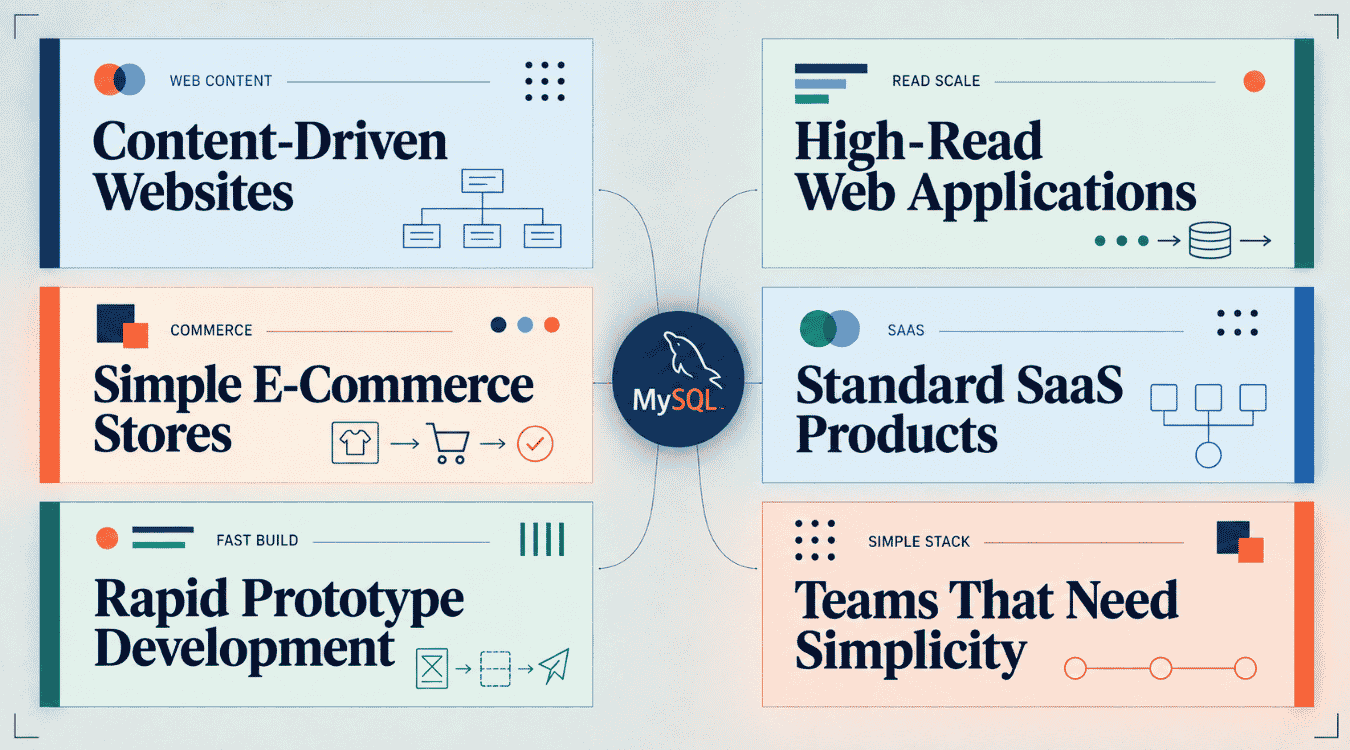
MySQL fits specific project types better than PostgreSQL, despite PostgreSQL offering more advanced features overall. These key differences matter most when the workload favors speed and simplicity over complexity.
Content-Driven Websites
WordPress, Drupal, and most CMS platforms were built around MySQL from the start.
Performance MySQL delivers on read-heavy content queries and fits blog posts, product pages, and article archives perfectly.
The MyISAM storage engine, while older, still handles simple read patterns fast on legacy setups. Modern InnoDB deployments improve on that further.
MySQL remains the most popular SQL database for this exact use case, backed by hosting providers that optimize specifically for CMS workloads out of the box.
High-Read Web Applications
Applications where reads outnumber writes by a wide margin play directly to MySQL features built for that pattern.
Simple SELECT queries against the same data structure execute with less planning overhead than PostgreSQL's more sophisticated optimizer requires.
News sites, directories, and catalog-style apps see this benefit daily.
MySQL still follows core SQL standards for these operations, so teams don't sacrifice portability while gaining speed on the read path that matters most.
Simple E-Commerce Stores
Smaller online stores with straightforward product catalogs rarely need PostgreSQL index types like GiST or GIN.
Standard B-tree indexing in MySQL covers product lookups, category filters, and order history without extra tuning.
MySQL is fully ACID compliant through InnoDB, protecting checkout and payment transactions just as reliably as PostgreSQL does.
Platforms like WooCommerce and Magento default to MySQL for exactly this reason, giving smaller stores a proven, low-maintenance path to launch. That same simplicity makes MySQL a common pairing with a headless commerce architecture for smaller storefronts.
Standard SaaS Products
Most SaaS applications with conventional relational schemas don't need PostgreSQL's extensibility to succeed.
MySQL handles typical user accounts, subscriptions, and activity logs without requiring custom software modules or extensions.
Managed hosting options are broader too, spanning more providers at more price points than PostgreSQL's ecosystem currently offers.
For a standard SaaS build with predictable query patterns, that hosting breadth often outweighs any advanced feature PostgreSQL brings to the table. Whichever database a SaaS product runs on, solid API testing tools remain essential for validating the endpoints built on top of it.
Rapid Prototype Development
Speed to a working prototype matters more than long-term extensibility in early-stage builds.
MySQL's simpler setup and abundant tutorials let developers stand up a working schema faster than researching PostgreSQL's deeper configuration options.
Most tutorials, courses, and boilerplate templates still default to MySQL first.
That familiarity shortens the path from idea to demo, which matters more than advanced tooling when validating a concept before committing to a full architecture. Just be mindful of the technical debt this speed can introduce once the prototype turns into a real product.
Teams That Need Simplicity
Smaller teams without a dedicated database administrator benefit from MySQL's flatter learning curve.
Fewer configuration options mean fewer decisions to get wrong during setup and maintenance.
MySQL's strong community support means most problems already have a documented fix, cutting the research time a lean team can't always spare.
That simplicity trades some flexibility for predictability, which is exactly the tradeoff teams without deep database expertise usually want to make. Tracking developer experience metrics over time can help confirm whether that tradeoff is still paying off as the team grows.
How Do MySQL And PostgreSQL Handle Vector Search
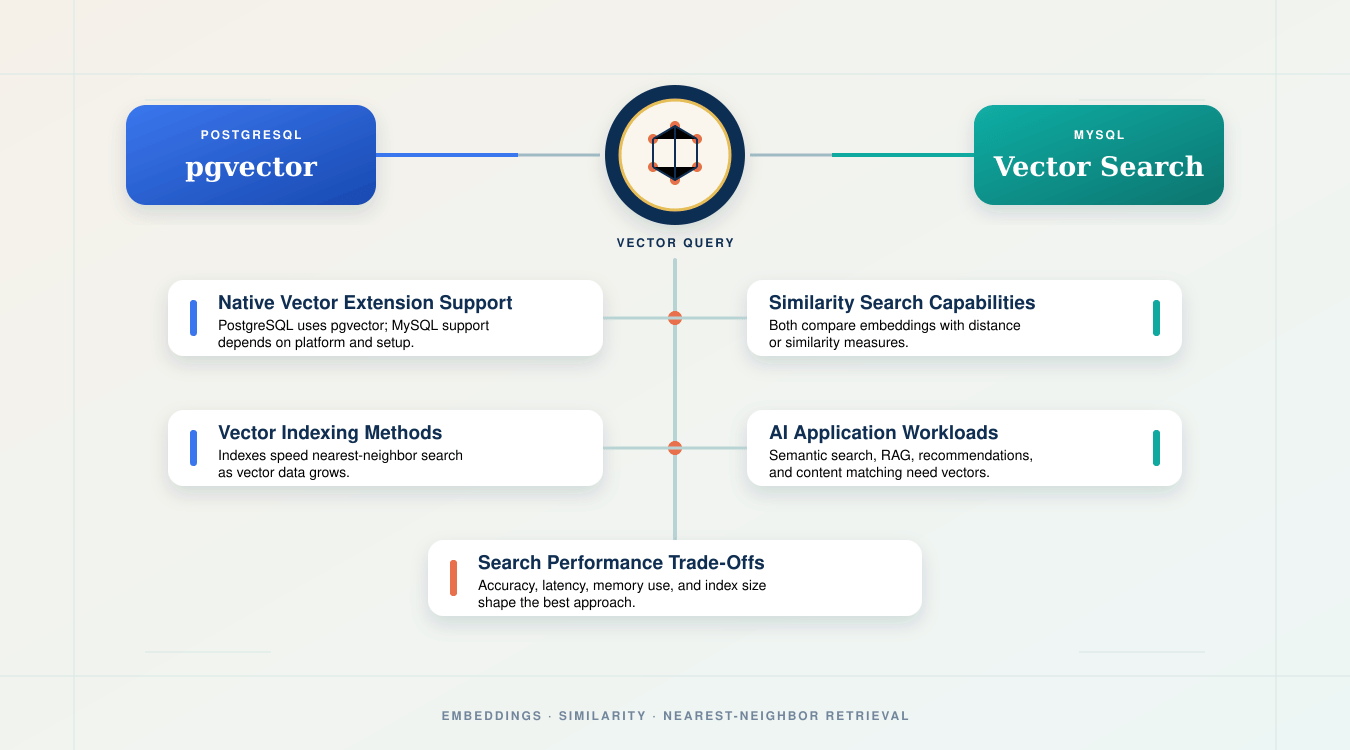
AI features have pushed vector search into mainstream database decisions, and comparing PostgreSQL and MySQL here reveals a real maturity gap.
Native Vector Extension Support
PostgreSQL supports vector search through pgvector, a mature extension that has seen years of production use across AI-heavy applications.
Complex data types like embeddings are stored directly alongside relational data, letting teams organize data without a separate vector database.
MySQL added a native VECTOR data type more recently, catching up to a pattern PostgreSQL's extension ecosystem already proved out.
Both MySQL and PostgreSQL now technically support vector storage, but production maturity still favors PostgreSQL's longer track record.
Similarity Search Capabilities
PostgreSQL's pgvector extension supports cosine similarity, Euclidean distance, and inner product searches out of the box.
Teams building recommendation engines or semantic search features get several distance functions without writing custom logic.
MySQL's native VECTOR type currently supports a narrower set of similarity functions, reflecting its earlier stage of development.
Applications doing heavy semantic matching, like RAG pipelines, tend to lean on PostgreSQL's broader function support for this exact reason.
Vector Indexing Methods
PostgreSQL offers HNSW and IVFFlat indexing methods through pgvector, both proven approaches for approximate nearest neighbor search at scale.
These index types trade a small accuracy cost for major speed gains on large embedding sets.
MySQL's vector indexing support is still maturing, with fewer index type options available across current releases.
For a data warehouse holding millions of embeddings, index method choice affects query speed directly, which currently tilts the decision toward PostgreSQL.
AI Application Workloads
Concurrent write operations matter more than usual in AI applications, since embeddings often update alongside live user activity. Many of these AI features also get exposed externally, which makes an API monetization strategy part of the same architecture conversation.
PostgreSQL supports MVCC across the entire vector workload, letting multiple users query and update embeddings without blocking each other.
MySQL handles concurrent access reasonably well too, but its vector feature set hasn't been battle-tested across multiple tables and complex joins the way PostgreSQL's has.
Scalable web applications adding AI features on top of existing relational data often find PostgreSQL requires fewer architectural workarounds. Teams running these workloads on Kubernetes should also prioritize Kubernetes security as embeddings and user data move through the same clusters.
Search Performance Trade-Offs
Common table expressions and multi-step filtering combine naturally with vector search in PostgreSQL, since both live in the same query engine.
A single query can filter by metadata, join across multiple tables, and rank by vector similarity together. MySQL can technically do this too, but with less optimizer maturity for combining traditional filters with vector operations.
Teams planning future database migrations toward heavier AI workloads generally find PostgreSQL's combined maturity in both areas the safer long-term bet.
When PostgreSQL Becomes The Better Database Choice
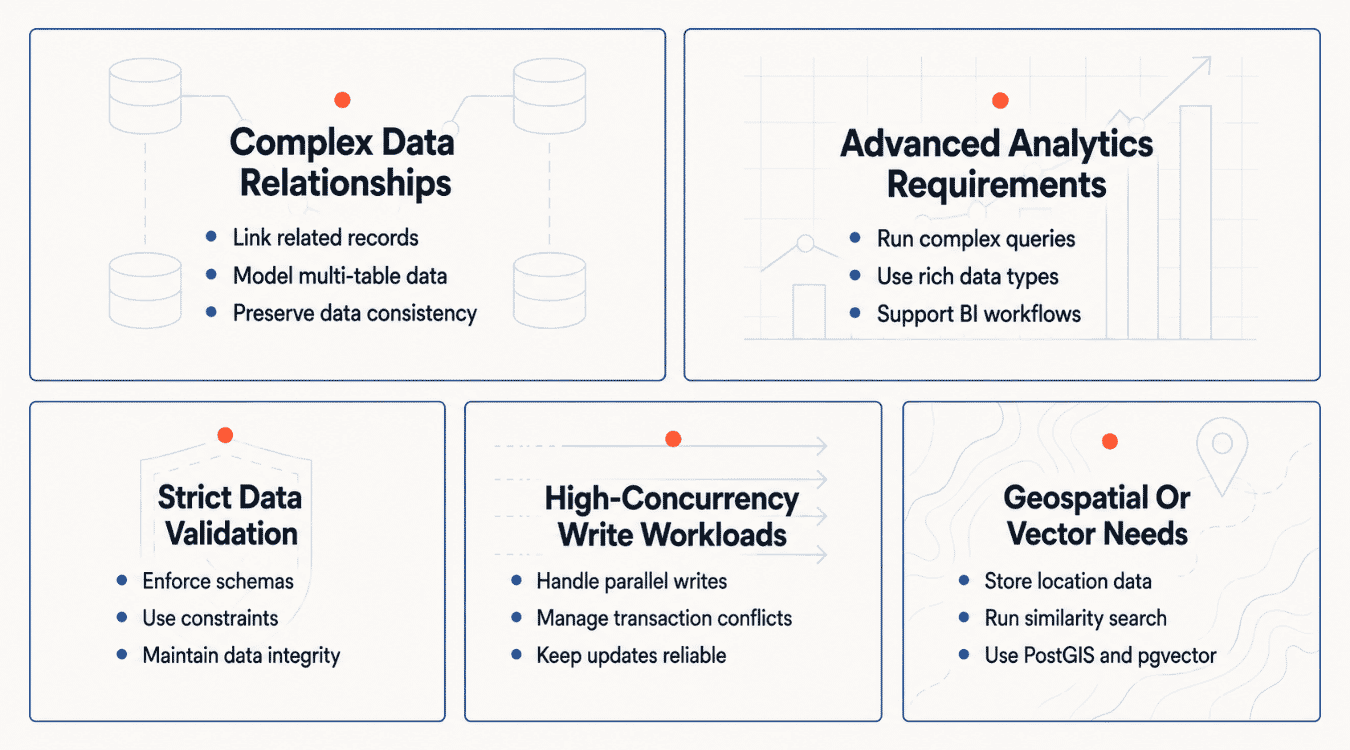
MySQL excels at read-heavy workloads, but certain project requirements shift the decision toward PostgreSQL instead.
Complex Data Relationships
Applications with deeply nested foreign keys and multiple interdependent tables benefit from PostgreSQL's stricter relational enforcement. Advanced capabilities like deferred constraints and complex check rules catch data integrity problems before they reach production.
MySQL handles standard relationships fine, but shows limited support for some of the stricter validation PostgreSQL enforces by default.
Teams managing intricate schemas across multiple languages and services often find PostgreSQL performs more predictably as relationships grow more complex. This is especially true for teams building a composable commerce architecture, where product, pricing, and inventory data all interlock.
Advanced Analytics Requirements
Data warehouse-style reporting, with heavy aggregations and window functions, is where PostgreSQL performs noticeably better than MySQL. Its query planner handles complex joins across large datasets more efficiently than MySQL's simpler optimizer.
Choose MySQL for basic reporting needs, but PostgreSQL scales further as analytical queries grow more sophisticated over time.
Businesses running on multiple Linux distros for their analytics stack generally find PostgreSQL integrates more smoothly with modern data tools.
Strict Data Validation
Insert, update, and delete statements in PostgreSQL run through stricter constraint checking by default, catching bad data earlier. Custom domains and check constraints let teams enforce business rules directly in the schema instead of application code.
Semi-structured data validation also benefits from PostgreSQL's native JSONB schema checks, something MySQL handles with less native rigor. Pairing that strictness with the right testing approach further reduces the chance bad data ever reaches production.
Regulated industries like healthcare and finance lean on this strictness to avoid the cleanup that loose validation eventually creates.
High-Concurrency Write Workloads
PostgreSQL's multiversion concurrency control lets many transactions write simultaneously without one blocking another. This matters most in applications where dozens of users update the same records at once, rather than mostly reading.
MySQL's InnoDB engine handles concurrency reasonably well too, but PostgreSQL's approach avoids creating duplicate copies of rows under heavy write contention more efficiently in several benchmarks.
Real-time collaboration tools and high-traffic transactional systems both fall into this category regularly.
Geospatial Or Vector Needs
PostGIS turns PostgreSQL into a full geospatial database, handling location queries far beyond what MySQL's spatial extensions currently support. Mapping applications, logistics platforms, and location-based services depend on this maturity daily.
Vector search through pgvector adds AI capability on top of the same extension model, letting one database handle both geospatial and semantic search needs. MySQL supports basic spatial data types, but its ecosystem lacks the extension depth PostgreSQL offers for either geospatial or vector workloads.
Final Discussion
MySQL and PostgreSQL both remain solid choices in 2026, but the deciding factor has shifted.
Raw speed rarely settles the argument anymore. Workload shape does. MySQL still makes sense for read-heavy content sites, simple e-commerce stores, and teams that want a proven, low-maintenance setup. Its ecosystem and hosting support remain unmatched for straightforward projects.
PostgreSQL has closed its historical write-performance gap and pulled ahead on complex queries, analytics, and AI-driven workloads involving vector search. That shift explains why PostgreSQL now leads MySQL in developer adoption for new projects.
The right call depends on where your project sits today, and where it's likely to grow. A database chosen for simplicity now can become a limitation later if analytics or AI features enter the roadmap.