API Gateway Vs Service Mesh: Which One Do You Actually Need?
by Rhea Collins | Sep 13, 2026 | Software Development Insights
Table of Contents
- API Gateway Vs Service Mesh: At A Glance
- What Is An API Gateway?
- What Is A Service Mesh?
- API Gateway Vs Service Mesh Vs Ingress Controller
- Key Differences Between API Gateway And Service Mesh
- Security: mTLS And Zero Trust In Each Layer
- A Quick Look At The Config: API Gateway And Service Mesh Side By Side
- Can You Use An API Gateway And A Service Mesh Together?
- Where Message Queues Fit With API Gateways And Service Meshes
- API Gateway And Service Mesh In 2026: Ambient Mesh, eBPF, And Gateway API
- API Gateway And Service Mesh Tools Compared
- How To Decide Which One You Need
- Final Thoughts
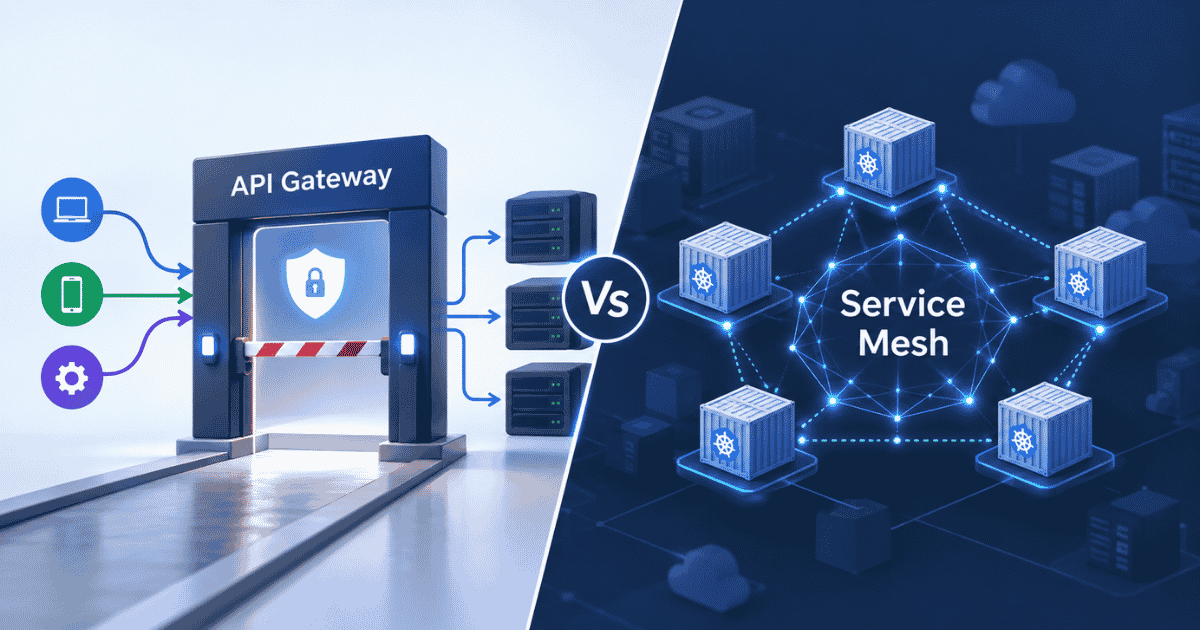
If you're building or scaling a microservices architecture, you'll hit this question sooner or later: do you need an API gateway vs service mesh, or both? The short answer is that they solve different problems.
An API gateway acts as the layer that handles external traffic management, everything coming in from outside your system. A service mesh manages service-to-service communication happening on the inside, between your internal services. Most production systems past a certain size end up using both a service mesh and an API gateway together, not because it's trendy, but because each one covers a gap the other doesn't, which is a similar kind of tradeoff you face when choosing between microservices vs monolith architecture for your product.
This guide breaks down what each one actually does, where they overlap, where they don't, and how to decide what your system needs right now instead of what you might need in two years.
API Gateway Vs Service Mesh: At A Glance
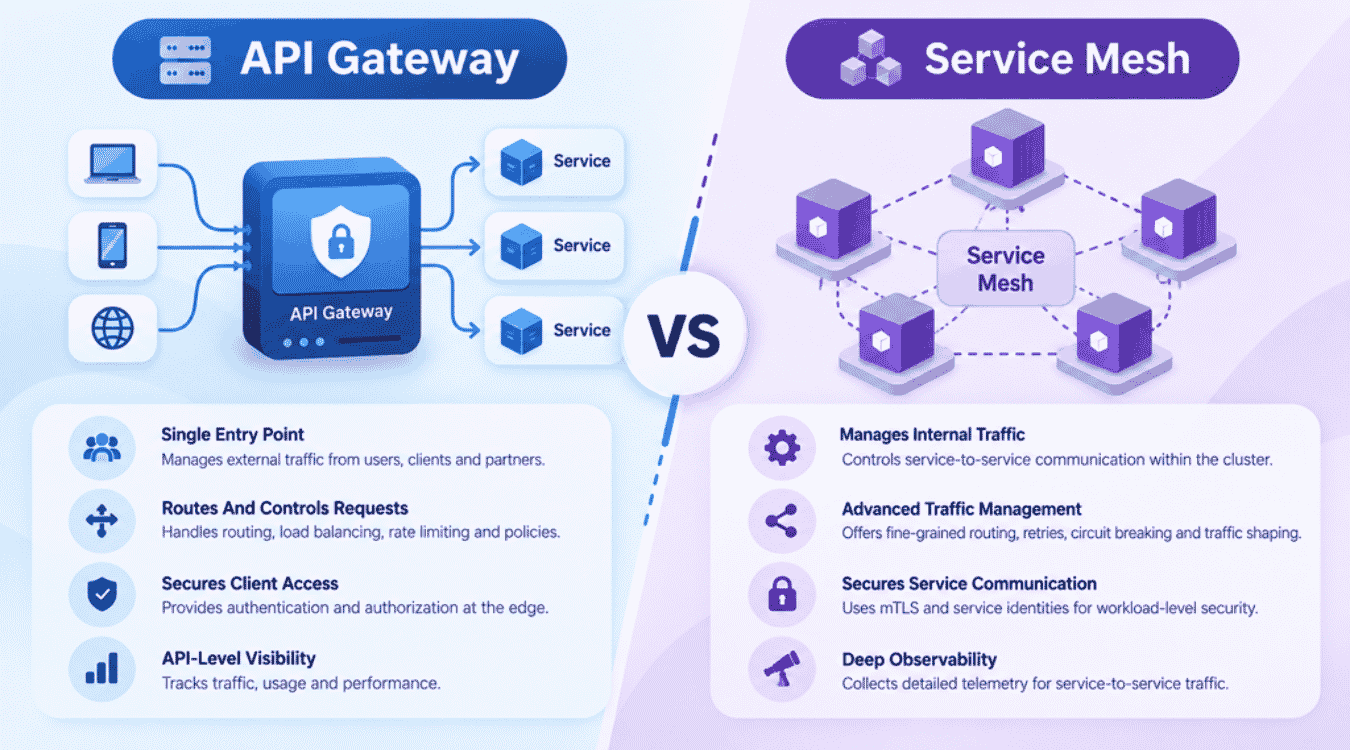
An API gateway sits at the network edge of your system. It's the single entry point for client requests coming from browsers, mobile apps, partner integrations, or any external consumers. The API gateway serves as a unified interface for external requests, handling routing, user authentication, rate limiting, and request/response transformation before traffic reaches your backend services.
A service mesh sits inside your system, one layer below. It's the infrastructure layer that handles internal communication between your microservices: service discovery, load balancing, retries, encryption, and observability for internal traffic that never reaches the outside world. In short, a service mesh manages everything that happens after a request has made it inside.
API Gateway | Service Mesh | |
|---|---|---|
Traffic direction | North south traffic (external to internal) | East-west (service to service) |
Primary job | Edge and API management: routing, auth, rate limiting | Internal traffic and service interactions: discovery, resilience, security |
Typical deployment | Centralized, at the edge | Decentralized, sidecar or per-node |
Who uses it | Every client-facing microservices architecture | Architectures with many internal services |
What Is An API Gateway?
An API gateway is a single entry point that sits between external clients and your backend services. Instead of every client talking directly to every service instance, all client requests go through the gateway first, which is what makes it such an effective tool for api management at scale.
A typical API gateway handles:
- Request routing to the correct backend service
- User authentication and authorization for incoming traffic
- Rate limiting and throttling to protect backend services from overload
- Protocol translation across different communication protocols (for example, REST to gRPC)
- Response aggregation from multiple services into one unified interface
- Analytics on API usage and api performance
Because it's the front door, the gateway is also where you enforce business logic tied to API access: who gets in, how much traffic they're allowed, and what version of an API they're calling, which pairs naturally with an API-first architecture for scalable systems, a thoughtful API integration strategy, and any API monetization strategy you adopt, as well as decisions around whether to expose your services through GraphQL vs REST API styles. Many api gateways on the market today, including Kong Gateway, AWS API Gateway, Azure API Management, Apigee, Tyk, and Traefik, cover most of this out of the box.
What Is A Service Mesh?
A service mesh is an infrastructure layer that manages service to service interactions between your internal microservices. Instead of every service handling its own retries, encryption, and service discovery in application code, the mesh handles it transparently, usually through a proxy deployed alongside each service instance (a sidecar) or, in newer architectures, without one at all.
A service mesh typically provides:
- Service discovery, so services communicate without hardcoded addresses
- Load balancing across every service instance
- Mutual TLS (mTLS) encryption for reliable communication between services
- Retries, timeouts, and circuit breakers to reduce the blast radius of service failures
- Distributed tracing and detailed metrics on inter service communication
The mesh doesn't care what's outside your cluster. It's entirely focused on making internal microservices talk to each other reliably, securely, and visibly. Modern service meshes worth knowing include Istio, Linkerd, Kuma, Kong Mesh, and Cilium, all of which need to be aligned with solid Kubernetes security practices in real-world clusters.
API Gateway Vs Service Mesh Vs Ingress Controller
This is where a lot of confusion starts, because all three sit somewhere in the traffic flow and all three do some kind of routing. Here's how they actually differ.
API Gateway | Ingress Controller | Service Mesh | |
|---|---|---|---|
Scope | Full API lifecycle and policy enforcement at the edge | Basic HTTP/HTTPS routing into a Kubernetes cluster | Service to service communication inside the cluster |
Traffic direction | North south traffic | North south traffic | East-west, internal traffic |
Typical features | Auth, rate limiting, transformation, analytics | Path/host-based routing, TLS termination | mTLS, load balancing, circuit breakers, tracing |
Runs where | Edge of the system, can be outside Kubernetes | Kubernetes-native, at the network edge | Inside the cluster, alongside every service |
Complexity to adopt | Moderate | Low | High |
Key Differences Between API Gateway And Service Mesh
Once you understand what each layer does, the real differences show up in the details: how traffic flows, who gets authenticated, how services locate each other, and how much complexity each layer brings to teams.
Traffic Direction And Scope
Traffic direction is the fastest way to tell these two apart. Everything arriving from outside your system counts as one type, and everything moving between your own services counts as another, each demanding a completely different kind of handling.
An API gateway handles north-south traffic: requests coming in from outside the system. A service mesh handles east-west traffic: service-to-service communication happening between multiple services inside the system. This is the single most useful mental model for keeping the two straight. If a request originates from an external client, it's gateway territory. If it's one internal service calling another, it's mesh territory.
Routing And Traffic Control
Routing decisions look similar on the surface since both layers point requests somewhere, but the logic behind them differs completely. One layer thinks in terms of URLs and versions, the other thinks in terms of service health and instance availability.
Gateways route based on API-level concerns: URL paths, HTTP methods, API versions, and client identity. Meshes route based on service identity and health: which service instance is healthy, which region it's in, and how to split traffic between versions for canary releases. Both are technically managing traffic, just at different layers of the request.
Authentication And Authorization
Authentication happens twice in a well-secured system, and each instance means something different. One checks whether the caller is who they claim to be. The other checks whether the calling service is actually allowed to reach the one it's requesting.
The gateway is usually where you validate API keys, OAuth 2.0 tokens, or JWTs from external clients, often alongside OpenID Connect for identity federation. The mesh handles a different kind of authentication entirely: proving that Service A really is Service A when it calls Service B, independent of any user identity. Many production systems check user authentication at the gateway and service-level identity in the mesh, and both are necessary for a genuinely secure system.
Service Discovery And Communication
Static routing works fine when your backend list barely changes. It breaks down fast in environments where services scale up and down constantly, get rescheduled across nodes, and need something smarter than a fixed list to find each other reliably.
Gateways typically route to a fixed, known set of backend services. Meshes handle service discovery dynamically because internal service instances scale up, scale down, and get rescheduled constantly, especially in cloud native environments running on Kubernetes. A mesh keeps track of what's alive and healthy in near real time so requests don't get routed to a dead service instance.
Observability And Monitoring
Monitoring one layer only tells half the story of what happened to a request. The outside view shows what came in and how fast it left. The inside view shows every hop a request took once it entered your system.
A gateway gives you visibility into API usage from the outside: which endpoints are hit, by whom, how often, and with what latency, which alone can provide valuable insights into how external consumers actually use your API and how to tune your API testing tools and pipelines. A mesh gives you visibility into what happens after that request enters your system: which service called which, how long each hop took, and where service failures happened along the chain. Distributed systems are hard to debug without both views of the traffic flow.
Deployment And Operational Complexity
Adding one more component is a manageable change for most teams. Adding a proxy next to every running service instance is a different scale of commitment entirely, and it's the reason a lot of teams wait longer than they probably should.
An API gateway is usually one component to deploy and manage; it's a well-understood addition to most architectures. A service mesh is a bigger operational commitment. Sidecar-based meshes add a proxy next to every single service instance, which means more resource usage, more configuration surface, and a real learning curve for the team running it. This is the main reason smaller teams delay adopting a mesh even when they clearly have east-west traffic that could benefit from one.
Security: mTLS And Zero Trust In Each Layer
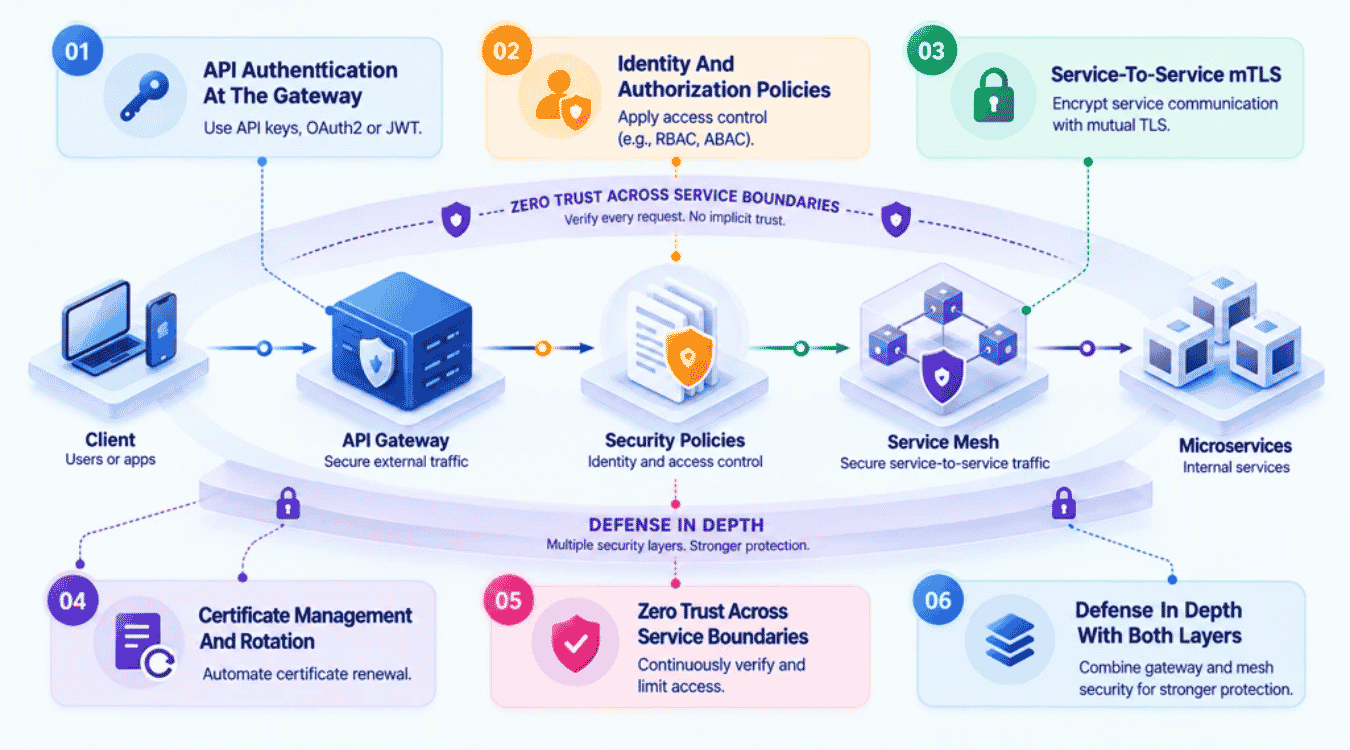
Security is one of the areas where API gateways and service meshes are most often confused for doing the same job. They enforce security controls at two different boundaries, not one.
API Authentication At The Gateway
Every external request has to prove who's making it before anything else happens. The gateway is the checkpoint for that identity check, verifying credentials once so the rest of your system doesn't need to repeat the same work downstream.
The gateway authenticates external callers. This is typically API keys, OAuth 2.0 tokens, or JWTs (often paired with OpenID Connect), validated once at the entry point so individual services don't each have to reimplement that logic.
Service-To-Service mTLS
Trusting a service just because it's inside your network is a risky assumption. mTLS removes that assumption entirely, forcing every service to prove its identity on every single call, whether the connection looks internal and safe or not.
Inside the mesh, mutual TLS (mTLS) encrypts traffic between services and verifies that both sides of a connection are who they claim to be. This matters even inside a "trusted" internal network, because a compromised service, say, a payment service that's been breached, shouldn't be able to freely talk to every other downstream service without being verified.
Identity And Authorization Policies
Encryption alone doesn't answer who's allowed to talk to whom. Authorization policies fill that gap, letting teams define exactly which services can reach which others, turning a flat network into one with real, enforceable boundaries.
A mesh typically assigns each service a cryptographic identity (often through SPIFFE/SPIRE standards) and lets you write security policies like "only the checkout service can call the payment service." This is policy enforcement at the service level, separate from anything happening at the user level.
Certificate Management And Rotation
None of this security works if certificates quietly expire or get forgotten somewhere in a growing fleet of services. Manual certificate handling doesn't scale past a handful of instances, which is exactly why automation here isn't optional.
mTLS requires certificates, and certificates need to be issued, rotated, and revoked constantly as services scale and redeploy. Meshes automate this so nobody is manually managing certificates for hundreds of service instances.
Zero Trust Across Service Boundaries
Perimeter security alone stopped being enough once attackers learned to move sideways inside a network after one breach. Zero trust assumes that can happen and checks every request anyway, regardless of where it's coming from inside your system.
Zero trust security means no service is implicitly trusted just because it's inside your network perimeter. Every service to service interaction is authenticated and authorized on its own merits. A service mesh is one of the most practical ways to actually implement zero trust across internal microservices, rather than relying on network segmentation alone, and it complements broader SaaS security architecture best practices and general best practices of SaaS architecture.
Defense In Depth With Both Layers
No single layer of security should ever be the only thing standing between an attacker and your data. Combining gateway and mesh protections means one layer's failure doesn't automatically expose everything sitting behind it.
Used together, the gateway secures the perimeter and the mesh secures the interior. If either layer is compromised or misconfigured, the other still provides comprehensive coverage as a backup. That's the real argument for running both api gateways and service meshes in any system handling sensitive data as part of a resilient SaaS infrastructure architecture.
A Quick Look At The Config: API Gateway And Service Mesh Side By Side
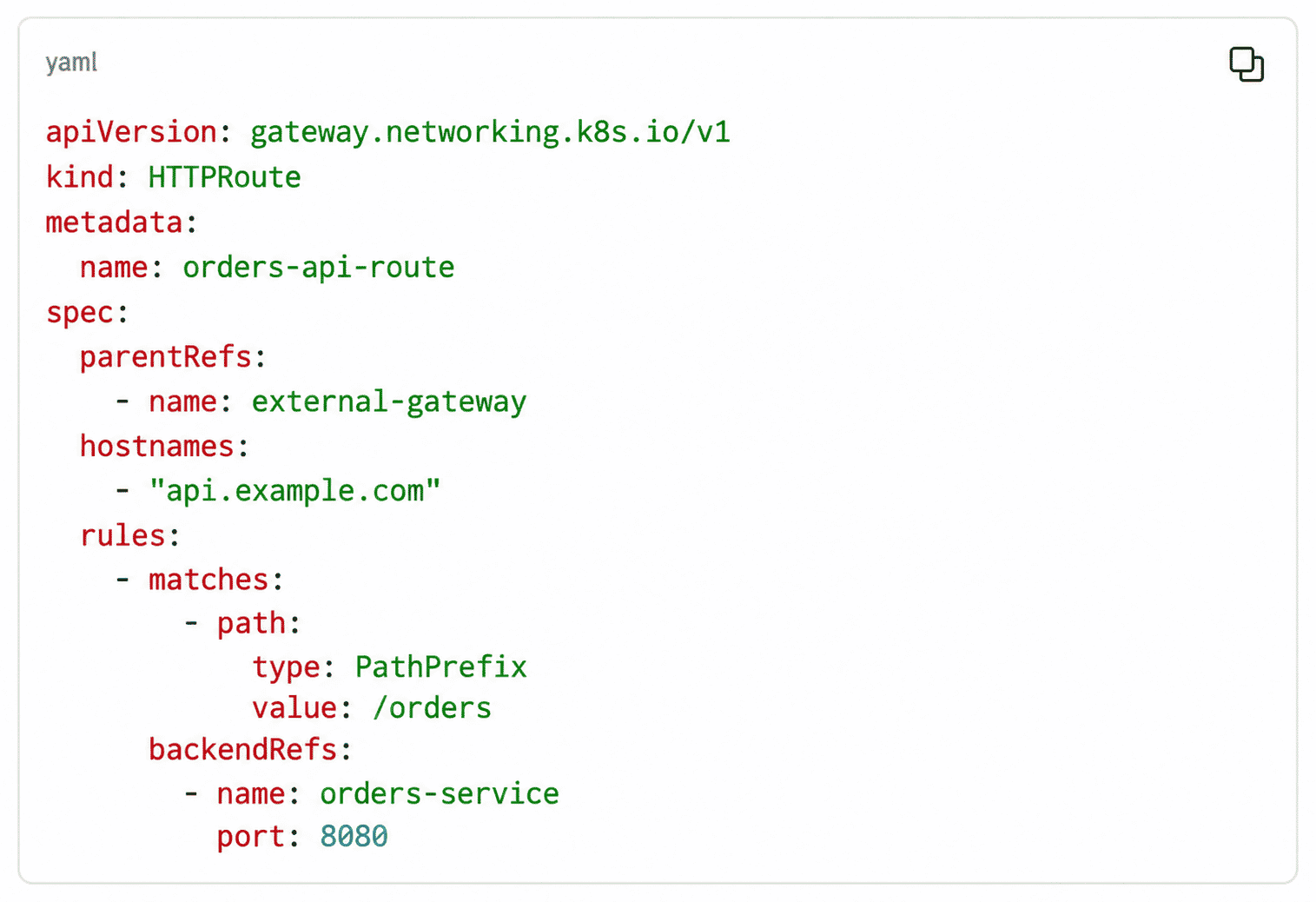
Seeing the actual config makes the distinction concrete. Here's a simplified Kubernetes Gateway API route (gateway-layer, handling incoming traffic from outside):
And here's a simplified Istio VirtualService (mesh-layer, managing traffic once it's already internal):
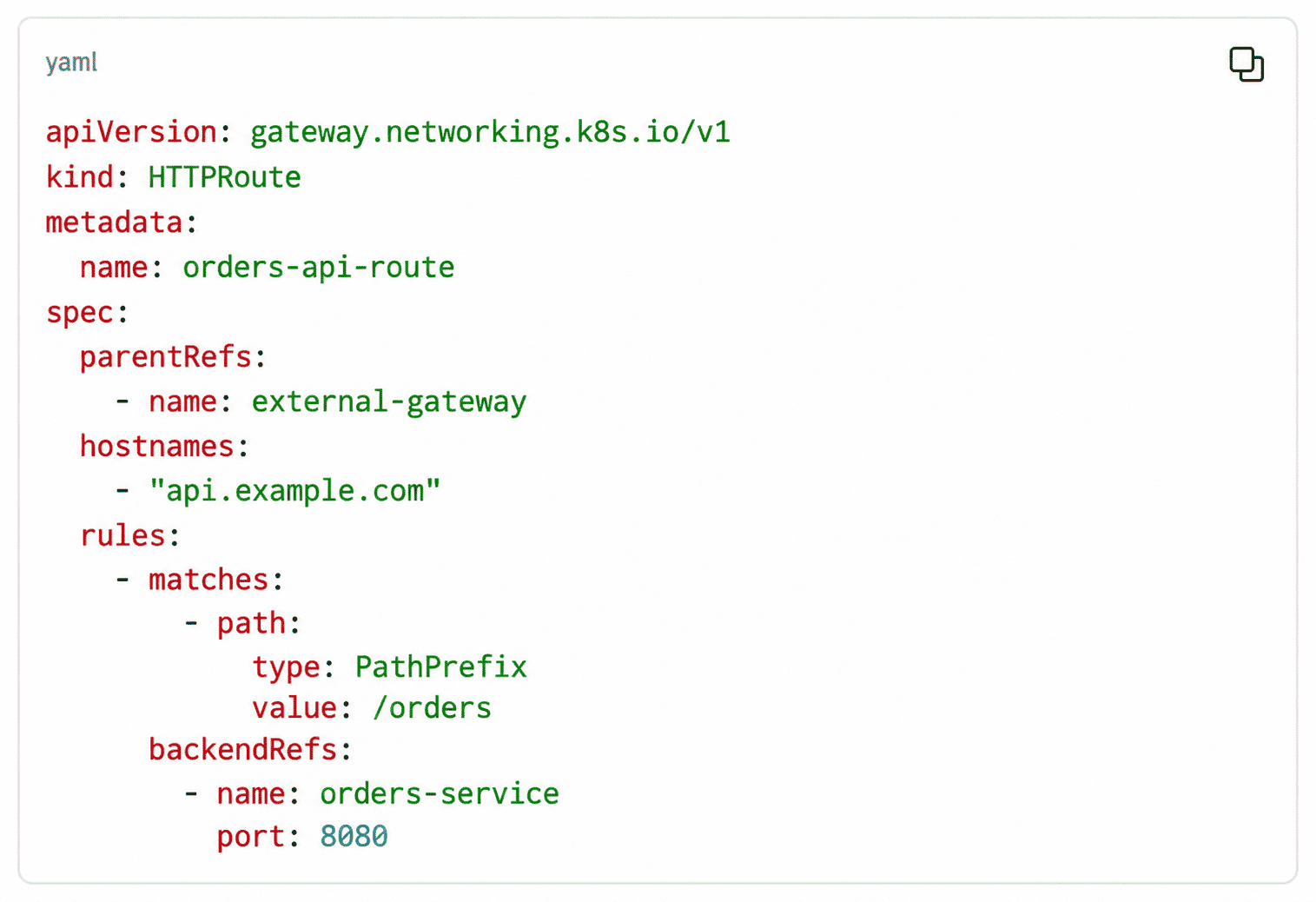
Notice the difference in what each one is optimizing for. The gateway route is about getting external traffic to the right backend service by path and host. The mesh route is about splitting traffic between service versions for a canary rollout, something that only matters once the request is already inside.
Can You Use An API Gateway And A Service Mesh Together?
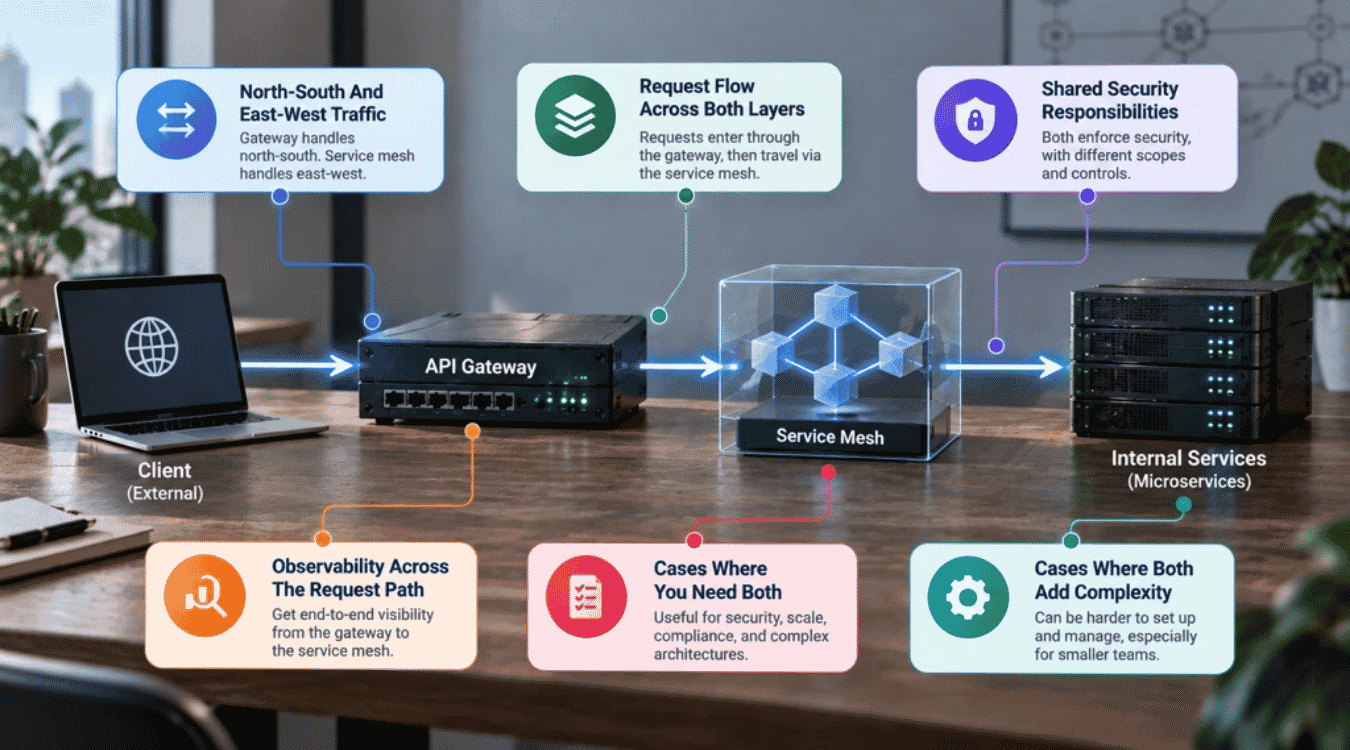
Yes, and in any system with meaningful internal traffic, running both a service mesh and an API gateway is usually the right setup rather than an either-or decision.
North-South And East-West Traffic
These two traffic types rarely compete for the same responsibility, which is exactly why running both layers together causes so little friction in practice. Each one simply handles its own half of the request's actual journey through the system.
The gateway owns north south traffic at the edge. The mesh owns east-west traffic between services. They don't compete for the same job, they cover two different halves of the same traffic flow.
Request Flow Across Both Layers
Watching one request move through a real system makes the division of labor obvious. It touches the gateway once at the edge, then hands off to the mesh for every internal hop that follows before a response finally comes back.
A typical request enters through the gateway, gets authenticated and rate limited, gets routed to the right backend service, and from there the mesh takes over: that service might call three other downstream services to fulfill the request, and each of those calls is secured, load balanced, and traced by the mesh.
Shared Security Responsibilities
Security isn't something either layer handles alone in a well-built system. Splitting the responsibility across two boundaries means an attacker has to get past both defenses, not just one, before anything internal is actually exposed.
The gateway secures the perimeter. The mesh secures the interior. Together they give you overlapping security controls instead of a single point of failure.
Observability Across The Request Path
Neither view alone tells you the full story when something goes wrong in production. Real debugging depends on stitching together what the edge saw with what happened deeper inside the system once the request actually got there.
Combining gateway-level metrics (what came in, from whom) with mesh-level tracing (what happened after) gives you a full picture of a request's lifecycle across distributed systems, which is essential for debugging latency or service failures.
Cases Where You Need Both
Certain signals make the case for both layers fairly obvious once you see them together. If several of these already describe your system, the operational cost of running both is usually worth paying for.
- You're running multiple services that call each other frequently
- You need mTLS and zero trust security internally, not just at the network edge
- You're on Kubernetes and already dealing with cloud native applications that scale dynamically
- Your team needs detailed service to service interactions traced for debugging
Cases Where Both Add Complexity
Not every system is ready for a service mesh just because it technically could use one. These signals point the other way, toward staying simple for now until the complexity is actually justified by real growth.
- You have a small number of services with simple, mostly linear communication
- Your team doesn't yet have the Kubernetes expertise to run a mesh reliably and control costs at the same time
- Your internal traffic is low volume and low risk enough that application-level libraries (like a shared HTTP client with retries) cover your needs
If you're in the second bucket, adopting a mesh too early is a common way teams add operational overhead without a matching benefit. Start with a gateway, and add a mesh once internal traffic complexity actually justifies it.
Where Message Queues Fit With API Gateways And Service Meshes
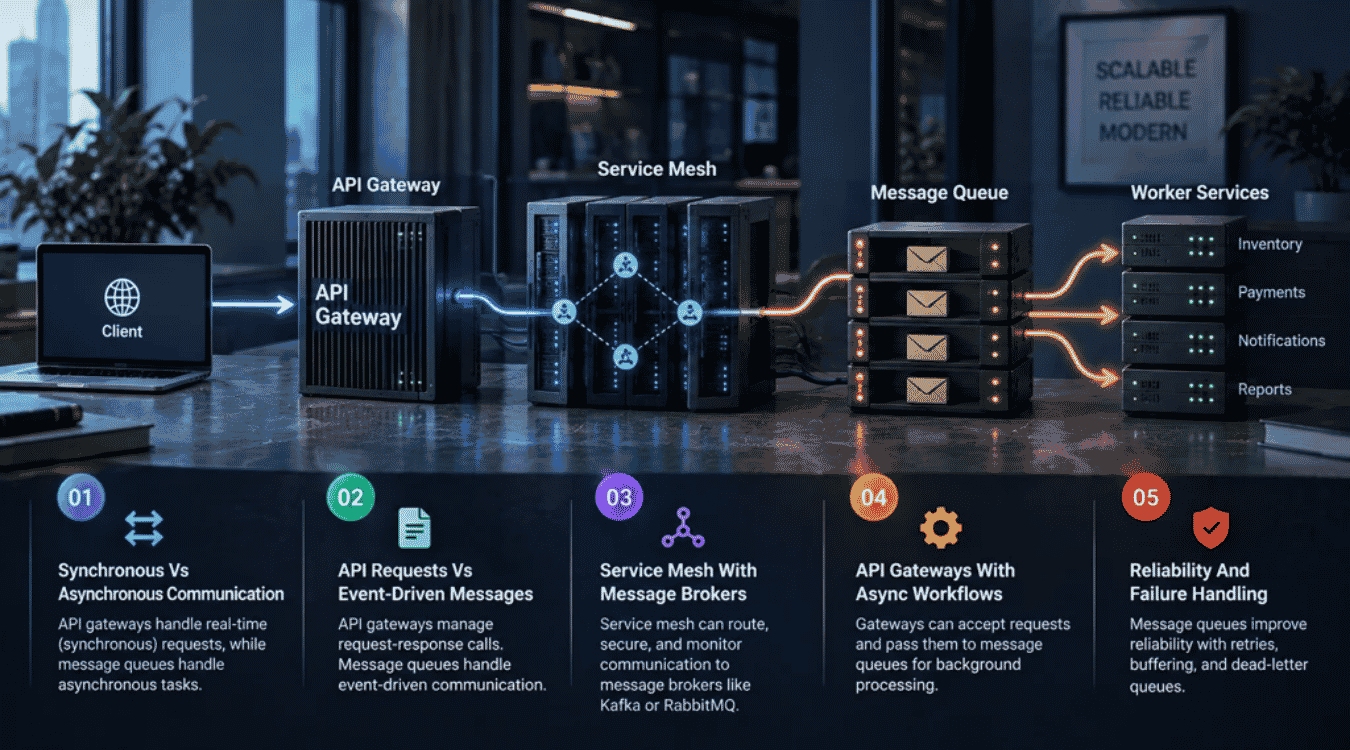
Neither an API gateway nor a service mesh replaces a message queue, because they solve a different kind of communication problem entirely.
Synchronous Vs Asynchronous Communication
Not every interaction between services needs an immediate answer, and treating them all the same way wastes resources. Splitting traffic into synchronous and asynchronous paths lets each one use the tool actually built for that job.
Gateways and meshes are built for synchronous, request-response traffic: a caller sends a request and waits for a response. Message queues (like Kafka, RabbitMQ, or SQS) are built for asynchronous, event-driven communication, where a service publishes an event and moves on without waiting for anyone to process it.
API Requests Vs Event-Driven Messages
The difference comes down to whether anything is actually waiting on the other end. A request blocks until it gets an answer. An event just gets published, and whatever happens to it afterward is somebody else's problem entirely.
An API call expects an immediate answer. An event on a queue might not be processed for seconds, minutes, or longer, and that's fine, because nothing is blocked waiting on it. Order confirmation emails, analytics events, and inventory updates are common examples of traffic that belongs on a queue, not behind an API call.
Service Mesh With Message Brokers
A mesh is built around the assumption that one service is calling another directly, which doesn't quite match how a broker works. That mismatch is why brokers usually sit outside the mesh's usual scope of control.
A service mesh generally doesn't manage traffic to and from a message broker the same way it manages direct service to service communication, though some meshes are adding partial support for this. Most teams still treat the message broker as separate infrastructure with its own reliability and monitoring setup.
API Gateways With Async Workflows
Async doesn't mean the gateway disappears entirely from the picture. It still has a job to do right at the handoff point, even if everything that happens after that handoff is completely outside its control.
Gateways can still play a role at the edge of async workflows, for example, accepting a webhook and publishing it to a queue for processing. But once the message is on the queue, it's out of gateway and mesh territory entirely.
Reliability And Failure Handling
Reliability means something different once messages are involved instead of live requests. A queue can hold work safely while something downstream is broken, which is a guarantee neither a gateway nor a mesh was ever built to offer.
Queues add their own reliability guarantees: message durability, retries, dead-letter queues, and ordering guarantees that neither a gateway nor a mesh is designed to provide. If your system needs downstream services to survive being offline for ten minutes without losing data, that's a queue problem, not a gateway or mesh problem.
API Gateway And Service Mesh In 2026: Ambient Mesh, eBPF, And Gateway API
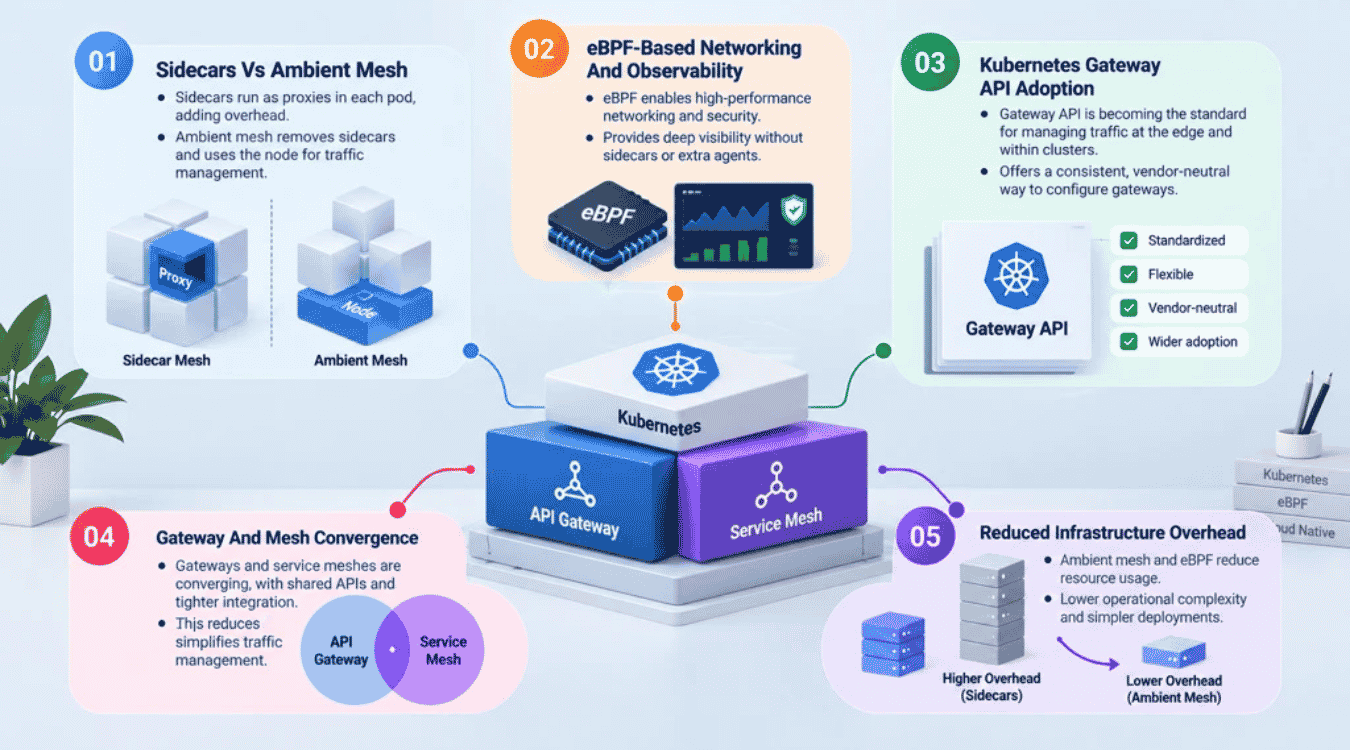
The underlying technologies behind service meshes have moved fast, and a lot of comparisons written even two years ago are already out of date on the details.
Sidecars Vs Ambient Mesh
Running a proxy next to every single service instance was the only option for years, and teams simply accepted the overhead as the cost of doing business. That assumption doesn't hold anymore now that alternatives actually exist.
The original service mesh model deploys a sidecar proxy next to every single service instance, which works but adds real memory and CPU overhead at scale. Istio's ambient mesh mode removes the sidecar entirely, moving mesh functionality to shared node-level infrastructure instead. This helps control costs significantly in large clusters while keeping most of the mesh's security controls and traffic management capabilities intact.
eBPF-Based Networking And Observability
Moving mesh functionality out of user-space proxies and into the kernel itself sounds like a small implementation detail, but it changes the performance math considerably. Fewer hops usually means less latency added to every single request.
Projects like Cilium use eBPF, a Linux kernel technology, to handle networking and security at the kernel level instead of through user-space proxies. This is a meaningfully different architecture from sidecar-based meshes and tends to optimize performance further, offering lower latency overhead, though it's a newer approach with a different operational learning curve.
Kubernetes Gateway API Adoption
Ingress got teams far enough for basic routing, but it was never designed for much more than that. The Gateway API picks up where it left off, built specifically for the kind of role-based control modern teams actually need.
The Kubernetes Gateway API has reached general availability and is steadily replacing the older Ingress API as the standard way to manage external traffic into a cluster. It's designed to be more expressive and role-oriented than Ingress, and it's increasingly the layer that both API gateways and service meshes build on for consistent configuration and for powering external-facing developer portals for API adoption.
Gateway And Mesh Convergence
These two categories were built by different vendors solving different problems, but the tooling underneath them is starting to look a lot more alike. That overlap doesn't erase the distinct jobs each layer is still doing.
There's a real trend toward gateway and mesh functionality converging under a shared control plane and shared APIs, particularly as more api gateways adopt the Gateway API and more service meshes support it as their configuration model too. The line between "gateway" and "mesh" as separate products is getting blurrier at the tooling level, even though the traffic patterns they manage remain distinct.
Reduced Infrastructure Overhead
Every one of these shifts points toward the same practical outcome for teams running this infrastructure day to day. Doing the same job with less hardware, less configuration, and less operational babysitting is the whole point.
Across ambient mesh, eBPF-based approaches, and tighter Gateway API integration, the overall direction is the same: less resource overhead and less operational burden for the same north-south and east-west traffic management capabilities that used to require heavier sidecar deployments.
API Gateway And Service Mesh Tools Compared
API Gateway | Best known for |
|---|---|
Kong Gateway | Open-source core, large plugin ecosystem |
AWS API Gateway | Fully managed, tight AWS integration |
Azure API Management | Enterprise-grade, deep Azure ecosystem integration |
Apigee | Enterprise API management, strong analytics |
Tyk | Open-source, lightweight, self-hosted friendly |
Traefik | Kubernetes-native, simple configuration |
Service Mesh | Best known for |
Istio | Feature-rich, largest ecosystem, ambient mesh support |
Linkerd | Lightweight, simpler operational footprint |
Kuma | Built on Envoy, multi-mesh and multi-zone support |
Kong Mesh | Enterprise Kuma distribution, pairs naturally with Kong Gateway |
Cilium | eBPF-based, strong performance and security focus |
How To Decide Which One You Need
Use this as a quick gut check rather than a rigid rule:
- Just a handful of services, one clear entry point: an API gateway alone is enough. Don't add a mesh yet.
- Growing number of internal services calling each other, but manageable: API gateway plus lightweight internal resilience patterns (retries and timeouts in your service code, or a simple lightweight mesh like Linkerd).
- Many services, real internal security and observability requirements, running on Kubernetes: API gateway plus a full-featured mesh like Istio or Cilium, handling load balancing and encryption for you.
- Simple internal architecture but heavy compliance/security requirements: consider a mesh for the mTLS and zero trust benefits even if your service count is moderate, since the security case can justify it on its own.
- Async, event-driven workloads: neither replaces a message queue. Add one alongside whichever of the above applies.
The team size and Kubernetes maturity matter as much as the architecture itself. A five-person team running a moderately complex system is usually better off with a gateway and simple in-code resilience than taking on a full service mesh before they have the operational bandwidth to run it well and control costs along the way.
Final Thoughts
An API gateway and a service mesh aren't competing solutions to the same problem, they're two layers solving two different problems: one manages external traffic management at the edge, the other manages internal communication once a request is already inside. Most systems start with just a gateway, and add a mesh only once service to service communication gets complex enough, and risky enough, to justify the added operational weight. Get the traffic direction and scope right first, and the rest of the decision tends to follow naturally.