CQRS Pattern Explained: When To Use It And When Not To
by Rhea Collins | Aug 30, 2026 | Software Development Insights
Table of Contents
Most teams reach for CQRS because a blog post said it scales better. Few stop to ask what breaks first.
Command Query Responsibility Segregation splits a system's write path from its read path, letting each scale, model, and fail independently of the other. Netflix, Uber, and plenty of mid-size SaaS platforms run some form of it in production today. So do teams who adopted it for the wrong reasons and now maintain two data models, an event pipeline, and a debugging process nobody enjoys.
Here's the real question worth answering before writing a single command handler: does your read and write load actually diverge enough to justify the split? This guide covers the architecture, the failure modes nobody mentions in the diagrams, and a practical path for migrating an existing CRUD system without a rewrite.
What Is CQRS?
Command Query Responsibility Segregation, or CQRS, splits an application into two distinct paths: one for write operations, one for reads. Bertrand Meyer's original Command Query Separation principle stated that a method should either change state or return data, never both. CQRS takes that idea further by applying it at the architecture level, not just the method level.
Traditional CRUD relies on separate models built from a single shared model for both jobs. CQRS uses separate databases instead: a write model built for validation and persistence, and a read model built purely for fast queries.
How CQRS Architecture Works
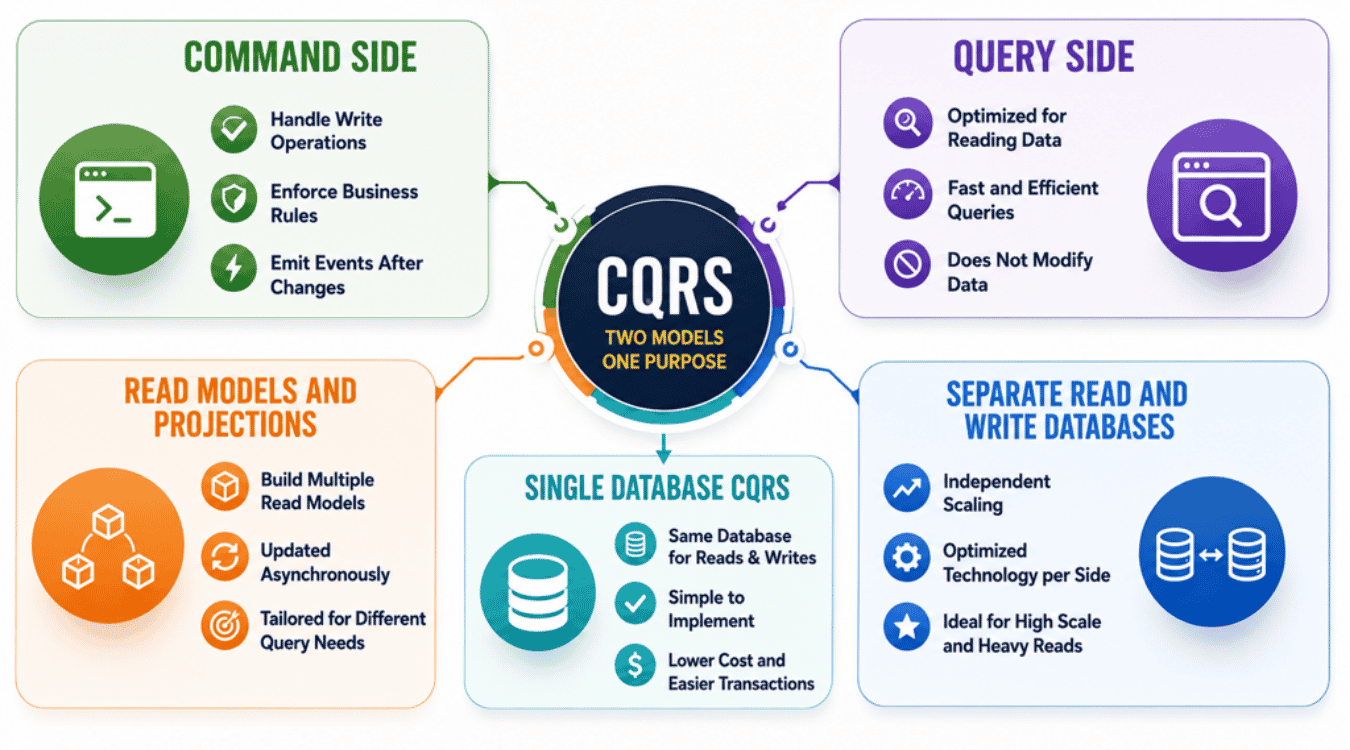
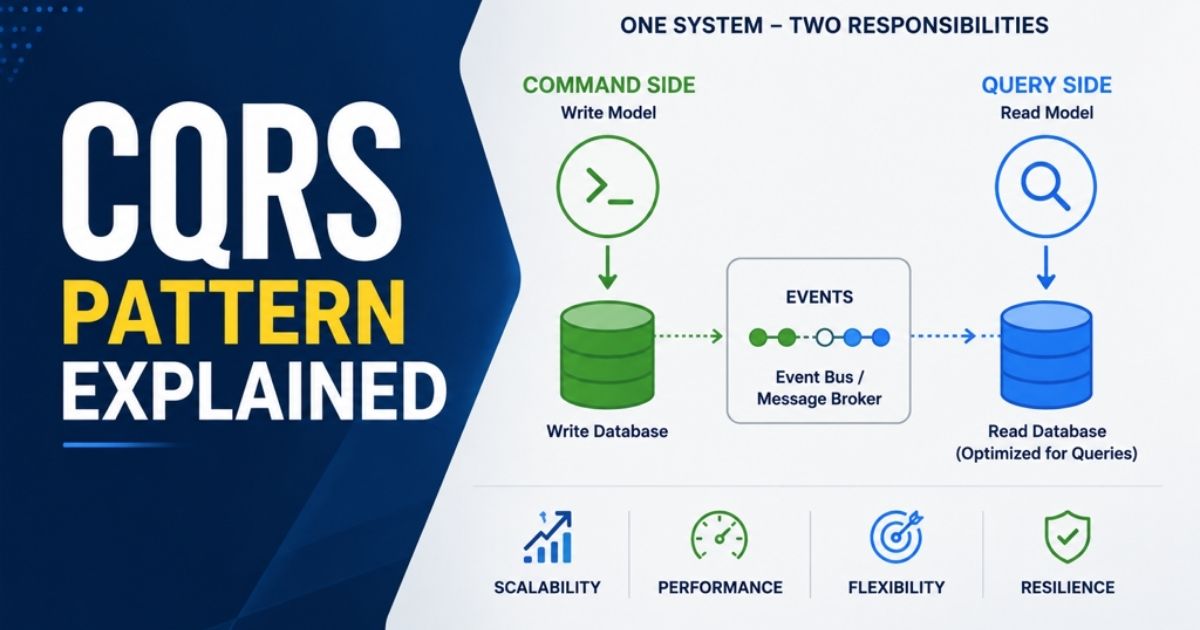
CQRS architecture rests on two distinct models working side by side instead of one shared structure trying to serve every purpose. Each side owns its own logic, its own data flow, and its own rules for handling requests.
Command Side
The command side handles every write operation in the system, from creating a new order to updating a customer's account. It contains the domain model, the object structure that encodes business rules and validation logic. A command represents intent, not a database update, so "place order" matters more than "set status to pending."
Handlers process commands one at a time, run domain validation, then persist changes. Nothing here returns data to the caller. Success or failure is all a command reports back, keeping the write side focused purely on protecting data integrity.
Query Side
The query side answers every read request without touching write logic. It relies on its own query model, shaped around what the interface needs rather than how data gets written. A query returns a data transfer object built for display, never a domain entity carrying rules it doesn't need.
Because queries never modify anything, they carry zero risk of side effects. Teams can add new query models freely, one for a dashboard, another for a mobile app, without changing a single line of write-side code. Flexibility here is exactly why CQRS earns its reputation for adapting to new use cases fast.
Read Models And Projections
Read models rarely mirror the write model's structure. Projections reshape that data into whatever the read side needs, a denormalized table, a search index, a cached view, whichever fits the query pattern best. Projections listen for events published whenever a command succeeds, then rebuild themselves to match.
A messaging system typically carries those events from the write side to the read side. Queues or an event bus keep projections synced without a direct connection between the two databases. Delay between an event firing and a projection updating is the real tradeoff, small most of the time, but worth monitoring when reads must reflect writes almost instantly.
Single Database CQRS
Single database CQRS keeps both models pointed at the same data store, just with separate logic for reading and writing. Command and query code paths stay distinct, but the underlying tables stay shared. Teams often start here because it needs no new infrastructure and no event pipeline to maintain.
Cleaner code, clearer intent, and easier testing come with this setup, without the operational overhead of running two databases. Scaling read and write independently isn't possible yet, since both still compete for the same storage layer.
Most teams treat single database CQRS as a stepping stone toward full separation.
Separate Read And Write Databases
Separate read and write databases give each side its own storage engine, tuned for its own job. Write side might run on a relational database built for transactions, while the read side runs on a document store or search engine built for fast lookups. Each database scales on its own schedule.
Data consistency becomes the main tradeoff once two databases stay in sync only through events. Reads may lag behind the latest write by a few milliseconds to a few seconds depending on the messaging system's throughput. Teams accept eventual consistency here in exchange for independent scaling and simpler, more specialized data models on each side.
CQRS Consistency And Production Failure Modes
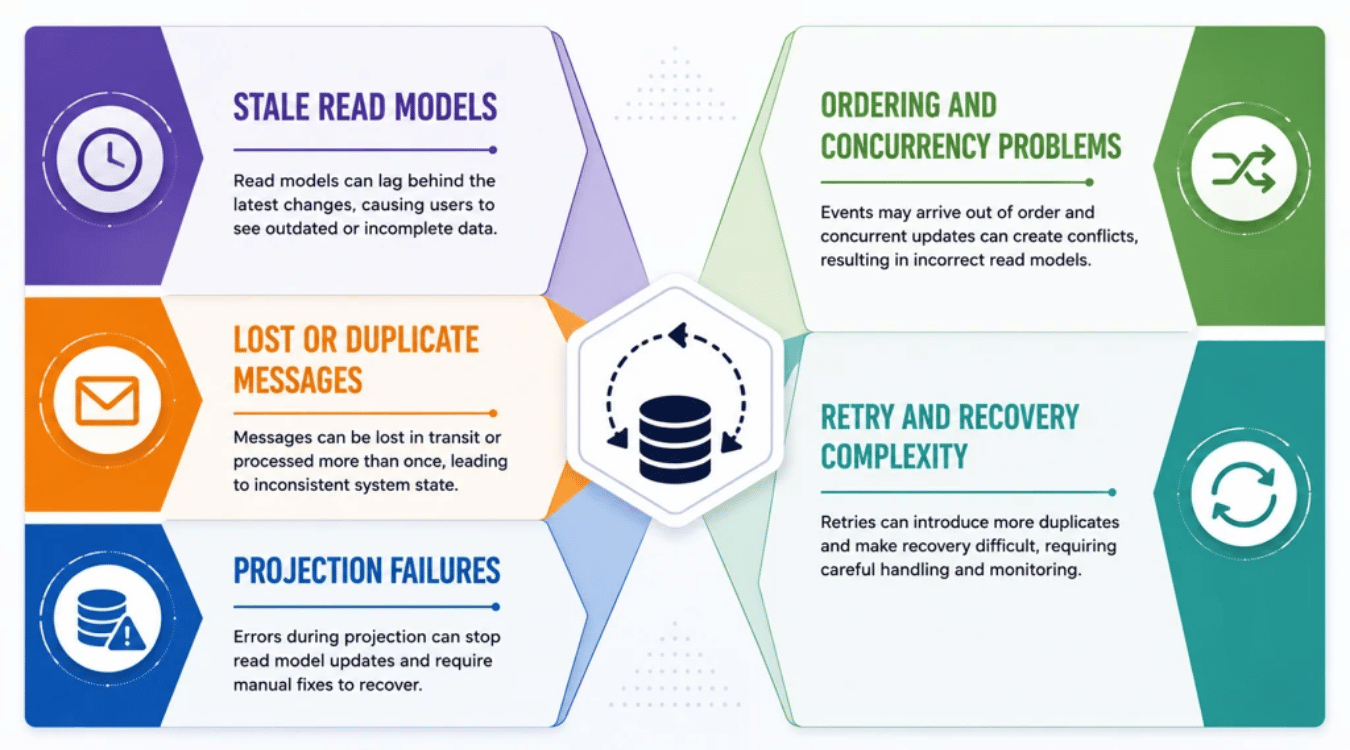
Running two models instead of one buys flexibility, but it introduces failure points a single database never had. Distributed systems fail in ways that CRUD architectures simply don't encounter, and most of these problems only surface once real traffic hits production.
Stale Read Models
Read database updates lag behind write-side changes by design, since projections sync through events rather than a shared transaction. Most of the time that delay is a few milliseconds, invisible to users. Under load, or when a projection falls behind, that gap widens into seconds.
A customer updates their shipping address, then immediately sees the old one on the confirmation screen. Nothing broke technically, but the experience feels broken. Teams that scale independently across read and write sides need a plan for surfacing this lag, whether that's a loading state, a version check, or simply setting expectations in the UI.
Lost Or Duplicate Messages
Messaging systems fail in two directions: they drop messages, or they deliver the same one twice. Network blips, broker restarts, and consumer crashes all create these gaps. Business logic on the read side has to assume either scenario will eventually happen, not treat it as an edge case.
Idempotent handlers solve the duplicate half of the problem. Assigning each command a public GUID ID lets the projection check whether it already processed that exact event before applying it again. Lost messages need a different fix entirely, usually a dead-letter queue and a replay mechanism that rebuilds the read side from the event log.
Projection Failures
A projection can crash mid-update, throw an exception on malformed data, or simply stop consuming events without any obvious error. Since projections run asynchronously, nothing in the command path notices when this happens. The read database quietly stops reflecting reality while writes keep succeeding.
Monitoring lag between the write side and each projection catches this before users do. Relational databases used for the read side make this easier to detect, since row counts and timestamps offer a clear signal. Rebuilding a projection from scratch by replaying stored events is usually the recovery path, which is exactly why keeping that event history intact matters.
Ordering And Concurrency Problems
Events don't always arrive in the order they were created, especially across multiple queue partitions or retried deliveries. A projection that assumes strict ordering will corrupt its own state the first time two events arrive out of sequence. This is where CQRS starts to introduce significant complexity most teams underestimate going in.
Versioning events per aggregate, or including a sequence number a projection can check before applying an update, fixes most ordering issues. Concurrency adds another layer: two commands touching the same entity at once need optimistic locking or a conflict-resolution rule, not just a database transaction to fall back on.
Retry And Recovery Complexity
Failed commands and failed projections both need retry logic, but naive retries risk duplicate side effects or repeated failures against the same bad input. A payment command that times out shouldn't simply fire again without checking whether the first attempt actually succeeded.
Building this well means combining idempotency keys, exponential backoff, and a dead-letter path for whatever keeps failing after several attempts. None of this is unique to CQRS, but running two models instead of one doubles the surface area where retries can go wrong, which is the tradeoff teams accept to optimize performance on both sides independently.
When To Use CQRS And When It Is Overkill
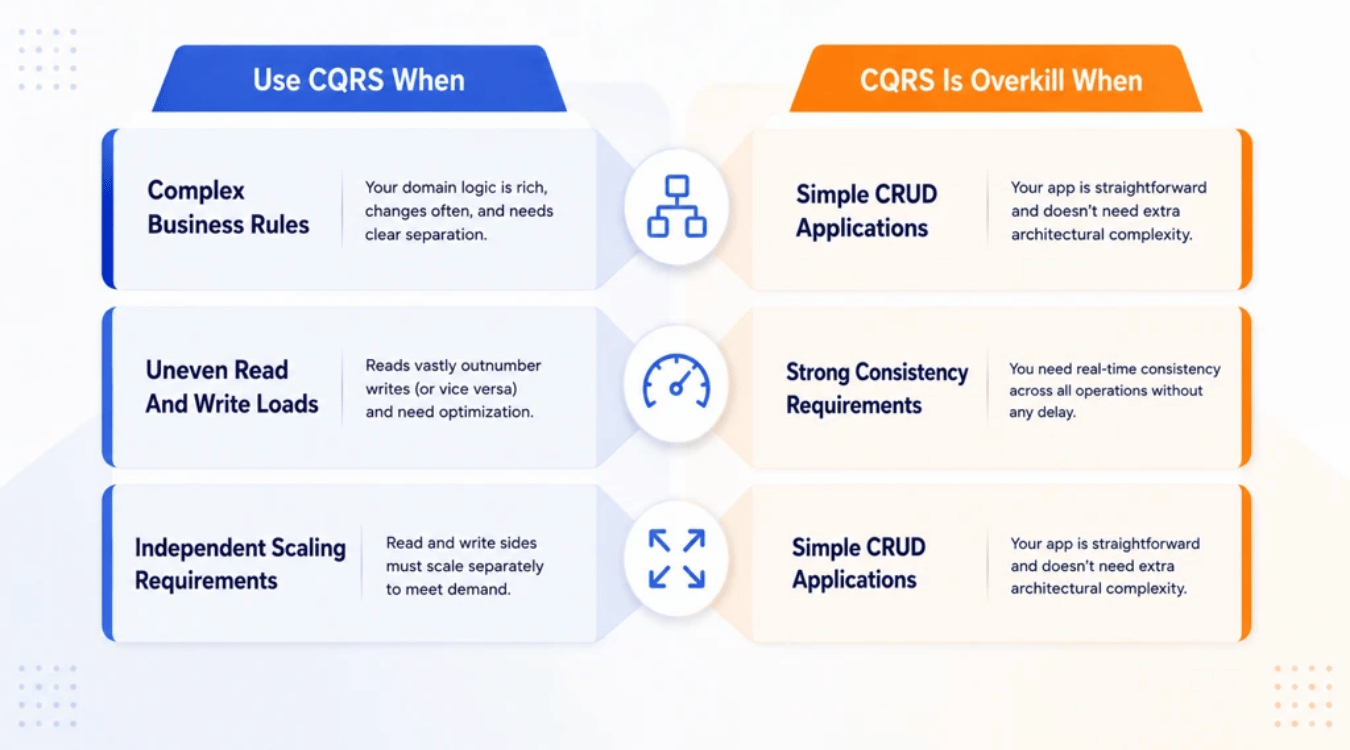
Deciding whether CQRS fits your system comes down to one real question: does splitting reads from writes solve an actual problem, or add complexity nowhere near justified yet. Some systems need it badly. Most don't, and forcing it early usually backfires.
Complex Business Rules
Complex business rules turn a single shared model into a tangle of conditionals fast. When commands need multi-step validation, cross-entity checks, or workflow-specific logic, isolating that weight on the write side keeps the whole system maintainable.
CQRS pairs naturally with domain-driven design here, since the write model can enforce every rule without the read side inheriting any of it. Systems with genuinely complex domains- insurance underwriting, loan approval, order fulfillment- benefit most, since the added structure earns its keep instead of adding pure overhead.
Uneven Read And Write Loads
Most applications read far more than they write, sometimes by a factor of 100 to 1. Forcing both operations through the same model means every read pays for structures built to support writes it never touches.
Splitting the two lets the read side focus purely on efficient querying, shaped around exactly the required data a screen or report actually needs. The write side stays lean too, freed from carrying denormalized fields that only exist to make reads faster. This mismatch alone justifies CQRS for plenty of systems.
Independent Scaling Requirements
Read and write workloads rarely share the same performance requirements. A write-heavy checkout flow needs strict consistency at moderate throughput, while a read-heavy product catalog needs speed at massive scale with looser consistency.
Running each side on different databases, or even different database technologies entirely, lets teams tune each independently instead of compromising both. A relational store handles writes with transactional guarantees, while a search index or cache handles reads. Improved performance on both ends is the direct payoff of scaling them apart.
Simple CRUD Applications
Simple CRUD applications, a basic content site, an internal admin tool, a small inventory tracker, rarely benefit from CQRS. When reads and writes touch the same handful of tables with no complex validation, one shared model is a common pattern for good reason: it's simpler to build, test, and maintain.
Adding CQRS here means maintaining two models, an event pipeline, and eventual consistency for a problem that never existed. The complexity tax outweighs any theoretical benefit until the system actually grows into needing it.
Strong Consistency Requirements
Systems that must show the same data immediately after a write- banking balances, inventory counts at checkout, safety-critical controls- don't tolerate eventual consistency well. CQRS's read side almost always lags by some margin, even a small one.
A single relational database already delivers strong consistency and audit trails through transactions and write-ahead logs, with none of the added architecture. Forcing CQRS onto a system that needs immediate consistency just trades a solved problem for a new one.
How To Implement CQRS Safely
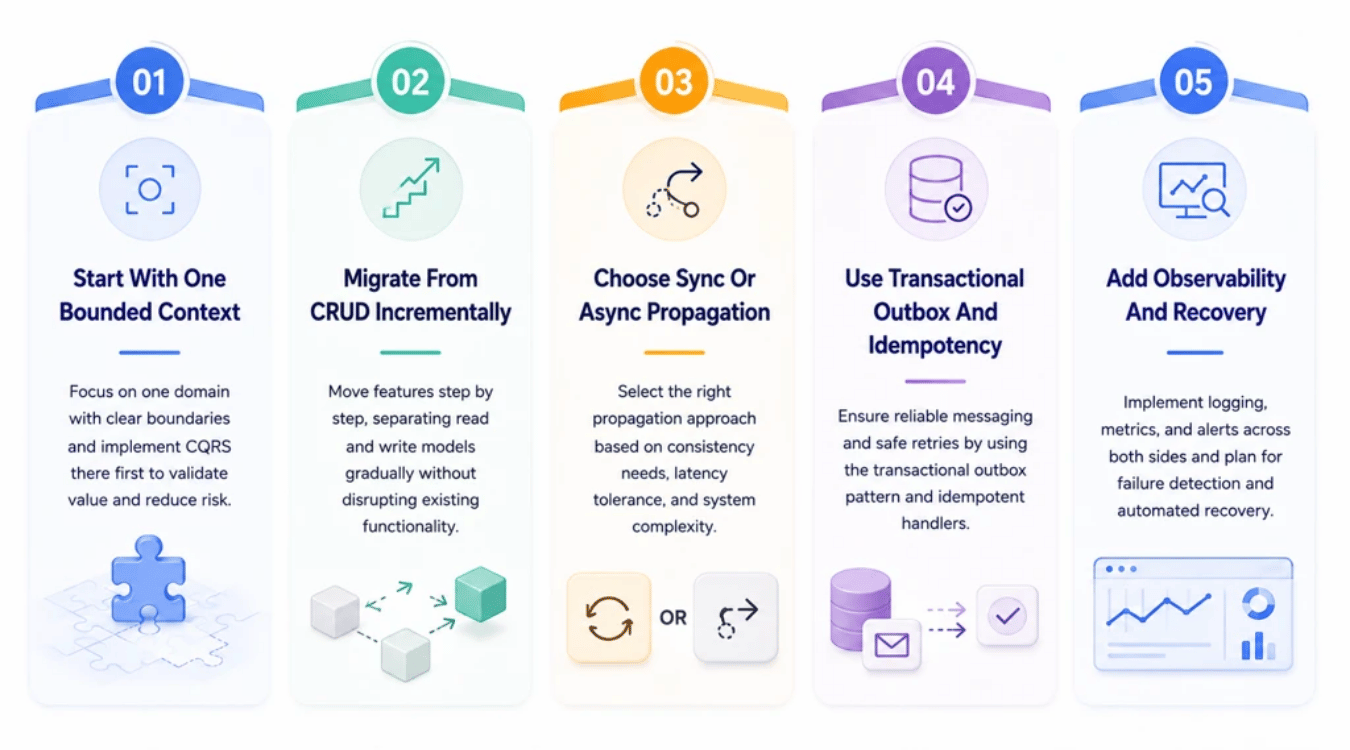
A safe CQRS implementation grows in stages, proven on a small slice of the system before spreading further. Teams that adopt it everywhere at once tend to hit performance problems and edge cases they never tested for, all in production at the same time.
Start With One Bounded Context
Pick a single bounded context, the part of the domain with the messiest write logic or the heaviest read operations, and apply CQRS there first. Order management or inventory tracking usually makes a better starting point than an entire application at once.
Keeping the rest of the system on its existing model limits how much additional complexity lands on the team at once. Lessons learned from that first context, event schema, propagation delay, and monitoring gaps carry directly into the next one, making each following rollout faster and safer than the last.
Migrate From CRUD Incrementally
Rewriting an entire CRUD system into CQRS overnight invites bugs nobody can trace back to a single change. A safer path adds the write model first, keeps the existing database as the read source temporarily, then introduces a dedicated read model once the write side proves stable.
Running both models side by side for a few weeks, with feature flags controlling which path serves live traffic, catches mismatches before they reach every user. This staged approach costs more calendar time upfront but avoids the all-or-nothing risk a full rewrite carries.
Choose Sync Or Async Propagation
Sync propagation updates the read model in the same transaction as the write, guaranteeing consistency but tying both operations to the same latency and failure risk. Async propagation decouples them through events, trading immediate consistency for the ability to improve scalability on each side independently.
Most systems land on async once traffic grows past a certain point, since sync propagation caps throughput at whatever the slower side can handle. Sync still makes sense for smaller systems or contexts where a stale read is genuinely unacceptable, even briefly.
Use Transactional Outbox And Idempotency
Publishing an event right after a database write creates a gap where the write succeeds, but the event never sends, or sends twice. The transactional outbox pattern closes that gap by writing the event to the same database transaction as the change itself, then relaying it separately.
Tagging every command and event with a public GUID lets consumers check whether they already processed that guid ID before acting on it again. Together, these two patterns are what most real-world CQRS implementations rely on to survive network failures without corrupting state.
Add Observability And Recovery
Projection lag, dropped events, and failed handlers all fail silently unless something is watching for them. Dashboards tracking the gap between write timestamps and read-model timestamps catch drift before users notice a stale screen.
A documented recovery path, replaying events from a known point to rebuild a broken projection, turns a production incident into a routine fix instead of a multi-hour outage. Teams that skip this step usually learn its value the hard way, during the first real failure rather than before one.
How To Test CQRS Systems
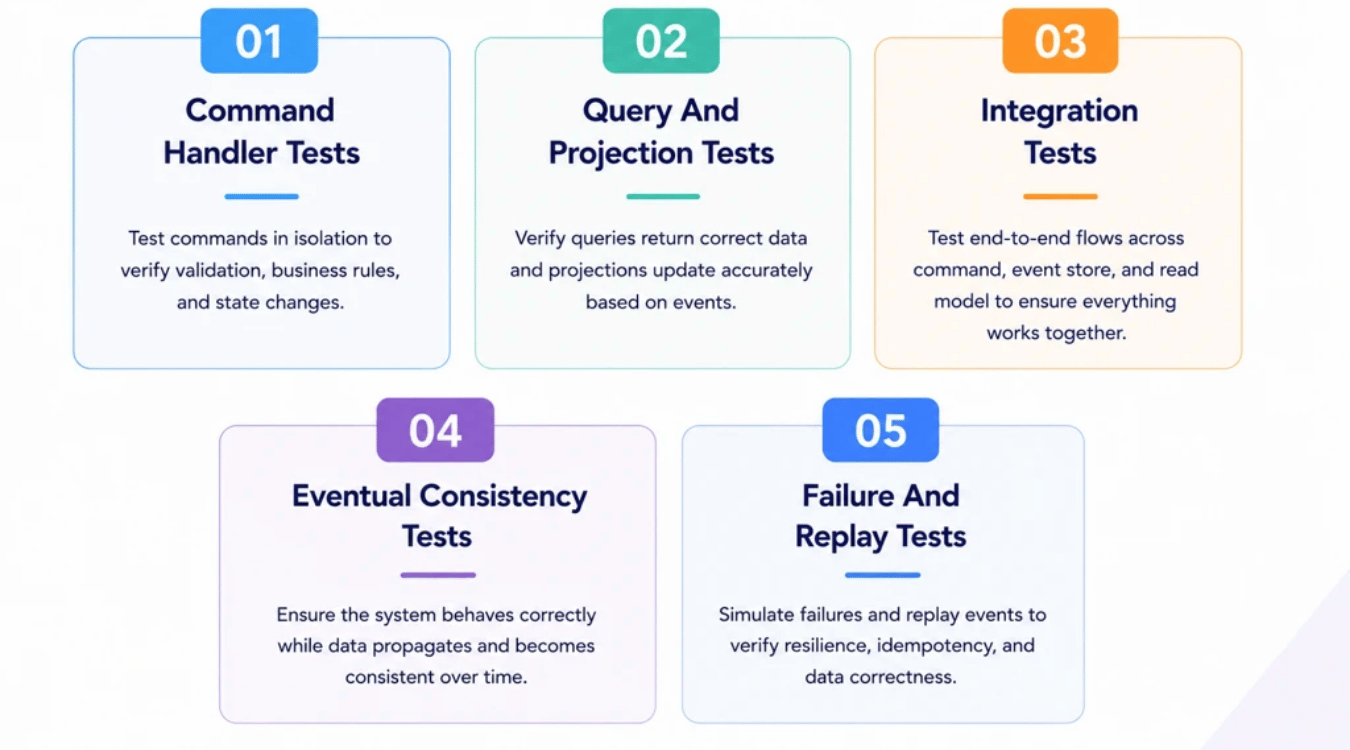
Testing a split architecture means testing two systems that happen to work together, not one. Skipping either side, or ignoring how they interact, is how the trade-offs of CQRS turn into production surprises nobody caught in a code review.
Command Handler Tests
Command handler tests focus purely on business logic, feeding in domain objects and checking that validation rules reject or accept them correctly. No database, no messaging system, no read side involved, just the command handler and the rules it enforces.
Fast, isolated unit tests here catch most logic bugs before anything touches infrastructure. A handler that lets an invalid state through won't get caught by any other layer of testing, since the read side has no way to validate what it never checked in the first place.
Query And Projection Tests
Query tests verify that a given set of events produces the correct read-side data, checking projections build accurate views for whatever the user actually needs to see. These tests confirm the read side transforms raw events into something usable, not just stored.
Seeding a projection with a known event sequence, then asserting the resulting query output matches expectations, catches transformation bugs early. This layer is also where teams confirm a new read model built to create a faster view actually delivers the access patterns it was designed for.
Integration Tests
Integration tests wire the command side, messaging layer, and read side together, confirming a command actually produces the correct projection end to end. This is where CQRS fits together as a whole system instead of isolated pieces tested in a vacuum.
Running these against a real or close-to-real message broker exposes issues unit tests can't: serialization mismatches, missing event handlers, or a projection that never subscribed to the right topic. Fewer of these tests than unit tests is normal, but skipping them entirely leaves the connective logic untested.
Eventual Consistency Tests
Eventual consistency tests confirm the system behaves correctly during the gap between a write and its reflected read, not just after everything settles. Asserting immediate consistency in a test suite hides a bug that surfaces the moment real network latency enters the picture.
Good tests here check reasonable propagation windows and confirm the UI handles a stale read gracefully rather than assuming instant sync. This is also where teams validate that performance under realistic lag still meets what users expect from the experience.
Failure And Replay Tests
Failure tests simulate dropped messages, duplicate deliveries, and crashed projections on purpose, confirming recovery logic actually works rather than assuming it will. Replay tests rebuild a projection from stored events and check the result matches what continuous processing would have produced.
These tests protect the real benefits of running two models, since a recovery path that only works in theory defeats the purpose of separating command and query in the first place. Teams that build this coverage early catch replay bugs long before a real outage forces the question.
CQRS Vs CRUD Vs Event Sourcing
Confusing these three often leads teams toward the wrong architecture entirely. CRUD gives every entity four interfaces: create, read, update, and delete, all operating against one shared model. Simplicity is the whole appeal, and it works well until read and write demands start pulling in different directions.
CQRS splits that single model into two, a write side handling commands and a read side handling queries, each with its own logic. Scalability improves because each side scales on its own schedule, but nothing here mandates how data gets stored underneath.
Event sourcing changes the storage layer itself. Rather than persisting current state, it saves every change as an immutable event, then rebuilds state by replaying that history. An order system built this way, for example, stores "item added" and "payment confirmed" as discrete events instead of overwriting a single order row each time something changes.
Pairing CQRS with event sourcing is common but not required. Picking the right combination comes down to what your system actually needs, not which pattern sounds most advanced. Use the table below to determine which fits.
Aspect | CRUD | CQRS | Event Sourcing |
|---|---|---|---|
Data model | Single shared model | Separate read and write models | Append-only event log |
Storage | Current state only | Current state (each side) | Full history of changes |
Complexity | Low | Moderate | High |
Best fit | Simple apps, low traffic | Uneven read/write loads | Audit-heavy, replayable systems |
Scalability | Limited, shared model | Read and write scale independently | Scales with event store design |
Consistency | Strong (single source) | Often eventual | Eventual, rebuilt via replay |
Best Practices For CQRS
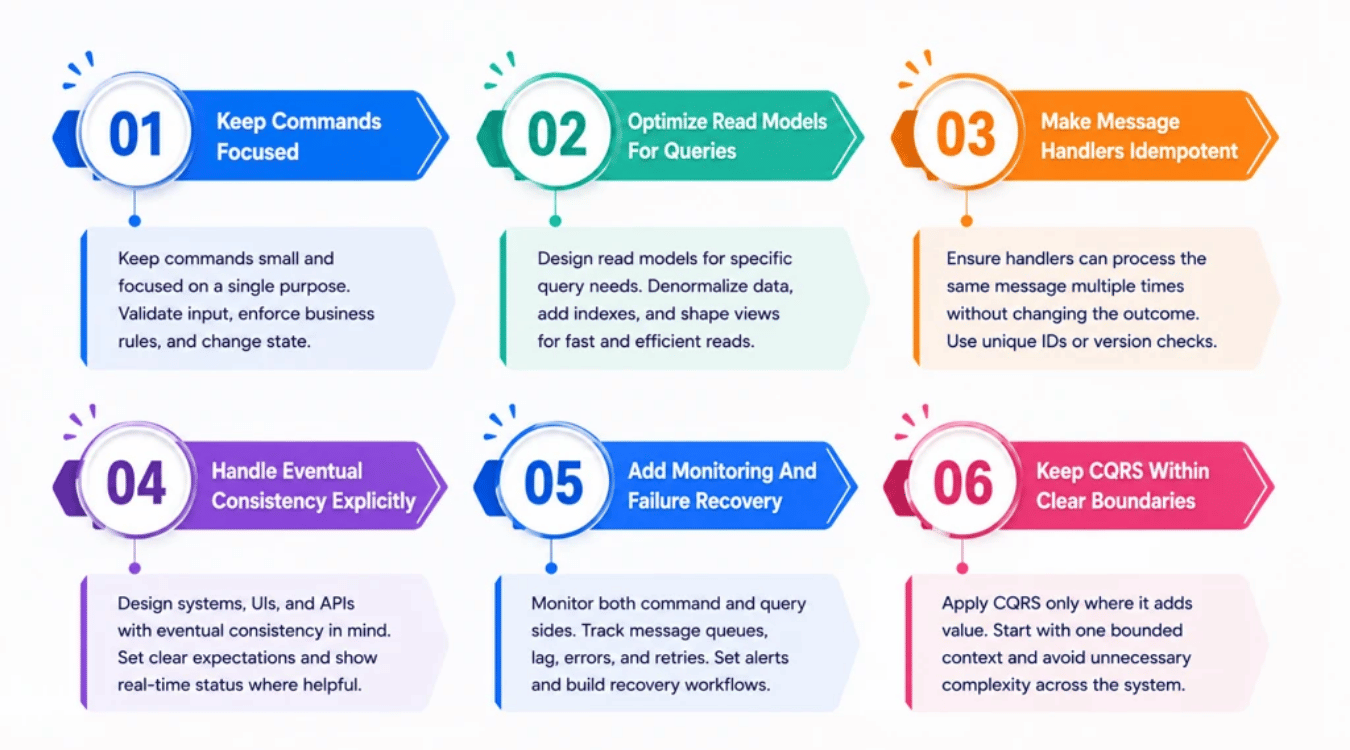
These practices pull together everything already covered, turning the concepts into a working checklist teams can actually apply during implementation.
Keep Commands Focused
Each command should represent one clear intent, not a bundle of unrelated changes bundled under one name. "Cancel Order" is a command. An "Update Order" handler that silently changes status, inventory, and billing all at once is really three separate concerns wearing a single name. Focused commands keep the write side's structure easier to reason about, test in isolation, and extend later without touching logic that has nothing to do with the change being made.
Optimize Read Models For Queries
Shape every read model around the exact query it needs to address, not around the write side's internal structure. A dashboard view, a search index, and a mobile list can all pull from separate projections built for their own access pattern, instead of forcing one generic model to serve every screen adequately. This is where CQRS implementation pays off directly, since each read model can evolve independently as new interfaces get added to the product.
Make Message Handlers Idempotent
Every handler should safely process the same message twice without triggering side effects. Checking a processed-event ID before acting on it again is a small addition to the code that prevents duplicate charges, duplicate emails, or corrupted projections down the line. Networks retry, brokers redeliver, and consumers crash mid-process, so idempotency isn't an edge case to plan for later. It's a baseline requirement for any handler running in production, regardless of the language or framework behind it.
Handle Eventual Consistency Explicitly
Don't let eventual consistency hide as an unstated assumption buried in the architecture. Surface it in the interface whenever a write might not reflect instantly, and document the expected delay clearly wherever the read and write side interact. Teams building in Java, .NET, or any other stack run into the same concerns here, since this isn't a language-specific problem. Addressing it upfront, rather than discovering it through a confused user report, saves real debugging time later.
Add Monitoring And Failure Recovery
Track projection lag, failed messages, and retry counts from day one, not after the first incident forces the question. A documented recovery process, replaying events to rebuild a broken read model, turns a production failure into a known procedure instead of a scramble through logs at 2 a.m. Good monitoring here doesn't just catch failures faster, it gives the team confidence to keep scaling the system without second-guessing every deploy.
Keep CQRS Within Clear Boundaries
Apply CQRS only where the system's bounded context actually justifies the added structure, not across the entire application by default. Letting scope creep past that boundary is how a targeted solution meant to address one real problem turns into unnecessary complexity everywhere else in the codebase. The strongest CQRS implementations stay disciplined about where the pattern applies, treating it as a tool for specific contexts rather than a default architecture for every part of the system.
Final Discussion
CQRS isn't a scaling silver bullet, and it was never meant to be. It's a targeted answer to one specific mismatch: read and write demands that have genuinely diverged enough to justify running two models instead of one.
Most systems never reach that point, and that's fine. CRUD remains the right call for a huge share of applications: simple, fast to build, and easy to reason about. CQRS earns its place only where complex business rules, uneven load, or independent scaling needs make the added structure worth the eventual consistency and operational overhead that comes with it.
Start small, apply it to one bounded context, measure whether it actually helped, then decide if it's worth expanding. That discipline matters more than the pattern itself.